
1982 Map of Royal Marines' Operations, Falklands War

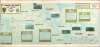

45 Commando Royal Marines East Falkland 12 May to 16 June 1982.
Recounting 'the Yomp'.
Recounting 'the Yomp'.
This is a c. 1982 map of East Falkland Island recounting the operations of the British 45 Commando Royal Marines unit during the Falklands War. The unit's difficult three-week overland march, known as the 'Yomp,' ending with the capture of two enemy high points in a nighttime attack, has attained legendary status in British military history.A Closer Look
The topographic map covers a large portion of East Falkland between Ajax Bay and the town of Stanley, the islands' capital. A bold black line traces the movements of 45 Commando between late May and mid-June, accompanied by explanatory text and photographs. These movements correspond to 'the Yomp,' a grueling overland march culminating in a literal uphill battle that has entered the annals of British military lore.Historical Context
45 Commando (pronounced as 'four-five commando') is a special battalion-sized unit within the Royal Marines, which has its origins in the 5th RM Battalion formed near the end of World War I and took on its current title in 1943, during World War II (1939 - 1945). The outfit participated in the D-Day landings and continued to fight until the end of the war. After the war, it was based between Hong Kong and Malta, seeing action in both the Mediterranean and the Far East. From 1960 to 1967, the unit was based in Aden and then returned to the U.K.During the 1982 Falklands War, 45 Commando, commanded by Lieutenant Colonel Andrew Whitehead, played a crucial role in the British campaign to retake the islands. Deploying as part of 3 Commando Brigade, the unit made an amphibious landing at San Carlos on Ajax Bay on May 21. Afterward, 45 Commando embarked on what became one of the most famous endurance marches in British military history, known as 'The Yomp.' Carrying full combat gear weighing up to 120 pounds per man through gale-force winds, freezing temperatures, and treacherous, boggy terrain that left their feet perpetually cold and wet, the unit traversed over 80 miles across East Falkland via Teal Inlet to reach the high ground commanding Port Stanley.
45 Commando's primary engagement came on the night of June 11-12, 1982, during the Battle of Two Sisters, a heavily fortified twin-peak mountain ridge defended by Argentina's 4th Infantry Regiment. Executing a night assault supported by naval bombardment from HMS Glamorgan and field artillery, the Marines fought up steep, boulder-strewn slopes through heavy machine-gun, mortar, and sniper fire. By daybreak on June 12, 45 Commando had successfully cleared and secured both peaks, with eight of its own dying in the process. Breaching this key outer ring of Port Stanley's defenses severely undermined Argentine positions, paving the way for the final Argentine surrender on June 14.
The Falklands War
The Falklands War (April 2, 1982 - June 14, 1982) was fought between the United Kingdom and Argentina after Argentina invaded the Falkland Islands and South Georgia. The Falkland Islands (commonly referred to as the Falklands) are an archipelago in the South Atlantic Ocean. First discovered by Europeans in the 17th century, the islands are believed to have been uninhabited before European arrival. Over the subsequent few hundred years, the archipelago changed hands between several European powers. In 1833, Britain secured its rule over the islands. However, Argentina still maintains that it has historic claims to the archipelago. This dispute came to a head in 1982 when Argentina invaded the Falklands and, in response, the United Kingdom sent a task force to reclaim them. After 74 days, the conflict ended in an Argentine surrender, and the islands were returned to British possession. The Falkland Islands held a sovereignty referendum in 2013, and the overwhelming majority of voters elected to remain a U.K. overseas territory.Publication History and Census
This map was originally prepared ('Scripsunt') in September 1982 by 45 Commando officers R. O. W. Passmore and K. J. Hammerton, employing several sheets of the Directorate of Overseas Surveys, and was printed by Burns and Harris in Dundee, Scotland. We have only been able to locate one example of the map in institutional collections, held by the Cleveland Public Library.Cartographers
The Directorate of Colonial Surveys (1946 - 2001), later named the Directorate of Overseas Surveys, was a government agency operating in Britain's colonies, former colonies, and in other countries in the mid-late 20th century. Originally established by the British Colonial Office in 1946 as the Directorate of Colonial Surveys (related to but distinct from the Directorate of Colonial Geological Surveys), the organization was renamed the Directorate of Overseas Surveys (DOS) in 1957 to reflect the rapid decolonization of British territories and its evolving role in international development assistance. Tasked with providing centralized geodetic, photogrammetric, and cartographic support, DOS dispatched field surveyors globally and leveraged aerial photography to map millions of square miles across Africa, the Caribbean, the Pacific, and eventually non-Commonwealth nations such as Ethiopia, Sudan, and Yemen. Throughout its tenure, the organization operated under various British foreign-aid bodies, including the Ministry of Overseas Development, to produce topographic maps and train local survey departments in developing nations. DOS was merged into the Ordnance Survey in 1984 to form the Overseas Surveys Directorate (OSD). Rebranded as Ordnance Survey International in 1991, the division shifted focus to international consultancy before disbanding in 2001, leaving behind a legacy archive of over 1.7 million aerial photographs and historic mapping records now preserved by institutions such as the National Collection of Aerial Photography and The National Archives. Further Details...
Burns and Harris, Ltd (1886 - 2012) was a British printer in Dundee, Scotland. The firm was founded in 1886 by stationer William Burns and William Harris, both employees of printer William Kidd, at 112 Nethergate in Dundee, operating as a stationer, printer, and bookseller. The company combined a retail shop with a printshop behind it, the latter including both letterpress and lithographic processes. By the end of the decade, the company was expanding and moved twice into larger premises in the early 1890s. They were particularly successful in printing colorful labels for distillers and confectioners. Despite their printshop burning down at one point in the early 20th century, the company continued to flourish and in 1927 bought the rights to print the Dundee Directory, which they printed until 1974 and for which they are best known. After the death of the company's founders, it continued to be managed by the descendants of William Burns. The printing business merged with George E. Findlay and Co., Ltd., in April 1995, after which the combined firm operated for several years before closing (one of its former printworks was rehabbed as an office and arts space). The stationary retail arm of Burns and Harris continued to thrive into the 21st century but eventually closed in 2012. An early and longtime employee of Burns and Harris, George Langlands Harley, eventually founded his own firm in 1904, also in Dundee, which later became Harley and Cox in partnership with William Cox and operated until Cox died in 1944. Further Details...
Condition
Very good. Very close margins. Light soiling.
References
OCLC 29579043.