
1882 Robida Pictorial Satirical Map of France

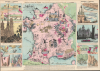
Nouvelle Carte de France, d'après les dernières découvertes des Savants et des Explorateurs.
Belle Epoque France satirized.
- Digital Map Information
- Suitable for large format printing
- Full resolution TIFF file
- ICC color profile embedded
- Delivered instantly via download link
Belle Epoque France satirized.
This is a lively 1882 pictorial satirical map of France drawn by Albert Robida and engraved by Yves and Barret for the publication La Caricature, which Robida edited. With a mix of celebration and ridicule, it presents cultural stereotypes and humorous observations of France's regional identities in the early Belle Époque.A Closer Look
The sheet includes multiple illustrations with a New Map of France at the center. This France includes the region of Alsace-Lorraine, depicted as covered in pipe smoke emanating from Germany, since the region had been under German rule since the Franco-Prussian War (1870-71), but was commonly included on French maps as a sign of nationalism and irredentism. Paris, naturally, occupies a large space towards top, being portrayed as a building filled with dancing, drinking, industry, intellectual activity, and an oven labeled 'A scorching political furnace for the whole of France,' an echo of the city's centrality and its frequent political upheavals, including the Paris Commune of 1871. Elsewhere, local habits, dress, and history are illustrated and parodied, with a strong emphasis on alcohol and allusions to war and political revolution. The famous winemaking regions of Champagne and Bourgogne are prominently displayed at right, the latter raising a flag of 'war on melancholy' and arraying wine bottles from its various subregions as cannons. Further south, in the Rhône Valley, a pair of figures prepares a cannon for a war against phylloxera. This root-eating aphid devastated European grapevines in the 19th century, with the Rhône Valley among the earliest victims. The historical unruliness and strong local identity of France's southern regions are referred to as the 'chaudiere Provencal' and 'chaudiere Gasconne.'Robida takes some liberties with geography, for instance, portraying Finistère in Brittany as an island separated from the French mainland. Corsica appears at bottom-left, the island itself resembling its most famous resident, Napoleon Bonaparte. Surrounding the map are additional illustrations of various French cities depicting them at an earlier point in their history, accompanied by lighthearted captions. At bottom is a more thorough discussion of Paris and France, including wonderful sentences such as: 'The French - despite our modesty, we are forced to admit it - possess every quality. We are all handsome, well-built, graceful, intelligent, and even witty.' Additional fun is poked at the French political system and regional stereotypes.
La Caricature
Founded in Paris in 1880 by Albert Robida and publisher Georges Decaux, La Caricature revived the title of Charles Philipon's 1830s satirical political journal while charting a distinctly fresh path. Unlike its fiercely revolutionary predecessor, the reborn La Caricature sidestepped heavy party politics to focus on social satire, theater, fashion, and the vibrant absurdities of modern Parisian life. Taking full advantage of recent printing technologies such as photogravure, the magazine featured striking, colorful visual spreads that satirized high-society gossip, rising feminist movements, and celebrities such as Sarah Bernhardt and Émile Zola. It also served as a launchpad for Robida's own imaginative science fiction, serializing farcical, yet surprisingly prescient visions of future technology, air transport, and mechanized warfare.During Robida's 12-year tenure as editor, La Caricature nurtured a generation of talented artists and defined the visual wit of the early Belle Époque. Following Robida's departure in 1892, the magazine took on new management. It shifted its editorial focus toward broader international geopolitics, famously lampooning foreign powers, including Queen Victoria and the British Empire. Though it gradually lost its artistic edge, abandoned full color, and eventually folded into a rival tabloid in 1904, La Caricature remains a high watermark of late 19th-century French print culture and satirical illustration.
Publication History and Census
This map was drawn by Albert Robida and engraved by Yves and Barret as a supplement to the December 23, 1882 issue of La Caricature. It is cataloged in the OCLC among the holdings of the Institut Cartogràfic i Geològic de Catalunya, the Bibliothèque nationale de France, and the PJ Mode Collection of Persuasive Cartography at Cornell University.Cartographers
Albert Robdia (May 14, 1848 - October 11, 1926) was a French novelist, journalist, and illustrator best known as the long-time editor of the satirical magazine La Caricature. Robida was born in Compiègne in the Oise département in northern France. As a youth, Robida had prepared to become a notary but found the work uninteresting and often doodled instead. In 1866, he began working at Journal amusant as an illustrator and in 1879 published his first science fiction (merveilleux scientifique) novel, Voyages très extraordinaires de Saturnin Farandoul, a parody of Jules Verne's Voyages extraordinaires in which a shipwrecked child is raised by monkeys before rejoining the human world. Filled with Robida's lively, colorful illustrations and published serially in installments, the book proved popular, especially in Italy, where it was later made into a 1913 silent film and a comic version starring Donald Duck. In 1880, Robida and Georges Decaux (1845 - 1914) founded La Caricature, which Robida edited for the next twelve years. The weekly illustrated satirical magazine gave an outlet for Robida and several other emerging illustrators of the day who would go on to have prominent careers as satirists, including Caran d'Ache, Ferdinand Bac, and Job (Jacques Marie Gaston Onfroy de Bréville). Between 1883 and 1890, Robida also published his richly-illustrated 'Vingtième Siècle' trilogy of science fiction novels, also similar to and influenced by Jules Verne, though more comical in tone and in some ways more accurate in predicting of future events, including flat-screen televisions, as well as imagining the effects of new technology on society. Aside from his most popular science fiction novels and his work with La Caricature, Robida illustrated dozens of tourist guides, historical works, novels by other writers, reissues of literary classics, and a series of sketches of historical sites in France titled La Vieille France. Robida and his wife Marguerite (née Noiret) had seven children. His son Camille (1880 - 1936) was injured and highly decorated in the Forst World War, and became a well-known architect and urban planner in Nantes. For his work, including designing the city's First World War memorial, he was made an officer of the Légion d'honneur. Another son, Henry, also trained as an architect but was killed in the opening months of war. Albert Robida was easily among the most recognizable and imitated illustrators in France at the turn of the 20th century. A staircase throughfare in the 19th arrondissement of Paris is named for him as the Villa Albert Robida. Further Details...
Yves et Barret (fl. c. 1870 - 1890) were French engravers active in the late 19th century. They engraved political cartoons and other images for French periodicals, including La Vie Parisienne. This partnership was known for creating works using gillotage, a now obsolete lithographic process wherein a drawing was made on or transferred to zinc and then dusted with resin, which adhered to the drawing. The resin then acted as an acid-resist when the entire plate was immersed in acid, creating a relief block that could then be inked and printed from. This printing technique was popular with newspapers, as it was completely compatible with blocks of type. Further Details...
Source
La Caricature, No. 156, December 23, 1882.
Condition
Good. Wear on original fold lines. Light foxing. A few minor archival verso reinforcements.
References
OCLC 494936308, 10220940565, 10355332427.