
1950 E.C.A. Pictorial Map of Paris and France, Marshall Plan, Cold War

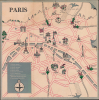
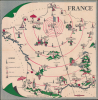
Paris / France / Destination France.
Tourism for Reconstruction druing the Cold War.
$300.00
Choose a Collection:
- Digital Map Information
- Suitable for large format printing
- Full resolution TIFF file
- ICC color profile embedded
- Delivered instantly via download link
This Item
Enquire
Tourism for Reconstruction druing the Cold War.
This is a c. 1950 English-language pictorial map of Paris and France, prepared by the advertising firm James Jones and Co. for the Economic Cooperation Administration. Though ostensibly a simple, whimsical map for tourists, it is more a propaganda product of the early Cold War (1947 - 1991), being the result of a coordinated effort to boost American tourism to France under the Marshall Plan.A Closer Look
This double-sided map presents a pictorial map of Paris on one side and a similar map of France as a whole on the other. The Paris side illustrates major tourist attractions such as Notre-Dame, the Arc de Triomphe, the Louvre, and Eiffel Tower, as well as the location of the American Embassy. Major train stations and the location of Paris' airports at the time, Orly and Le Bourget, are also indicated. A compass rose at bottom-left is closely reminiscent of the one appearing on the NATO flag, though this might be a coincidence (NATO was founded on April 4, 1949, but did not adopt the flag until 1953).The reverse side is a pictorial map of France, with concentric circles emanating from Paris. Major cities, tourist attractions, and mountains are illustrated, including the French Riviera, Mont St-Michel, and Lourdes. The marking of the locations of steel mills and power plants belies the Marshall Plan connection with the map.
The Economic Cooperation Administration (ECA) and Tourism to France
Established under the Economic Cooperation Act of 1948, the Economic Cooperation Administration (ECA) was a U.S. government agency charged with administering the historic Marshall Plan (officially the European Recovery Program). Operating alongside its European counterpart, the Organization for European Economic Cooperation (OEEC), the ECA oversaw the distribution of roughly $13.3 billion (some $150 billion in today's dollars) in aid to 16 war-torn European nations. The agency's primary mandate was to revitalize the continent's agricultural and industrial productivity, restore monetary stability, and foster economic integration. By rebuilding devastated infrastructure, modernizing factories, and stabilizing local currencies, the ECA aimed to stave off postwar economic collapse while building a resilient, democratic bulwark against the spread of Soviet communism.While the ECA is widely remembered for importing industrial machinery and food, it also championed postwar tourism as a vital tool to bridge Europe's crippling 'dollar gap,' the severe shortage of U.S. currency needed to purchase American goods. Tourism allowed European nations to earn dollars directly from American travelers without facing protective U.S. trade tariffs. This strategy was highly prominent in France, which served as the European headquarters for the ECA. Working closely with French planners, the ECA used 'counterpart funds' to finance over 85 percent of France's tourism development projects in 1950. These capital injections rehabilitated war-damaged hotels, upgraded regional airports, and launched aggressive marketing campaigns tailored to the rising American middle class. By transitioning France from an elite-only destination into a highly marketed consumer experience, the ECA successfully turned American tourism into a major economic engine, eventually accounting for up to a third of France's dollar receipts.
The Marshall Plan
The Marshall Plan, officially known as the European Recovery Program, was a landmark United States initiative enacted in 1948 that provided economic aid to revitalize Western Europe following the devastation of World War II. Spearheaded by Secretary of State George C. Marshall, the four-year program aimed to rebuild shattered infrastructure, modernize European industries, and remove trade barriers to foster regional economic integration. Beyond its humanitarian and economic objectives, the plan was a vital geopolitical strategy in the early Cold War; by restoring stability and laying the groundwork for later prosperity, the U.S. sought to halt the spread of Soviet Communism by eliminating the economic desperation that bred political extremism. Ultimately, the Marshall Plan was a resounding success, sparking an economic resurgence across the continent, strengthening democratic institutions, and laying the groundwork for the modern transatlantic alliance and European integration.Publication History and Census
This map was prepared by the advertising firm James Jones and Co., based in Paris, using maps by Parkinson (it is unclear which firm this refers to), and was 'presented by' the E.C.A. in cooperation with the Commissariat général au tourisme of the Ministère des Travaux publics. We have only identified one example of this map in institutional collections, held by the Library of Congress.Condition
Very good. Light wear along fold lines.
References
OCLC 5500683.