
1890 McLoughlin Brothers 'Game of Nations' Card Game

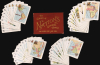
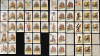
The Game of Nations or Quaker Whist.
Cartographic Card Game for Children.
- Digital Map Information
- Suitable for large format printing
- Full resolution TIFF file
- ICC color profile embedded
- Delivered instantly via download link
Cartographic Card Game for Children.
This is a c. 1890 McLoughlin Brothers geographical card game titled 'The Game of Nations or Quaker Whist,' in which chromolithographed continental maps replace aces and illustrated people replace the conventional court cards. Published in New York and accompanied by its red, gold-lettered box, the game brought geography to the family parlor through a familiar pastime. Its four continental suits associate places with distinctive inhabitants and dwellings, offering an illustrated geography lesson that also reveals the cultural stereotypes embedded in late 19th-century children's entertainment.A Closer Look
The 52-card design is divided into four suits representing America, Europe, Asia, and Africa. Each contains a map, a man, a woman, a child, and nine dwelling cards numbered 2 through 10. The map ranks highest (equivalent to an ace card), followed by the man (king), woman (queen), child (jack), and numbered cards. Small architectural emblems identify the suits on the figure cards, allowing players to recognize them without the usual hearts, diamonds, clubs, and spades. Each card measures 2.5 × 3.5 inches, and the box measures 5.5 × 4 inches. The geography is somewhat simplified, with many countries and colonies shaded but unlabeled. Africa is particularly indeterminate, as the continent was being divided up during the 'Scramble for Africa' and its territorial borders were in flux.The game's representation of the continents' inhabitants relies on common cultural stereotypes, with Europeans depicted as middle-class Victorians, China serving as a synecdoche for Asia, and Africans living in thatched huts. The Americas are notably represented by Native Americans (of North America and particularly the Great Plains), recently herded onto reservations at the time of publication, rather than Amerindians of Central or South America. Therefore, American residences are depicted as tipis, and the American child is snuggled into a papoose attached to a tree. This notable division of America and Europe was perhaps convenient to lend the game some variety, but also may reflect changing perceptions of Native Americans in the popular American imagination, shifting from a sense of indigenous people as threatening or obstructionist towards tropes of romanticization and guilt over the continent's 'lost innocence.'
Though playing cards could appear in a wide range of contexts in the time period, including saloons, this game was instead most likely intended for didactic purposes, especially given McLoughlin Brothers' other output, which was primarily educational in nature.
'Quaker Whist' Gameplay
While we have not found an example of the game 'quaker whist' outside of the context of this game, it presumably was a variation on the older game simply called whist. Whist is a classic trick-taking card game played by four players in two fixed partnerships sitting opposite one another, using a standard 52-card deck. All cards are dealt clockwise so each player receives thirteen, with the dealer's final card turned face-up to designate the trump suit for the round. The player to the dealer's left leads the first card, and all subsequent players must follow suit if they can; if void in that suit, a player may play a trump card or discard an off-suit card. Each trick is won by the highest trump played, or by the highest card of the suit led if no trumps are involved, with the winner leading to the next trick. Once all thirteen tricks are played, the partnership that captures more than six tricks (known as the 'book') scores one point for each additional trick won, with teams typically playing toward a target score of five or seven points.Chromolithography
Chromolithography is a color lithographic technique developed in the mid-19th century. The process used multiple lithographic stones, one for each color, to create a rich composite effect. Often, the process started with a black basecoat on which subsequent colors were layered. Some chromolithographs used 30 or more separate lithographic stones to achieve the desired effect. Chromolithograph color could also be effectively blended for even more dramatic effects. The process became extremely popular in the late 19th and early 20th centuries, when it emerged as the dominant method of color printing.Publication History
This game was produced by McLoughlin Brothers in New York around the year 1890, an estimate based on the printing process (chromolithography), the geography present (the Africa card appears to include the Congo Free State), and the appearance of a 'safety bicycle' on the European child card. The game had a substantial publishing history, from being listed in catalogs as early as 1874, to a later edition carrying a copyright date of 1898. The illustrations on the cards changed substantially over time across the various editions, but the lack of a date on most examples makes a census difficult to establish. The American Antiquarian Society holds two examples of 'Game of Nations' dated to c. 1876, while Yale University holds an example with this exact title (Game of Nations or Quaker Whist) dated to c. 1896.Cartographer
McLoughlin Brothers (1855 - 1920) was a New York-based publisher of children's books and games. They were early adopters of chromolithographic printing for children's books and the original artwork for their book is now a sought-after collector's item. They were bought by Milton Bradley and Company in 1920, but continued to publish under their own name for many years, even after Milton Bradley was purchased by Hasbro. Further Details...
Condition
Very good.
References
OCLC 1455573081, 1150966780, 1151002212. Association for Games and Puzzles International, Archives Game Catalog, G-23237. Association for Games and Puzzles International, Archives Game Catalog, G-34434, related 1898 illustrated-box issue. The Strong National Museum of Play, 107.2839, related packaging variant. American Antiquarian Society, McLoughlin Bros., Inc., Collection, 1858 - 1920, collection finding aid.