
1874 Unsen Ukiyo-e Triptych of a German Warship


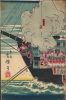
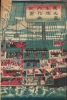
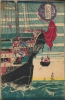
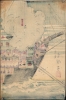
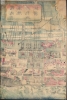
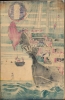
獨逸國軍艦内郭機械圖 / [Drawing of the Internal Workings of a German Navy Ship].
Passion for foreign technology.
- Digital Map Information
- Suitable for large format printing
- Full resolution TIFF file
- ICC color profile embedded
- Delivered instantly via download link
Passion for foreign technology.
A scarce c. 1874 ukiyo-e (more specifically, nishiki-e) triptych depicting lively scenes aboard a German naval ship, prepared by the artist Unsen. It is an example of Japan's flourishing interest in foreign technology and practices in the early Meiji period and specifically represents the special connection between the Prussian-led German Empire and the Empire of Japan.A Closer Look
A German naval ship is depicted at anchor, presumably off the coast of Yokohama, Japan's main port for trade and interaction with foreigners. Like many ships of the era, it employs a combination of steam power and sails. The deck is a bustle of activity with gunners, rigging monkeys, and other sailors engaged in various tasks, including firing a cannon on the left, likely to announce their arrival in port. (The rowboat being lowered at right also indicates close proximity to shore). The ship's interior is mostly presented in cross-section to display its rooms. The captain's (船將) and first mate's (副將) quarters are labeled at the right, the galley (屠肉) at the center towards the right, a room for training soldiers (練兵) at the left, and a variety of other rooms for guns, shells, horses, and other military equipment. Lower-ranking sailors (舩夫, 水夫, and 列兵) are seen conducting drills, resting, and horsing around.Two other foreign vessels can be seen in the background at right, again suggesting the location of Yokohama. The prominent stamp at the top right reads 'newly discovered' or 'new discovery' (新發明), appealing to the sensibility of the intended audience, educated (literate) and curious about the outside world. Considering all these factors, the work could arguably be classified as Yokohama-e (橫濱繪), a genre of ukiyo-e that depicted foreigners and foreign technology, culture, and influences in Yokohama, which was extremely popular at the time.
The German Connection
Japan underwent a dramatic transformation in the mid-to-late-19th century, beginning with the arrival of American 'black ships' in Tokyo Bay in 1853. First under the dying Tokugawa Shogunate, and much more intensely under the new Meiji government, foreign ideas and technologies were sought out and adapted to rapidly modernize Japan. Though Meiji reformers naturally looked to Britain, as it was the most powerful country at the time, they searched far and wide for inspiration and found it in the German Empire. The two countries shared an affinity as 'latecomers' to national unity and modernization. The Prussian system, with a powerful emperor at the core of a constitutional monarchy, appealed to the leaders of the Meiji Restoration, which was ostensibly undertaken to restore the emperor to political centrality. (Japan's 1889 Meiji Constitution closely modeled the Prussian one.) German universities, factories, and scientists were also among Europe's most active and advanced, providing a model for Japan. Finally, having defeated Austria and France in short order in the late 1860s and early 1870s, the Prussian military was seen as a premier and cutting-edge force, likely a factor in the production of this work.Nishiki-e (錦繪)
Nishiki-e (literally 'brocade picture,' also known as Edo-e 江戸繪 because it began in the Tokugawa capital of Edo) is a style of woodblock printing that developed in the 1760s and revolutionized the medium. Instead of producing a black-and-white print that was then hand-colored, or perhaps with one or two color blocks added, as had been done previously, nishiki-e prints allowed for the combination of many blocks, each adding one color to a complete image, which were fitted together perfectly. The result was that vibrantly colored prints could be produced in greater numbers in far less time, allowing for widespread distribution of woodblock prints, especially ukiyo-e.Nishiki-e remained the dominant mode of woodblock printing through the Meiji era and was critical to the distribution of prints depicting new technologies and ideas throughout Japan in the mid-to-late 19th century. But by the Taisho Era, lithographic machine printing had advanced to the point that woodblock prints could no longer compete, and the tradition continued as a niche art rather than as mass media.Publication History and Census
This triptych was prepared by the artist Unsen (雲僊) around the year 1874. It is a scarce work, with known examples held by the Metropolitan Museum of Art (two examples), the Harvard Art Museums, and the Otepia Kochi Library in Japan. (The Harvard Art Museums also hold a preparatory drawing by Unsen.) The other known examples all bear the mark of the printer Masadaya Heikichi (政田屋平吉), which is missing here, suggesting an alternate printing.Cartographer
Unsen (雲仙, written as 雲僊; fl. c. 1873 - 1875) was a Japanese woodblock print artist of the early Meiji period. An obscure and mysterious figure who was only briefly active, he may have been the same person as the painter Koyama Unsen (小山雲泉, 1855 - 1911). Only a few surviving works are attributed to him, but he appears to have been mentioned in a directory of artists whose work was presented at the 1893 World's Columbian Exposition, deepening the mystery around his identity and works. Further Details...
Condition
Very good. Light soiling. Minor restoration, upper right corner.
References
Metropolitan Museum of Art, Accession Number JP3421a–c and 2007.49.327. Harvard Art Museums 2007.214.123.2.1-3. Otepia Kochi Library Identification No. LA200706217.