
1949 John Sparks Infographic Chart or Histomap of Evolution

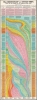
The Histomap of Evolution Earth, Life and Mankind for Ten Thousand Million Years.
10,000 Million Years: The History of Everything on One Sheet.
- Digital Map Information
- Suitable for large format printing
- Full resolution TIFF file
- ICC color profile embedded
- Delivered instantly via download link
10,000 Million Years: The History of Everything on One Sheet.
This is the 1949 edition of John B. Sparks's infographic triumph, Histomap of Evolution, an audacious attempt to compress Earth's, life's, and humanity's history into a single spectacular infographic. Beginning with the planet's formation billions of years ago, its great streams of color trace the emergence, diversification, and extinction of life through geological time before converging on human civilization and the geopolitical world of the mid-20th century. Part scientific diagram, part historical chronology, and part period worldview, the Histomap is an artifact of an era obsessed with organizing, visualizing, and understanding all of history at a glance.A Closer Look
The enormous central diagram is the chart's heart. A spectrum of color flows downward through geological time, branching and converging as Sparks visualizes the development of life from primitive organisms through plants, invertebrates, fishes, amphibians, reptiles, mammals, primates, and eventually humanity. The result resembles a vast river system or evolutionary tree turned on its side, transforming billions of years of natural history into a compelling visual narrative.Running alongside this evolutionary stream are parallel chronologies of geology, biology, and human history. The Paleozoic, Mesozoic, and Cenozoic Eras and their constituent periods - including the Triassic, Jurassic, and Cretaceous - are identified and accompanied by summaries of important geological and biological developments. Other columns trace changes in climate, landforms, plants, animals, and human civilization, allowing the reader to move horizontally across the chart and compare events occurring at roughly the same moment in Sparks's chronology.
As the diagram approaches modern humanity, however, biological evolution gives way to a distinctly early-20th-century conception of human populations. Sparks organizes humanity into racial, national, and ethnic categories, eventually identifying groups including Germans, French, British, Slavs, Russians, Americans, Chinese, and Japanese. The conflation of biological ancestry, race, ethnicity, and nationality reflects racial theories then circulating in popular and scientific literature but now recognized as scientifically unsound. This portion of the chart makes the Histomap particularly revealing as an artifact not simply of scientific knowledge, but of the assumptions and prejudices through which that knowledge was interpreted.
From the Origins of Earth to the Atomic Age
The scope is astonishing. Sparks begins billions of years before the appearance of humanity and eventually arrives at events within living memory of the chart's original audience. Successive editions were updated as history overtook the diagram: the present version extends through World War II (1939 - 1945), the founding of the United Nations in 1945, and the postwar spread of Communism.Sparks even carries his chronology beyond the present and into the future. The chart extends speculatively toward 1990, turning what begins as a retrospective history of life into a distinctly mid-century attempt to imagine where human development might lead next. Viewed today, this combination of deep time, contemporary geopolitics, and projected future makes the chart as much a document of how the 20th century imagined history as a diagram of evolution itself.
Fourteen Years in the Making
Sparks reportedly spent 14 years developing the Histomap of Evolution. A bacteriologist and chemical engineer, he conceived the chart as a way to present an almost incomprehensibly large body of information in a single coherent visual system. Shortly after its first publication, the Plainfield, New Jersey, Courier-News interviewed Sparks on October 13, 1932, noting that the chart had renewed public discussion of evolution only seven years after the celebrated Scopes Trial.Sparks apparently had mixed feelings about becoming involved in that controversy. His comments are particularly interesting because they reveal that he regarded evolution as extending beyond biology into intellectual and spiritual development. Rather than seeing evolutionary science as necessarily antagonistic to religion, he framed the more important contemporary struggle as one between spiritual and materialistic interpretations of human existence.
Sparks on Evolution
In the 1932 Courier-News interview, Sparks explained his position at length:I regret to hear that the Histomap has aroused the evolution controversy again, as the present conflict is not between science and fundamentalism, but between behaviorism and spirituality. Modern mystics and other spiritually minded men and women accept evolution but do not deny God or Christ, and these spiritual forces must combine against the growth of materialistic behaviorism as represented by Dr. John B. Watson and Charles Dorsey.
Fundamentalism, instead of being the bulwark of religion, is its most vulnerable spot. It is outmoded and inconsistent with modern thought, a very 'heel of Achilles' which we must dispose of before we can establish a firm front in this new conflict. Evolution applies to mental and spiritual growth as much as to the development of man as an organism.
Publication History and Census
Rand McNally published the Histomap of Evolution in successive editions beginning in 1932, with revised editions in 1942 and 1949. Although the present chart retains the original 1932 copyright date, its inclusion of events through the end of World War II and the establishment of the United Nations identifies it as the updated 1949 edition.Institutional examples are scarce. The 1942 edition appears to be the most frequently represented, although even that issue is held by only a small number of institutions. We have been unable to identify institutional examples of either the original 1932 issue or the present, substantially updated 1949 edition.
Cartographers
John B. Sparks (1886 - December 22, 1949) was a chemical engineer, bacteriologist, and historian. Born in England, at some point in his life Sparks immigrated to the United States. He developed a fascination with culture, history, and the philosophies of other civilizations from a young age, which led him to create a series of three 'histomaps' concerning history, evolution, and religion. At the time of his death, Sparks was a director of Nestle's Milk Products Inc. in New York City. He married Dorothy C. Sparks with whom he had three children, one son and two daughters. Further Details...
Rand, McNally and Co. (fl. 1856 - present) is an American publisher of maps, atlases and globes. The company was founded in 1856 when William H. Rand, a native of Quincy, Massachusetts, opened a print shop in Chicago. Rand hired the recent Irish immigrant Andrew McNally to assist in the shop giving him a wage of 9 USD per week. The duo landed several important contracts, including the Tribune's (later renamed the Chicago Tribune) printing operation. In 1872, Rand McNally produced its first map, a railroad guide, using a new cost effective printing technique known as wax process engraving. As Chicago developed as a railway hub, the Rand firm, now incorporated as Rand McNally, began producing a wide array of railroad maps and guides. Over time, the firm expanded into atlases, globes, educational material, and general literature. By embracing the wax engraving process, Rand McNally was able to dominate the map and atlas market, pushing more traditional American lithographic publishers like Colton, Johnson, and Mitchell out of business. Eventually Rand McNally opened an annex office in New York City headed by Caleb S. Hammond, whose name is today synonymous with maps and atlases, and who later started his own map company, C. S. Hammond & Co. Both firms remain in business. Further Details...
Condition
Very good. Light wear along original fold lines. Manuscript writing along right side.
References
Rumsey 9869.002. OCLC 864894669.