
1851 Banks Bird's-Eye View of London, Crystal Palace Exhibition

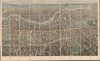
A Balloon View of London [As Seen from Hempstead].
Iconic View of Victorian London.
- Digital Map Information
- Suitable for large format printing
- File Size: 107.04 MB
- File Type: ZIP / TIFF
- ICC color profile embedded
- Delivered instantly via download link
Iconic View of Victorian London.
This is a spectacular example of John Henry Banks' iconic 1851 bird's-eye view of London, published by Effingham Wilson. The magnificent view illustrates countless individual buildings, a monumental accomplishment. It was produced in conjunction with the 1851 Crystal Palace Exhibition, considered the first world's fair.A Closer Look
The view looks south over London from Hampstead (as the subtitle indicates): Regent's Park dominates the foreground and the Thames, and today's South London in the distance at the top. Streets, lanes, and waterways are traced throughout. Hundreds of buildings are individually illustrated, from common residential structures to palaces, churches (including the distinctive dome of St. Paul's Cathedral), palaces, hospitals, and governmental buildings (including, most prominently, the Houses of Parliament at right). Large parks, including Regent's Park and Hyde Park, the site of the exposition and the remarkable Crystal Palace, are also depicted and labeled. The already considerable presence of railways and railway stations, especially evident along the edge of the city in South London, reflects the importance of this new technology to the city and its development in the early Victorian era. Other new technologies (such as the Imperial Gas Works in the foreground), factory smokestacks, the multitude of ships along the Thames, and the presence of busy docks south of the Thames at left all hint at London's industrialization and growing global commercial centrality.The 1851 Crystal Palace Exhibition, or Great Exhibition
The 1851 Crystal Palace Exhibition, officially titled the Great Exhibition of the Works of Industry of All Nations, was a landmark event held in London's Hyde Park. It was organized by Prince Albert (1819 - 1861) and Sir Henry Cole (1808 - 1882), who envisaged an international platform to showcase innovations, arts, and technological prowess. The venue, the Crystal Palace, was an architectural marvel in itself - an expansive iron and glass edifice designed by Sir Joseph Paxton (1803 - 1865) that was three times larger than St. Paul's Cathedral - symbolizing the union of art, design, and engineering. Exhibitors flocked to this event, displaying a diverse array of products, from machinery to exotic artifacts, revealing the vast scope of 19th-century human achievement. Drawing over 6,000,000 visitors, including dignitaries, intellectuals, and curious commoners, the exhibition was not merely a commercial or technological display, but a cultural spectacle that emphasized Britain's central role in the Industrial Revolution. Moreover, the legacy of the Great Exhibition extended beyond its temporal confines, influencing design principles, shaping international trade and diplomacy, and inspiring subsequent world's fairs and expositions.Publication History and Census
This view was engraved by John Henry Banks and published by Effingham Wilson in several printings and color schemes. The present example is unusual for its stunning, likely original, color and for being dissected and laid on linen, leaving it in very good condition, whereas most examples have heavy wear along the fold lines. This desirable view occasionally comes to the market and institutionally is noted among the holdings of the Wisconsin Historical Society, Duke University, and Yale University in the OCLC, while the London Museum and National Library of Scotland also hold examples.Cartographers
John Henry Banks (January 7, 1816 - 1879) was a British engraver active in London in the mid-19th century. Banks was born in the Marylebone district of London. He engraved extensively for the game and print publisher Edward Wallis. His best-known works are likely A Panoramic View of London (1845) and Balloon View of London (1851). Despite being a skilled engraver, his life was troubled by financial duress. He declared bankruptcy at least four times and was twice imprisoned for debt. He married Eliza Charlotte Jewell in 1837 and had six children. Banks died in Battersea, London, in 1879. Further Details...
Effingham Wilson (September 28, 1785 - June 9, 1868) was a British publisher and bookseller based in London. He was born in Yorkshire and raised in part by his uncle, Dr. Thomas Hutchinson, an antiquarian, man of letters, and friend of William and Dorothy Wordsworth. Wilson displayed an entrepreneurial spirit and understanding of popular demand from a young age, founding Railway Magazine, the first railway-themed journal, after being among the earliest rail passengers into London. Wilson published a wide range of works, including poetry, literature, politics, and religion. He was known for publishing works that others considered too politically dangerous, including religious and political dissenters. Wilson was well-connected with the literary and intellectual circles of early Victorian Britian, being close friends with Walter Bagehot and George Birkbeck, and corresponding with Charles Dickens and John Stuart Mill, among others. Further Details...
Condition
Very good. Old color. Some wear on old fold lines and edges. Dissected and mounted on linen. Original linen remains stable and strong.
References
OCLC 775694152. London Museum, A23791. National Library of Scotland, Shelfmark EME.s.115.