
1927 South Manchuria Railway Co. Bird's-Eye View of Manchuria

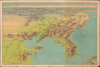
滿洲の鳥瞰 / [Bird's-Eye View of Manchuria].
Eyeing Manchuria from Japan.
- Digital Map Information
- Suitable for large format printing
- Full resolution TIFF file
- ICC color profile embedded
- Delivered instantly via download link
Eyeing Manchuria from Japan.
This is a c. 1927 bird's-eye view of Manchuria and environs prepared by the South Manchuria Railway Company (abbreviated as Mantetsu). At the time, Mantetsu was in control of a vast but informal colonial enterprise in Manchuria which anticipated Japan's full-scale invasion and occupation in 1931.A Closer Look
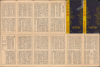
The view is oriented towards the northwest, looking over Korea, Manchuria, northern China, and beyond, as far as Karymskoe (カルイムスカヤ / Карымское) near Chita, from the perspective of southern Japan. (Shimonoseki and Fukuoka sit in the foreground at the bottom-right.) Unsurprisingly, the view highlights railway lines, with the South Manchuria Railway traced in red and other lines in black, and routes under construction, such as that between Jilin (吉林) and Laotouergou (老頭兒溝), dashed. Shipping routes are also marked. Some cities not connected by rail as well as major rivers and mountains are labeled, and the Great Wall of China is illustrated. The verso contains multiple panels of information on the geography, natural resources, economy, peoples, and transportation of Manchuria. There is a rather long and interesting section (開拓景の聚落) on settlement in the region by Han Chinese, Japanese, and others, as well as the difficulties and wanderings of the Manchu people after the fall of the Qing Dynasty in 1912. With the benefit of hindsight, we can see glimpses of the massive push for Japanese settlement coupled with the nominal championing of Manchu identity that would come in the following years.Mantetsu, the Kwantung Army, and Manchuria
The Treaty of Portsmouth that ended the Russo-Japanese War (1904 - 1905) granted to Japan, among other rights, the Kwantung Leased Territory and the southern section of the China Eastern Railway, from Changchun (長春) to Port Arthur (旅順 Lüshun), which became known as the South Manchuria Railway. The northern section between Harbin (哈爾濱) and Changchun was jointly managed by Russia and China and, along with the rump China Eastern Railway between Manzhouli (滿洲里) and Harbin, came to be known as the North Manchuria Railway or Trans-Manchurian Railway; for years, Changchun served as a 'break of gauge' point between the standard gauge used to the south and the wider Russian gauge used northwards (allowing for seamless integration with the Russian rail network, namely the Trans-Siberian Railway). The company created to manage the southern section of the China Eastern Railway, the South Manchuria Railway Company (Mantetsu), soon developed into a mega-conglomerate that oversaw hotels, mines, mills, power plants, publishing, and much more, expanding Japanese influence in Manchuria to the point that it became a virtual colony. By the early 1930s, Mantetsu was the largest company in Japan and by itself formed a significant portion of the Japanese economy.Although Japan already exercised an informal empire in much of Manchuria, the territory was still under the control of the Fengtian Clique of warlords led by Zhang Zuolin. Meanwhile, a sizable Japanese garrison occupied the Kwantung Leased Territory, known as the Kwantung Army (or Kantō-gun in Japanese). The Kwantung Army was a hotbed of ultranationalism, militarism, and anti-democratic secret societies, and produced several of Japan's future wartime leaders, including Tōjō Hideki. Although the Kwantung Army had initially supported Zhang Zuolin as a bulwark against Chiang Kai-Shek, who was seen as pro-Communist, he was assassinated soon after Chiang nominally reunified the country in 1928 when a bomb exploded under his private train traveling on the South Manchuria Railway. The plot had been hatched by junior officers in the Kwantung Army. This event set the stage for the Kwantung Army's full-scale invasion of Manchuria three years later, beginning on September 18, 1931. After staging a false flag incident (another bombing along the South Manchuria Railway) to provide a pretext for invasion, the Kwantung Army rapidly occupied Manchuria. Although Japan's political leaders and likely even the top military leadership were unaware of the invasion plot, they did not force the Kwantung Army to retreat despite international condemnation because the invasion was extremely popular domestically and was a convenient solution to Japan's long-term problems with resource constraints and overpopulation. Rather than make Manchuria a formal colony, as with Taiwan, or annex it outright, as with Korea, a puppet regime was established, led by the last emperor of the Qing Dynasty, Aisin Gioro Puyi, who had been living in the Japanese Concession in Tianjin. But real power rested with the Japanese military and Mantetsu, whose operations expanded even further, including overseeing all railways in Manchukuo (the name given to the new puppet state), including the rump China Eastern Railway, which was sold by the Soviets to Mantetsu.
Publication History and Census
This view was prepared by Mantetsu and printed by the Toppan Printing Company c. 1927 (Showa 2) or 1928 (Showa 3), based on the dated statistics provided on the verso. It is similar to the bird's-eye views of Yoshida Hatsusaburō (吉田初三郎) that were popular in Japan at the time, but no artist is named here and there is no sign of Yoshida's direct involvement. The view is noted among the institutional collections of Harvard University, the University of Hawaii at Manoa, the National Diet Library, and the Edo-Tokyo Museum.Cartographers
South Manchuria Railway Co. (南満州鉄道株式会社; 1906 - 1945) was a conglomerate initially formed to manage the southern section of the China Eastern Railway, won from Russia in the Treaty of Portsmouth after the Russo-Japanese War. In time, Mantetsu would move into a wide range of industries including shipping, hotels, mining, and publishing, and become the largest company by value in Japan, constituting a significant portion of the Japanese economy in itself. Mantetsu was the primary means by which Japan colonized Manchuria, a process well-underway before the establishment of Manchukuo in 1932. Its publications, often in conjunction with Mantetsu's various 'investigation' bureaus, generally dealt with the economy, infrastructure, and society of Manchuria and northern China but later expanded to cover all of China and beyond, in effect serving as an intelligence wing of the Japanese government and military. Further Details...
Toppan Printing Company (凸版印刷株式會社, 1900 - present) was a printer and lithographic press founded in Meiji Japan in 1900 as Toppan Printing Limited Partnership. The founding of Toppen closely correlates to Meiji efforts to modernize Japan in the late 19th and early 20th centuries. The firm was formally reorganized with an influx of new investment in 1908, taking the name Toppan Printing Co., LTD (凸版印刷株式會社), which literally translates as 'Letterpress Printing Company,' reflecting the company's embrace of the then cutting edge Erhört letterpress method. By 1910, Japan had modernized to such an extent there was a growing need for brightly colored advertising, propaganda, touristic, and commercial printing. Toppen employee Gennojo Inoue split off from the firm to import color offset printing technologies from the United States and Europe, founding the Offset Printing Company in 1913. After four years of successful operation and growing market share, Toppen acquired the technologically superior company and reabsorbed Gennojo Inoue as an executive. Despite the Great Kanto Earthquake of 1923, Japanese efforts at modernization advanced rapidly. Between 1920 and 1929 the company's production and revenue grew dramatically. In 1920 or 1920 photomechanical printing was introduced to Japan, again by the efforts of visionary company president Gennojo Inoue. From the 1930s on, Toppen under Gennojo Inoue's guidance continued to grow, becoming one of the largest printing concerns in Japan. They established offices in other cities, including Osaka. In 1938, they built a large press factory, the Itabashi Plant, in Tokyo. During World War II the Toppen firm was utilized for the war effort, producing new currencies, bonds, government securities, and propaganda material. Following the war, Toppan was reorganized and continued to grow. It is today a major Japanese firm, diversified in multiple industries and traded on the Tokyo Stock Exchange. Further Details...
Condition
Good. Wear along original fold lines. Verso repairs to fold separations. Slight loss at a few fold intersections. Closed tear extending 1.5 inches within printed area in upper left corner professionally repaired on verso. Text on verso.
References
OCLC 1492215680, 938960046. Edo-Tokyo Museum Reference No. 99870745.