
1972 NASA Shaded Relief Map of Mars - Mariner 9 Mission


This item has been sold.
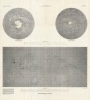
Shaded Relief Map of Mars.
Polar ice on Mars.
Polar ice on Mars.
This is a striking 1972 terrestrial relief map of Mars issued from photogeological data collected by the Mariner 9 Mission. The map is a groundbreaking achievement of planetary mapping, completed through a collaborative effort from the Jet Propulsion Laboratory, the California Institute of Technology, and NASA.A Closer Look
The map is divided into three sections. At top are northern and southern polar projections, illustrating the Red Planet's famous icecaps as of October 12, 1972 (North) and February 28, 1972 (South). Below is a Mercator Projection focused on the equator extending to 65° North and South, thus overlapping somewhat with the polar projections above. As stated on the map,This preliminary map was made from Mariner 9 television image data. The positions of topographic features were taken from a series of uncontrolled photo mosaics prepared by the U.S. Geological Survey from unrectified Mariner 9 pictures. The pictures in the mosaics were positioned primarily for consistency with spacecraft tracking data with some adjustment to minimize the mismatch between pictures. Positional inaccuracies as large as 60 km exist throughout the map. The map portrays topography only and no albedo variations except for delineations of the polar caps.
Mariner 9
Mariner 9 was a groundbreaking NASA mission, launched on May 30, 1971, that became the first spacecraft to orbit another planet when it successfully entered orbit around Mars on November 14, 1971. Its mission was to map the Martian surface, study its atmosphere, and provide detailed imagery of the planet's features. Mariner 9 exceeded expectations by sending back over 7,300 images, revealing a planet with vast canyons, ancient riverbeds, and massive volcanoes. It also documented a global dust storm, offering unprecedented insights into Martian weather patterns. Mariner 9's success paved the way for future Mars exploration, significantly advancing our understanding of the Red Planet.Publication History and Census
This map was published by a collaboration of governmental and private organizations, including NASA, the U.S. Geological Survey, the Jet Propulsion Laboratory, and the California Institute of Technology. The topographic data was interpreted by P. M. Bridges and Jay L. Inge. Well represented in institutional collections.Cartographer
The United States Geological Survey (March 3, 1879 - present), commonly abbreviated USGS, is an American federal scientific bureau and civilian mapping agency within the Department of the Interior, established in Washington, D.C., and subsequently headquartered in Reston, Virginia. Congress created the Survey to classify public lands and investigate the geological structure, mineral resources, and products of the national domain, replacing separate western investigations with a permanent scientific organization. Its first director, Clarence King (1842 - 1901), organized geological investigations and recruited experienced scientists and topographers from earlier federal surveys. Under his successor, John Wesley Powell (1834 - 1902), director from 1881 to 1894, topographic mapping expanded from support for individual geological investigations into a nationwide undertaking. Congressional authorization in 1882 to continue preparation of a geological map of the United States extended the Survey's work into the eastern states, while systematic topographic mapping received authorization in 1884. Henry Gannett (1846 - 1914), the Survey's chief geographer, helped establish enduring methods and standards for this work. Its topographic quadrangles represented terrain through contour lines alongside drainage, settlements, roads, and other features, furnishing a common geographic foundation for scientific investigation and practical land use. During the 20th century, the Survey's mapping evolved from field surveying and compilation toward aerial photography, photogrammetry, and digital geographic information systems. A formal program begun in 1947 to map the conterminous United States at 1:24,000 scale culminated in nationwide coverage in 1992, comprising more than 55,000 maps. The Survey also produced geological and thematic maps and assembled national geographic information. In 2009 it introduced US Topo, a digitally generated successor to its traditional topographic quadrangles. Its continuing cartographic work includes The National Map, digital topographic products, and public access to historical quadrangles, alongside broader investigations of water, ecosystems, mineral and energy resources, and natural hazards. Further Details...
Condition
Very good. Slight wear on original fold lines. Accompanies original slipcase.
References
OCLC 9821240.