
1960 Manuscript 'Fan Art' Wall Map of Tolkien's Middle Earth in Elvish Tengwar

This item has been sold.
[Endor / Middle-Earth].
Greatest map of Middle Earth.
Choose a Collection:
This Item
Enquire
Greatest map of Middle Earth.
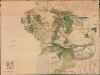
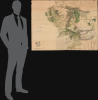
This is an extraordinary c. 1960 manuscript wall map of J.R.R. Tolkien's Middle-earth (Endor), composed entirely in Sindarin Elvish Tengwar. The map is a prodigious feat of scholarship that digs deeply into Tolkien's novels, both the Hobbit and the Lord of the Rings, and the supplementary Legendarium. The unknown author is not merely copying known works, but was actively interpreting the literature, often reading between the lines, adding accurate content, much of which was later confirmed. It is, moreover, an aesthetic masterwork, being perhaps the finest modern manuscript map of any kind we have encountered.A Closer Look
Coverage embraces the scope of Middle-earth addressed in the Lord of the Rings, extending slightly further to both the north and south than the iconic Fellowship of the Rings map drawn by Christopher Tolkien, thus encompassing much of the Bay of Forochel and Arctic ice fields in the extreme north and the broken land of Far Harad in the south. The cartography is consistent with the Third Age of Middle-earth, during which the events of both the Hobbit and the Lord of the Rings take place. The unknown author meticulously maps topography, forest and swamp lands, river systems, and road networks.This last includes multiple elements that appear on none of Tolkien's own maps, but which can be presumed to exist, for example, the north-south route through Mirkwood. This road connects the Elf King Thranduil's Woodland Realm (Eryn Lasgalen / Felegoth) with Southern Mirkwood and possibly even Dol Guldur (Amon Lanc), which, though at the time of the novels was a fortress of the Dark Lord Sauron (The Necromancer), in the Second Age served as the Sindarin Elven capital. This road might also be presumed to exist by evidence from the novels, such as the fact that Sauron's forces operating out of Dul Guldur were traveling north through Mirkwood to besiege Thranduil's realm.
The map is composed entirely in Tengwar, a phonetic writing system devised by Toikien for his Elvish languages, particularly Quenya and Sindarin. We must credit the Finnish scholar Thorsten Renk for assistance in understanding and interpreting the mapmaker's Elvish - much of what is below is understood only with his gracious assistance. However, as Gandolf notes in the Fellowship, it can be adapted to nearly any language, including the Black Speech of Morder, Westron, Dwarvish, or, for that matter, English. Tengwar is both versatile and highly sophisticated, with a complex diacritical system. Although fans have long eagerly embraced Tengwar, only Tolkien was its master. Thus, while it is very easy to transcribe nearly anything into Tengwar, it is difficult to reverse-construct words and placenames written in Tengwar into Latin script, as there is little or no standardization, canonization, or even a Tengwar placenames glossary. In this case, the author again was not merely transcribing, but interpreting.
In the case of this map, we can identify and infer many of the placenames, but a meticulous study of the thousands of locations here named would be a daunting task. For example, the first two characters of the title, in the lower left, are the Tengwar for the Sindarin name for Middle-earth, 'Ennor'. Most of the other placenames are also Sindarin. The second line of the title reads 'í dùnadorath' or 'all the noble lands of the West', the third, in brackets, is the Quenya for Middle-earth, 'Endóre'.
Remarkably, the artist is not just transcribing the place names hefound in the books and on Tolkien's maps, he is, in many cases, using his own translations. For instance, he denotes the ocean as 'anaear' ('great sea' with an intensifying prefix 'an-' -(curious, because we have Tolkien's _belegaer_ 'great sea' for that purpose) and below 'etaear' ('outer sea').
Despite the mapmaker's erudite efforts to translate the text into Elvish, some errors that modern scholars of Tolkien's languages can point out. For example, he does not seem to understand that a diphthong like 'ae'isn't written as 'a e' in Tengwar. This suggests that the mapmaker had little or no direct contact with Tolkien, who would have pointed this out.
The mysterious author's sources remain a mystery. Certainly, the author references the large Middle-earth included in the first edition of Fellowship of the Rings, as well as the detailed maps that appeared in The Hobbit and the subsequent books of LOTR. We note other content that is accurate but cannot be directly attributed to any of Tolkien's published maps - for example, the broken lands and hills southeast of Morder. These actually appear on Tolkien's own manuscript map, but do not appear on any published map. We believe that the bulk of the content and placenames are derived from a meticulous study of Tolkien's works and writings.
Publication History and Census
This is a unique manuscript work by an unknown author. The date of production is unknown, but based on the paper and its content, it was sometime in the 1960s. We are aware of nothing comparable that has ever come to market.Condition
Excellent.