
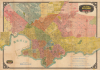
1939 Bemporat City Plan or Map of Montevideo, Uruguay


This item has been sold.
Plano Bemporat de Montevideo.
Striking city map of Montevideo, Uruguay.
- Digital Map Information
- Suitable for large format printing
- Full resolution TIFF file
- ICC color profile embedded
- Delivered instantly via download link
Striking city map of Montevideo, Uruguay.
This is a c. 1939 large-format folding city plan or map of Montevideo, Uruguay, produced by Oficina Cartográfica Bemporat. It captures the city at a time when the politics and economy of the country were in flux, but Montevideo itself was a growing, cosmopolitan, charming, and thriving metropolis.A Closer Look
As noted at bottom-right, the map is color-shaded to correspond to judicial districts, likely the result of administrative reorganization following Uruguay's 1934 Constitution. Streets and avenues are labeled throughout, along with hospitals, schools, cemeteries, parks, port facilities, and beaches. The Fortaleza General Artigas, the Frigorifico Uruguayo, Escuela de Aviacion Militar, and the Arsenal de Marina are also labeled. Rather than a typical alphanumeric grid surrounding the map, a novel overlay segments it into numbered blocks for use with an index that appeared in a binder originally accompanying the map.Historical Context
At this time, Montevideo was a thriving city of around 600,000 and the capital of the most prosperous country in South America. The city boasted a large economy and a rich cultural and intellectual scene. However, as the country was heavily reliant on foreign trade, it was badly impacted by the Great Depression and the resulting protectionism. Under the leadership (or dictatorship) of President Gabriel Terra (de facto ruler 1931 - 1938), Uruguay underwent a raft of reforms in education, labor laws, and social security as Terra attempted to address growing discontent. Although largely traditionalist and conservative, Terra's eclectic ideology also championed women's suffrage, equality of the sexes, the right to strike, and the decriminalization of homosexuality. Terra left office in 1938 amid declining health but was succeeded by Alfredo Baldomir, also a member of the Colorado Party, who continued the administration's corporatist policies. Despite the economic challenges of the time, Montevideo was known for its beautiful Art Deco and Beaux Arts architecture, and, as mentioned at bottom-right here, was expanding rapidly, adding new streets at an impressive rate.Publication History and Census
This map was created and published by the Oficina Cartográfica Bemporat. It is undated, but from context likely dates to the mid-late 1930s. The map was printed in several editions (some dated) between roughly 1934 and 1944, and, as the text at bottom-right indicates, was based on Bemporat's earlier maps of Montevideo dating back to 1924. Conveniently having an office in Montevideo itself, Bemporat was able to regularly update his maps 'con su trabajo personal.' The present edition can be distinguished by the code below the maker's logo at bottom-left ('U.T.E. 2-6453'). The map in any edition is only noted among the holdings of five institutions in the OCLC, and the present edition is only held by Brigham Young University.Cartographer
Aquiles Bemporat (1869 - September 22, 1957) was an Argentine-Italian cartographer and map publisher based in Buenos Aires. He was born in Trieste, Italy and emigrated to Buenos Aires sometime in the late 1870-80s, when he was a child. His firm, Oficina Cartográfica Bemporat, was founded around 1910 and remained active until at least 1960. Bemporat himself is elusive, despite a significant publication corpus. His map c. 1915 map of Buenos Aires won a gold medal at the 1915 San Francisco Exposition Universal. A 1949 CIA analysis of his work suggested that most of the map compilation was done in house by Bemporat himself, then over 70, and printed locally by network of small independent printers. The CIA report ultimately dismissed his maps as 'insufficiently accurate for intelligence use.' Nonetheless, Bemporat's work was highly decorative and enjoyed a strong local and international following, particularly in Latin America and Europe. He was widely admired for his longevity and continued to publish until his death at age 88. Further Details...
Condition
Very good. A few minor verso repairs and fill at a couple of fold intersections. Even toning.
References
OCLC 367461200.