
1985 Cober / Postermotions Promotional Pictorial View of New York City

Great Restaurants of New York.
Scarce, Unusual Promotional View of New York City.
Scarce, Unusual Promotional View of New York City.
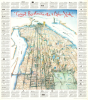
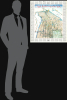
This is a scarce 1985 pictorial promotional view of Manhattan, New York City, drawn by Alan E. Cober for Postermotions. It highlights New York City's fine dining scene at a time when the city was struggling with peak levels of crime, drugs, and homelessness.A Closer Look
The view adopts an unusual perspective, a high-oblique view looking at the city from high above the Upper East Side. This has the effect of making parts of the Upper East Side and Midtown larger, and deprioritizing areas further downtown (such as the Lower East Side and the Meatpacking District), which were known for bohemianism and crime rather than haute cuisine. Central Park appears at bottom-right and the Queensboro Bridge at bottom-left, while the Empire State Building, Chrysler Building, World Trade Center, Brooklyn Bridge, Statue of Liberty, and other landmarks are easily distinguishable in the distance.Around the border of the view are 82 restaurants that are marked with numbers on the view. the vast majority are located near 59th St. and on the eastern side of Midtown. Most are French, Italian, and classic American food, reflecting the preferences of the time, but they contain a smattering of Chinese, Japanese, Indian, Korean, and Middle Eastern restaurants. Some were quite distinctive due to their location, such as 'Windows on the World' high up in the World Trade Center. A small handful of these restaurants still exist, such as the Ambassador Grill near the United Nations, Hatsuhana in the heart of Midtown, and the legendary Tavern on the Green in Central Park. Several others had survived into the present decade but were done in by COVID-19.
This view was produced at a period when fine dining was thriving in the United States, fueled by tax cuts and economic growth, but the common perception was that New York City was far less appetizing. Nonetheless, by the mid-1980s, the city had improved substantially from its near bankruptcy and population losses of the 1970s, and at this point had not yet endured the worst of the crack cocaine epidemic and racial tensions that would define the late 1980s. Mayor Ed Koch, easily one of the most colorful politicians of the era, cruised to reelection in 1981 and 1985 on these successes, but the troubles of his third term (including corruption scandals involving his associates) caused him to lose the 1989 Democratic primary to eventual winner David Dinkins. Koch's defenders (himself more so than anyone else) would take credit for laying the groundwork for the city's stunning 'revival' in the 1990s and early 2000s.
Publication History and Census
This view was drawn by artist Alan E. Cober and printed by Flower City Printing of Rochester, New York, for Postermotions, 'a division of Great Earth Trading and Company, Inc.' A second edition was issued in 1988, sponsored by the credit card company Visa. In either edition, the view is scarce in institutional collections and on the market; it is only held by the University of Wisconsin-Milwaukee, the University of South Carolina, and the Library of Congress.Cartographer
Alan Edwin Cober (May 18, 1935 - January 17, 1998) was an accomplished American illustrator whose work frequently appeared in major newspapers and magazines, as well as 25 books. Cober was born and raised in the Bronx, in New York City. His father was a criminal defense lawyer while his mother was the president of an organization working with intellectual disabled children; the young Cober gained an appreciation for social inequalities and the disadvantaged through his parents' work that would later become a prominent theme in his illustrations. He attended the Barnard School for Boys and then the University of Vermont but later completed his degree at the School of Visual Arts in New York City. Cober was drafted into the U.S. Army in 1958 and spent most of his Army years in the graphics department at the Special Warfare School in Fort Bragg, North Carolina. After leaving the Army, Cober became a freelance illustrator and developed a gritty, idiosyncratic style and a willingness to deviate from established conventions. But the quality of his work was such that art directors at various publications published his works nonetheless. Cober's illustrations appeared in nearly all the major periodicals of the era, from Sports Illustrated, Seventeen, and Esquire to Newsweek, The New York Times, and Time. He additionally was commissioned for works by the National Park Service and major corporations like IBM, CBS, and Exxon. Cober considered himself a visual journalist rather than an illustrator and indeed he was often given journalistic assignments such as Jimmy Carter's 1980 presidential campaign and space shuttle liftoffs at Cape Canaveral. But Cober never lost his fascination with the unfortunate and downtrodden, for instance publishing a collection of drawings from nursing homes, prisons, and mental institutions titled The Forgotten Society in 1975. In addition to illustrations, Cober worked in several other media, including painting and ceramics, and taught at various points at the State University of New York at Buffalo, the University of Georgia, and the Ringling School of Art and Design in Sarasota, Florida. Further Details...
Condition
Excellent.
References
OCLC 20352853 (two editions cataloged together).