
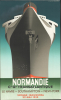
1939 / 1979 Cassandre Promotional Poster for the S.S. Normandie


This item has been sold.
Normandie Cie. Gle. Transatlantique French Line.
Height of Art Deco Martime Elegance.
- Digital Map Information
- Suitable for large format printing
- File Size: 52.37 MB
- File Type: ZIP / TIFF
- ICC color profile embedded
- Delivered instantly via download link
Height of Art Deco Martime Elegance.
This is a striking example of the 1979 restrike of Cassandre's iconic 1935 poster for the SS Normandie, the fastest and largest Transatlantic passenger ship of its time. The poster celebrates the ship's inaugural voyage, which smashed the previous record for a Tranastlantic crossing by a passenger steamer, achieving the feat in just over four days.A Closer Look
This iconic poster was the best-known work of Cassandre, depicting the Normandie traveling straight on towards the viewer. This dramatic perspective allowed Cassandre to emphasize the streamlined design of the ship, one of several features that allowed it to achieve remarkable speed and stability despite its tremendous size. A group of seagulls flies in front of the ship at left, a clever device used to indicate its massive proportions.The SS Normandie
The SS Normandie was one of the great ships of its day and remains the most powerful steam turbo-electric-propelled passenger ship ever built. Surpassing all previous ocean liners in speed and size, and at least matching any predecessor in terms of luxury, it could carry more than 800 passengers and make the trip across the Atlantic Ocean in just over four days. Built for the Compagnie Générale Transatlantique, it was, along with the RMS Queen Mary, the pinnacle of oceangoing passenger ships before the airplane overtook ships as the preferred means of Transatlantic transportation in the Postwar period. The Normandie was distinguished by its elegant Art Deco interiors and its sheer size, requiring new piers to be built to accommodate it.The ship's maiden voyage advertised here was a media sensation. The Normandie set out on May 29, 1935, from Le Havre with an air of unprecedented grandeur and a manifest including celebrities, diplomats, and industry titans. The primary goal of the inaugural crossing was to capture the prestigious Blue Riband, the accolade awarded to the fastest passenger liner crossing the Atlantic. On June 3, 1935, the Normandie triumphantly arrived at Ambrose Light in New York, shattering the previous record and solidifying her status as the fastest and most technologically advanced vessel of her era.
The ship's end was less glamorous, however. During World War II (1939 - 1945), the Normandie was seized by the U.S. while in New York (France being under German occupation) and converted into a troop ship. Unfortunately, the ship caught fire while docked at Pier 88 on the Hudson River and partially sank, sitting half-submerged until the end of the war. After the war, the ship was salvaged but was too costly to fully restore, resulting in its being scrapped in 1946.
Chromolithography
Chromolithography, sometimes called oleography, is a color lithographic technique developed in the mid-19th century. The process involved using multiple lithographic stones, one for each color, to yield a rich composite effect. Oftentimes, the process would start with a black basecoat upon which subsequent colors were layered. Some chromolithographs used 30 or more separate lithographic stones to achieve the desired product. Chromolithograph color could also be effectively blended for even more dramatic results. The process became extremely popular in the late 19th and early 20th centuries when it emerged as the dominant method of color printing. The vivid color chromolithography produced made it exceptionally effective for advertising and propaganda imagery.Publication History and Census
This poster was originally designed by the artist Cassandre in 1935 and printed by his firm Alliance Graphique, becoming his best-known work. There are several variations of the poster, with different text at bottom (see, for comparison, the example digitized by the Museum of Modern Art). The present example is a 1979 restrike from the original plates, issued in a limited run by Studio Editions and printed by Imprimerie Bedos in Paris (this information being absent here due to the trimmed margin). Inconsistency in cataloging and dating makes an institutional census difficult to conduct. In terms of market presence, original prints from 1935 are quite rare, while examples of this 1979 restrike are increasingly scarce and valuable.Cartographer
Cassandre (January 24, 1901 - June 17, 1968), also known as A. M. Cassandre, was the pen name of Adolphe Jean-Marie Mouron, a renowned French commercial artist and designer of the mid-20th century. He is best known for his stunning posters designed for railways and shipping companies, as well as his development of several notable typefaces. Mouron was born to French parents in Kharkiv, then the Russian Empire, now part of independent Ukraine. In his youth, he moved to France to study at the École des Beaux-Arts (briefly) and the Académie Julian in Paris, studying under the painter Lucien Simon (1861 - 1945) at the latter. Although his passion was painting, due to financial necessity Mouron took a job with the design studio Hachard in 1922 and began to use the pseudonym Cassandre. Influenced by avant-garde movements like Cubism, Futurism, and Bauhaus architecture, Cassandre submitted innovative designs that won him accolades and supporters, allowing him to establish his own successful advertising agency called Alliance Graphique. He also taught graphic design at the École des Arts Décoratifs and then at the École d'Art Graphique in Paris. Cassandre's had achieved remarkable success on the eve of the Second World War, including an American foray that included an exhibition at the Museum of Modern Art in New York and cover designs for Harper's Bazaar, but his career took a hit due to the war. During and after the war, he branched into other fields including costume and stage design as well as a return to painting. He also continued his commercial art business, designing the iconic logo of Yves Saint Laurent in the early 1960s among other successes. Further Details...
Condition
Very good. Trimmed to neatline.