
1943 Complete Set of Six Covarrubias Pictorial Maps of the Pacific Region

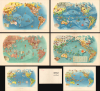
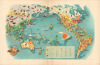
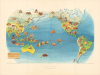
Pageant of the Pacific.
Complete set: Covarrubias' Pageant of the Pacific.
- Digital Map Information
- Suitable for large format printing
- Full resolution TIFF file
- ICC color profile embedded
- Delivered instantly via download link
Complete set: Covarrubias' Pageant of the Pacific.
This is a complete set of the 1943 second edition of Miguel Covarrubias' pictorial maps of the Pacific, originally painted as a set of murals for Pacific House at the Golden Gate International Exposition (1939 - 1940).A Closer Look
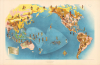
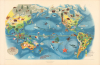
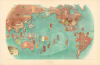
Each map focuses on a specific aspect of Pacific history and culture:- Plate I - Peoples of the Pacific - highlights the peoples of the Pacific in traditional dress.
- Plate II - The Flora and Fauna of the Pacific - focuses on flora and fauna. Illustrated creatures range from blue whales and sharks to koalas, Komodo dragons, pandas, and Galapagos tortoises.
- Plate III - Art Forms of the Pacific Area - emphasizes local and indigenous art.
- Plate IV - Economy of the Pacific - details varied economies.
- Plate V - Native Dwellings of the Pacific Area - presents indigenous architecture.
- Plate VI - Native Means of Transportation in the Pacific Area - focuses on indigenous travel and transportation.
A History of the Murals
The murals were on display in Pacific House, the thematic centerpiece of the Golden Gate International Exposition. Two of the murals measured 9 feet by 13 feet (four panels each- 'Native Dwellings' and 'Transportation'), while the four others measured 16 feet by 24 feet. After the Exposition, they were loaned to the American Museum of Natural History in New York City, where they were exhibited until 1953, when they were put into storage. In 1959, the AMNH decided to return the murals to Pacific House and shipped them back to San Francisco. In transit, Art Forms of the Pacific vanished. They were subsequently exhibited at the World Trade Center Ferry Building in San Francisco from 1959 until 2001. When Ferry Building renovations commenced in 2001, they were returned to the Treasure Island Development Association (TIDA) and put in storage. In March 2004, the Mexican Government approached TIDA with a proposal for a loan of the five remaining murals. The Mexican government paid for necessary conservation and restoration work and sponsored four major exhibitions between 2006 and 2008. After the murals returned to the United States, a handful of exhibitions were held, but the five murals were never again exhibited together.The Golden Gate International Exposition
The Golden Gate International Exposition was a 'World's Fair' held to celebrate the two new bridges of San Francisco - The San Francisco-Oakland Bay Bridge and the Golden Gate Bridge. It ran from February 18, 1939, through October 29, 1939, and from May 25, 1940, through September 29, 1940. The Exposition featured, among other attractions, the Tower of the Sun and a giant statue of 'Pacifica,' the goddess of the Pacific Ocean, highlighting the exposition theme, 'Pageant of the Pacific.' During the radio broadcast of the opening ceremony, President Franklin D. Roosevelt said:Washington is remote from the Pacific. San Francisco stands at the doorway to the sea that roars upon the shores of all these nations, and so to the Golden Gate International Exposition I gladly entrust a solemn duty. May this, America's World's Fair on the Pacific in 1939, truly serve all nations in symbolizing their destinies, one with every other, through the ages to come.Treasure Island, an artificial island constructed specially for the Exposition, was slated for conversion into a municipal airport but was instead turned into a naval base during World War II (1939 - 1945). It remained Naval Station Treasure Island until 1997.
Publication History and Census
The original murals were created by Miguel Covarrubias in 1939 for the Golden Gate International Exposition. The sets of the six mural prints were copyrighted by the San Francisco Bay Exposition Company in 1940 and published by Pacific House in San Francisco, California. A second edition was published in 1943, which is only identifiable if the Pageant of the Pacific booklet accompanies the print - as here. These prints occasionally appear on the market, sometimes in full sets but more often as individual sheets. The full set is well represented in institutional collections.Cartographer
Miguel Covarrubias (November 22, 1904 - February 4, 1957) (also known as José Miguel Covarrubias Duclaud) was a Mexican illustrator, caricaturist, painter, ethnologist, and art historian. Born in Mexico City, Covarrubias began producing illustrations and caricatures for materials published by the Mexican Ministries of Education and Communication after graduating from the Escuela Nacional Preparatoria in 1918. At just 19, although he spoke little English, the talented artist grant from the Mexican government to study in New York City. Covarrubias was introduced around New York City art circles by the Mexican poet José Juan Tablada and the New York Times critic Carl Van Vechten. His mastery attained instant recognition and he was soon booked to produce art for many of Manhattan's top magazines. Eventually, Covarrubias become a prominent illustrator and the premier caricaturist for Vanity Fair and The New Yorker. Covarrubias also worked on set designs, and painted murals, one of which was commissioned by the 1939-1940 Golden Gate International Exposition. He married Rosa Rolando in 1930. Further Details...
Condition
Excellent. Set of six (6) maps. Light wear along original centerfold of each sheet. Plates V and VI are smaller than Plates I, II, III, and IV.
References
OCLC 60395041.