
1945 Manuscript Wall Map of the Philippines, World War II

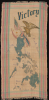
Victory.
Souvenir of the Liberation of the Philippines.
$950.00
Choose a Collection:
- Digital Map Information
- Suitable for large format printing
- Full resolution TIFF file
- ICC color profile embedded
- Delivered instantly via download link
This Item
Enquire
Souvenir of the Liberation of the Philippines.
This is a large-format c. 1945 manuscript map of the Philippines hand-painted on local silk. Likely produced soon after the conclusion of World War II's Philippines Campaign, it celebrates the Filipino-American success in expelling Japanese forces, which had occupied the islands since 1942.A Closer Look
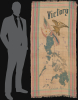
The very large map (over 6 feet tall) includes the entire Philippine archipelago, labeling the larger islands and surrounding bodies of water in an ornate text. Atop Luzon is a bald eagle holding an American and Filipino flag in its talons. At the top is the word 'Victory' written in large letters. The map is hand-painted on local silk, distinguishable by its handwoven, slightly uneven 'knobbly' texture. It was likely drawn by a local Filipino artist for sale to a U.S. serviceman stationed in Manila.The Philippine Campaign
Launched on October 20, 1944, the Philippine Campaign was a World War II joint American and Filipino military operation intended to liberate the Philippine Islands from occupying Imperial Japanese forces. The Japanese Army overran most of the Philippines during the first half of 1942, and occupied it for the subsequent 2 years. American General Douglas MacArthur began the campaign by announcing on Philippine radio 'This is the Voice of Freedom, General MacArthur speaking. People of the Philippines: I have returned.' The campaign progressed rapidly, driving the Japanese out of one island after another. Although by this time the Japanese were clearly losing the war, they gave no sign of capitulation and refused to surrender.During the campaign, Japan suffered nearly half a million casualties, compared to only about 50,000 Americans and an unknown number of Filipino guerrilla fighters, and surviving Japanese troops suffered from widespread hunger and disease. The civilian toll of the campaign was also significant, especially in the brutal battle for Manila in February and early March 1945, when some 100,000 civilians died, largely from atrocities committed by Japanese troops. The campaign continued until Japanese forces in the Philippines were ordered to surrender by Tokyo on August 15, 1945, after the dropping of atomic bombs on Hiroshima and Nagasaki.
Publication History and Census
This manuscript map was prepared by an unknown artist in 1945 or shortly thereafter. As a manuscript work, it is entirely unique.Condition
Very good. Hand painted on local silk.