
1909 Dieulefils Photo Book of Saigon (Ho-Chi-Min City), Vietnam

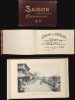
Saïgon et ses environs Cochinchine. 棍柴.
Stunning zinco photos of Saigon, its people, and environs
Stunning zinco photos of Saigon, its people, and environs
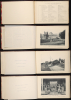
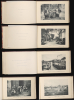
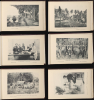
A stunning c. 1909 Pierre Dieulefils photo book of Saigon (Ho-Chi-Min City), French Indochina (Vietnam). The photos capture Saigon at the peak of its colonial decadence, but importantly, also focus on the Vietnamese people, illustrating a wide array of commercial and social activities ranging from port scenes in the Chinese enclave of Cholon to theater troupes and tribal guerrilla warriors.A Closer Look
The work features 54 beautifully composed helio-zinco photographs, separated by tissue paper, of Saigon buildings and life. The index, introduction, and label text are in French, English, and German, underscoring the intended trans-national audience. Photographs cover a wide array of subjects, including typical colonial buildings, but the more interesting images include local port scenes, a Saigonese funeral, tribal peoples, an acting troupe, Vietnamese women, and much more.Photo-zincography and Helio-zincography
Photo-zincography and helio-zincography are two very similar reprographic processes originally made famous by their use in the British Ordnance Survey. In 1859, photo-zincography was developed, separately but simultaneously, by John Walter Osborne in Australia and by two soldiers at the Ordnance Survey in Southampton. The soldiers, Captain Alexander de Courcy Scott and Lance-Corporal Rider, were working under Colonel Henry James, who immediately took credit for the innovation. Essentially, photo-zincography is a reproductive process wherein a glass photographic negative is used to create a carbon positive print, which is then transferred to a zinc plate. Helio-zincography, while essentially the same process, eliminates the need for the carbon positive print by placing the negative directly on the zinc plate. It offers several advantages, most importantly, zinc plates are lighter and cheaper than lithographic stones, economizing the process considerably. Zincography was embraced by various cartographic agencies that demanded mobility and economy, among them the British Ordnance Survey, the French Bureau Topographique, and many military mapping agencies.Publication History and Census
The book was compiled in Hanoi by Pierre Dieulefils. It was printed in Paris by A. Paul, C. Vigier and Company. Although undated, most comparable Dieulefils publications were issued between 1907 and 1909, so we have adopted a date of c. 1909. We see some examples in library catalogs dated as late as 1925, but this is unlikely, as Dieulefils had retired by that point. There are records in OCLC of 6 institutional holdings, but no history on the market, making this among Dieulefils' rarest works.Cartographer
Pierre Marie Alexis Dieulefils (January 21, 1862 - November 19, 1937) was a French photographer, soldier, and publisher, primarily known for his work in Cambodia and Vietnam during the late 19th and early 20th centuries. Dieulefils was born in Malestroit, Morbihan, France. He traveled to Tonkin as a non-commissioned officer in the 24th artillery regiment of Vannes with French colonial forces in 1885. He settled in Hanoi, where in 1888 he established a photo studio at 61 Rue Paul Bert, thus becoming Hanoi's first photographer. Along with a friend and fellow photographer, Fournereau, he traveled extensively in French Indochina, producing more than 5000 photos, which were sold separately, bound into books, and reduced as postcards. His colonial photographs were presented to great acclaim at the 1889 Paris Exposition Universelle. He went on to participate in subsequent exhibitions in 1900 (Paris), 1902 (Hanoi), 1906 (Marseille), 1908 (London), and 1910 (Brussels). He traveled to Morocco around 1915 and also completed a series of photographs there. According to the Dieulefils family, he remained in Indochina until about 1925, however, his output ceased around 1920. Other references suggest he had settled in Paris by 1913. Further Details...
Condition
Very good. Some edge wear to binding. Contents excellent.
References
OCLC 39012608.