
1885 Letts Folding Map of the Egypt and the Sudan, Gordon Relief Expedition

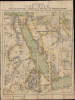
Letts's Map of the Nile Embracing the Soudan, Abyssinia, the Red Sea, and Western Arabia. / Letts's New of the Soudan...
Fall of Khartoum and the Death of a Victorian Hero.
- Digital Map Information
- Suitable for large format printing
- Full resolution TIFF file
- ICC color profile embedded
- Delivered instantly via download link
Fall of Khartoum and the Death of a Victorian Hero.
This is a c. 1885 folding map of northeastern Africa prepared by Letts and Son. Produced in the midst of the Mahdist War (1881 - 1898), it was issued to meet public demand for information on the Gordon Relief Expedition, which struggled up the Nile to the besieged city of Khartoum in late 1884 and early 1885.A Closer Look
The map covers from the Mediterranean and the Levant to southern Sudan (including part of today's South Sudan), central Ethiopia, and northern Somalia. Mountains and waterways are labeled, including the Nile with its branches and tributaries. The routes of explorers, telegraph lines, caravan routes, and other paths, and wadis are traced. Settlements, ruins (including pyramids), oases, the cataracts of the Nile, the sites and dates of battles in the relief expedition, and other features are labelled. Some explanatory notes appear on terrain and water availability. An inset map at top-right displays the telegraph network of Eurasia as far as India, while an inset at right covers the environs of Khartoum.The Mahdist War (1881 - 1889) and the Gordon Relief Expedition
This map was produced in the context of the Mahdist War, a massive religiously-inspired uprising against the rule of the British-backed Khedivate of Egypt beginning in 1881. The conflict was initially only one of many in the orbit of Britain's global empire, but it captured the public's imagination in 1884, when the charismatic adventurer-soldier Charles Gordon, acting beyond his orders from the British government, decided to defend Khartoum in a months-long siege, prompting the organization of a relief expedition.Charles George Gordon (1833 - 1885) was one of the more colorful and storied British imperial adventurers of the 19th century. Born to a family with a long line of British military service, he attended a military academy and then served in the Royal Engineers during the Crimean War with great distinction. Finding peacetime life uninteresting, Gordon volunteered to fight in China during the Second Opium War (1856 - 1860), which he arrived too late to participate in, instead finding work in Shanghai leading a multinational group of mercenaries known as the Ever Victorious Army against the rebels of the Taiping Heavenly Kingdom. After his service in China, Gordon found employment with the Egyptian Khedive government, which appointed him as governor of their southern Equatoria province, over which they had only nominal control. Gordon was appalled by the Ottoman-Egyptian bureaucracy, which he found oppressive and corrupt, and the prevalence of the slave trade (Gordon's abolitionism was inspired by his intense religiosity). Nevertheless, his capabilities as an administrator and diplomat allowed him to rise to the position of Governor-General of the Sudan, earning the nickname of 'Gordon Pasha.' Still, Gordon eventually alienated other officials in the bureaucracy (several of whom he fired) to the point that he was not asked to continue in his position and left Egypt in 1880. But he was soon called on by the British government to report on a large-scale rebellion in Sudan known as the Mahdist Uprising that had broken out in 1881.
Given his prior experience in the region, Gordon was an obvious choice for such a mission, but his public statements about the uprising and his desire to see British military intervention initially made the government wary of sending him. It ultimately relented to public pressure, giving Gordon a mandate only to gather information and organize an orderly evacuation of Khartoum. Gordon indeed evacuated Khartoum of civilians, but then 'went rogue' and attempted to defend the city, hoping to use it in the future as a base from which to subdue the Mahdist rebels. Initially, his position looked strong, as he had ample supplies and the city was ideally suited for defense, surrounded by the Nile and rows of fortifications. Relying on friends in the press, Gordon continuously appealed to the British public to pressure the government to send a larger force to defend Khartoum.
By March 1884, Khartoum was completely cut off and surrounded by Mahdist troops. The Gladstone government was deeply opposed to any effort to relieve Gordon, but by August had to relent to public pressure and authorized a relief force, led by General Garnet Wolseley, who, like Gordon, was very adept at using the press to rile up the public and pressure the government. Not wanting to send a regular force, the government enlisted French-Canadian voyageurs as private mercenaries, but by the time they arrived in Egypt and were prepared to travel by camel and steamship up the Nile, it was already October 1884. Ascending the cataracts of the Nile (indicated here) was an especially difficult process and, along with skirmishes with Mahdist forces, delayed the expedition's progress by weeks. The relief force began to suffer exhaustion and casualties, including two of its leading officers, Herbert Stewart and William Earle.
The advance of the expedition was closely tracked in the British press. In the meantime, Gordon's force had been reduced by disease and skirmishes, and his supplies were running low. The relief force finally reached Khartoum on January 28, 1885, but the Mahdists had already stormed the city two days earlier, captured it, and killed the entire garrison, including Gordon. The British public was incensed at the death of the popular Gordon, and blamed Wolseley and the other leading officers of the relief expedition for delays, as well as the Gladstone government for its reluctance to send a relief force in the first place. Gordon was lionized as one of the great military heroes of his age, while historians have subsequently debated his legacy, his psychology, and his significance as a public figure of the late Victorian era.
Concurrent with the Gordon Relief Expedition, a contingent was sent to cut a path to the Red Sea port of Suakin, clearing out Mahdist forces who controlled the lands between the Nile and the port. Following the fall of Khartoum, this group managed to win a series of battles against the rebels, but soon afterwards, the Gladstone government decided to abandon Suakin and the Sudan. The British returned several years later, crushed the Mahdists, and established a 'condominium' (effectively a protectorate) over Sudan.
Publication History and Census
This map was issued by Letts and Son in 1885. It is undated, but records the locations of battles along the Nile in mid-January 1885, so must have been published after that date. Contemporary newspaper advertisements also demonstrate that this third edition of Letts's map of the region (originally published c. 1883 with a second edition c. 1884) was reissued in 1885 to meet popular interest in the Mahdist War. Due to uncertainty over the date and title (title on the map versus the cover), in addition to the three editions, the cataloging of this map has been somewhat scattered. However, we have been unable to locate any other examples of this third edition in institutional collections, while the OCLC records the first and second editions at a small handful of institutions.Cartographer
John Letts (c. 1772 - 1851) was a British stationer, diary publisher, and printer who established the Letts dynasty of British printers and publishers. Little is known of his life before he opened a stationary shop in the arcades of London's Royal Exchange in 1796. His products proved popular with local merchants and Letts's business succeeded, especially after he printed the world's first commercial diary (essentially a combination of a journal and a calendar) in 1812. These proved to be extremely popular and Letts began offering the diaries in a variety of sizes and formats. Under John's son Thomas Letts (1803 - 1873), the firm's (now 'Letts, Son and Co.') offerings expanded even more to industry-specific journals with dedicated technical information, as well as almanacs, calendars, parliamentary registers, ledgers, maps, and logbooks, all of which were printed in a series of factories in New Cross, London. Letts's diaries became ubiquitous not only among the clerical classes but also for intellectuals and adventurers. For instance, David Livingstone and Henry Morton Stanley recorded their travels across Africa in Letts diaries. Late in Thomas' life and tenure at the head of the company, it went public but soon lost direction and went into liquidation in 1885. The company was effectively refounded by Thomas' son Charles (1836 - 1912) as a private firm called 'Charles Letts and Co.' Charles quickly reestablished the company's reputation and business, becoming a major supplier of hundreds of different types of specialist and hobbyist diaries by the early 20th century. The firm in this original manifestation went through several reorganizations and mergers in more recent decades, but the family name survives in the stationary Filofax, Letts and Blueline Group as well as the education publisher Letts and Lonsdale. Further Details...
Condition
Good. Dissected and mounted on linen. Closed tear extending 5.5 inches into printed area from bottom margin. Areas of infill in bottom margin. Some soiling.