
1904 / 1950 Furlong Archive of Discovery of U.S.S. Philadelphia Sunk During Barbary Wars

This item has been sold.
Solving the Mystery of the Frigate Philadelphia.
Scuttled in a sneak attack to keep it out of Barbary hands.
Scuttled in a sneak attack to keep it out of Barbary hands.
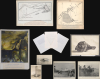
This is a one-of-a-kind archive created by Charles Wellington Furlong recounting his 1904 discovery of the U.S.S. Philadelphia, a U.S. Navy frigate that sank during the First Barbary War (1803 - 1805). After being captured by the enemy, the ship was intentionally scuttled by an American sneak attack to keep it out of Barbary hands. The archive includes a typewritten manuscript, two manuscript maps, and over a dozen photographs. Compiled in the 1950s, this account combines new information with information originally published in Harper's Magazine in June 1905.U.S.S. Philadelphia
The U.S.S. Philadelphia (originally City of Philadelphia) was a frigate and was built in Philadelphia between 1798 and 1799 for the United States Navy. The citizens of Philadelphia funded her construction through a June 1798 fundraising drive that collected the required $100,000 in one week. The Philadelphia was launched on November 28, 1799, and commissioned on April 5, 1800. She first went to sea during the Quasi-War between the United States and the First French Republic. She captured five French naval vessels in the West Indies during this first mission. After returning home in March 1801, she was ordered to the Mediterranean for a year-long cruise to blockade Tripoli during the First Barbary War and returned to the United States in mid-July 1802. After returning to the U.S., the Philadelphia was decommissioned and spent a year out of service before being recommissioned in May 1803. After being recommissioned, the Philadelphia again sailed for the Mediterranean. It was during this cruise that, while pursuing a Tripolitan vessel, the Philadelphia ran aground on an uncharted reef on October 31, 1803. The American captain was unable to refloat the Philadelphia and was forced to surrender to the Tripolitans. The Tripolitans managed to refloat the Philadelphia and towed her into Tripoli Harbor.Intent on keeping the valuable and advanced warship out of enemy hands, on the afternoon of February 16, 1804, the U.S.S. Intrepid, disguised as a Maltese merchantman, entered Tripoli harbor and part of the Intrepid's crew boarded the Philadelphia and set her ablaze. While the Intrepid successfully made her escape, the Philadelphia burned free of her mooring lines and drifted in Tripoli harbor, eventually landing ashore below the walls of the palace. Philadelphia burned for three days before the fire finally went out.
Furlong Discovers the Philadelphia
Charles Wellington Furlong spent the summer of 1904 in Tripoli and dedicated much of his time to discovering the final resting place of the Philadelphia. Eventually, he was introduced to an elderly gentleman who recounted the story of the burning of the Philadelphia, as it had been told to him by his father, an eyewitness to the event. This story led Furlong to the Philadelphia's resting place below the walls of the palace, where the frigate's skeleton was discovered. With the help of the Greek Navy, Furlong was able to recover an 18-pound cannonball that had lodged in the ship's hull.The Archive
This archive contains manuscript maps, a typewritten manuscript of an article written by Charles Wellington Furlong, and several photographs.- The Manuscript: Entitled 'Solving the Mystery of the Frigate Philadelphia', the twelve-page typewritten manuscript recounts Furlong's search for the Philadelphia in detail, including numerous footnotes. The manuscript differs from an article published in the June 1905 issue of Harper's Magazine and written by Furlong, and from the account published in 1909 in Furlong's The Gateway to the Sahara.
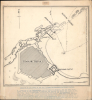
- Manuscript Map of Tripoli and its Environs: Oriented to the south, this manuscript map depicts Tripoli and its immediate environs. It marks the location where the Philadelphia ran aground and the locations of the Tripolitan gunboats that compelled the Philadelphia's surrender. The course of the Philadelphia's captured crew from their ship to the Castle of the Bashaw. Tripoli itself appears on the right, and several coastal forts are labeled. The Sahara is labeled along the top border. This map was used to illustrate the 1905 article published in Harper's. This map is mounted on card.
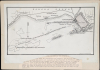
- Manuscript Map of the Location of the wreck of the U.S.S. Philadelphia: This is a detailed manuscript map of the Bay of Tripoli. The most important notations here are the location where the Philadelphia was anchored after being towed into the bay by the Tripolitans and where it was attacked by the crew of the Intrepid (A) and the direction she drifted while burning until she reached her final resting place near the Mole (B). This map was created in the 1950s when the typewritten manuscript was written because it noted the area filled in during the Italian occupation that buried the wreck of the Philadelphia. The dot and dash line represent the course taken by the Intrepid to attack the Philadelphia.
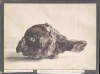
- Photograph of Cannonball Recovered from the Wreck of the Philadelphia: Measuring 7x9.675 inches, this photograph depicts the cannonball pulled from the wreck of the Philadelphia with the plank and barnacles still attached. It is mounted on a black card.
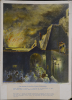
- Photographic Reproduction of Furlong's Painting 'The Burning of the U.S. Frigate Philadelphia': Measuring 13x11 inches, this hand-colored photograph reproduces Furlong's painting in a striking way.
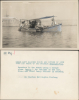
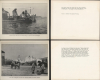
- 7 Large-Format Photographs: 6 of the 7 photographs measure 8x10 inches. 2 of them were used as illustrations for the 1905 Harper's article. All have typewritten captions on the verso. The 7th measures 12x9 inches but is badly damaged.
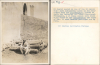
- 8 Small-Format Photographs: These 8 photographs were taken by Furlong in Tripoli, 7 of which were never published. The 8th is the photograph of the Arab man sitting on the cannons, the source for a painting that illustrated the 1905 Harper's article.
Publication History and Census
This archive was created by Charles Wellington Furlong between 1905 and the early 1950s. Parts of the archive were used to illustrate Furlong's article published in the June 1905 issue of Harper's Magazine. These include a painted version of the photograph of the man sitting on the cannons, the photograph of Furlong's painting of the burning Philadelphia, the captioned photograph of the diver next to the boat, and the map of Tripoli Harbor. As an archive, this is a unique collection of documents that recounts an important discovery in the history of the United States Navy.Cartographer
Charles Wellington Furlong (December 13, 1874 - October 9, 1967) was an American author, artist, explorer, photographer, and former professor. Born in Cambridge, Massachusetts, Furlong graduated from the Massachusetts Normal Art School in 1895. From 1896 until 1904, Furlong served as the head of the Cornell University Art Department. He left Cornell for his first extended expedition in 1904, during which time he discovered the wreckage of the frigate U.S.S. Philadelphia which sunk during the Barbary Wars. Harper's Monthly Magazine sponsored his next expedition, to Patagonia and Tierra del Fuego in southern South America, where he lived with the Selk'nam and Yahgan peoples. During this expedition he also created maps and navigational charts of the region. 'Gateway to the Sahara', his first book, was published in 1909, and he returned to South America in 1910. During World War I, he served as a war correspondent in North Africa, created a series of tactical field manuals concerning geographic intelligence. After the war, Furlong served an intelligence aid on President Woodrow Wilson's staff during the Paris Peace Conference. Furlong remained in the military after World War I and attended the Army War College from 1923-1924. He returned to South America in 1925 as a member of the Tacna-Arica Plebiscitary Commission organized to settle boundary disputes between Peru and Chile. He remained in South America until 1930, when he went to East and Central Africa. He served in the Military Intelligence Division of the War department during World War II as a Middle East consultant. He married Eva Earl in 1899, with whom he had two children. Later in life he remarried to Edith Virginia Calista Spinney. Further Details...
Condition
Very good. All photographs with the exception of 1 excellent (which is in poor condition). Nearly all photographs have typewritten captions on verso. Chart, photograph of cannon ball, and photograph of painting mounted.
References
Furlong, C.W., 'Finding the Frigate Philadelphia', Harper's Monthly Magazine, Vol. CXI No. DCLXI (New York: Harper and Brothers) June 1905. Naval History and Heritage Command. Frigate II Philadelphia 1800-1804.