
1996 Plans for the Residence of Saeed bin Zayed Al Nahyan, Abu Dhabi

This item has been sold.
Residential Complex for H.H. Sheikh Saeed bin Zayed.
Stately Residence for a Leading Sheikh.
Choose a Collection:
This Item
Enquire
Stately Residence for a Leading Sheikh.
This is a rare and possibly unique c. 1996 set of five diazotype or whiteprint sheets detailing plans for the Abu Dhabi residence of Saeed bin Zayed Al Nahyan (1965 - 2023), the son of Zayed bin Sultan Al Nahyan (1918 - 2004), the dynamic ruler of Abu Dhabi and first president of the United Arab Emirates. Saeed bin Zayed was a respected businessman and statesman in his own right, serving as a member of the Abu Dhabi Executive Council and a Representative of the Ruler of Abu Dhabi in meetings with other Emirati and regional leaders.A Closer Look
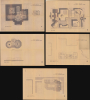
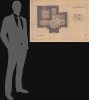
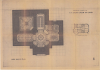
The collection consists of five numbered sheets for plans of a residence for Saeed bin Zayed consisting of five distinct functional sections: a main majlis (usually translated as 'meeting room' but in this context more a room for greeting and entertaining guests), an 'Arabic majlis' (likely covered in detail in a missing Sheet No. 4), a residential complex or villa for the sheikh and his family, a 'service quarter' (with kitchens, storage, and guest rooms), and a health center with a swimming pool, tennis court, and related facilities. Sheet No. 2, the fourth image above, provides an overview of the entire complex, while the other sheets focus on specific structures, with floor plans and profile views. Some sheets, particularly the last on the health center, contain extensive annotations, including notes in both English and Arabic, reflecting an early stage of planning (the last sheet has a handwritten note in Arabic reading 'Please wait in this section until you are provided with the required modifications').Sheikh Saeed bin Zayed Al Nahyan
Sheikh Saeed bin Zayed Al Nahyan was the sixth son of the founder of the United Arab Emirates, Sheikh Zayed bin Sultan Al Nahyan and a member of Abu Dhabi's ruling Al Nahyan family. Throughout his career, he played a prominent role in business, government, and sports. Sheikh Saeed served as chairman of Abu Dhabi's Seaports Department, as undersecretary of the Abu Dhabi Planning Department, and as a member of the Abu Dhabi Executive Council from 2004 to 2010. In 2001 - 2002, he headed the UAE Football Association and later served as chairman of Al-Wahda Football Club. Most prominently, he acted as a Representative of the Ruler of Abu Dhabi from 2010 until he died in 2023, meeting frequently with other leaders in the Emirates and throughout the Gulf Region.Diazo Print or Whiteprint
The diazo print (whiteprint or diazo for short) is a photo-reproductive technique best understood as a reverse cyanotype or blueprint. The process yields distinctive blue lines on white paper. Like cyanotypes, the diazo process gained popularity in architecture circles as a simple, effective way to duplicate documents in the field. The earliest diazotypes appeared around 1880 and were adopted for military and field cartographic use from about 1895. The diazo process was commercialized in 1923, when the German firm, Kalle and Company, developed Ozalid, a patented diazo paper that made diazotyping even easier. By the 1950s, it supplemented cyanotypes as the reprographic technique of choice for technical drawings.Publication History and Census
These sheets were prepared by an unknown creator, likely a local architectural firm with international connections, and from style and context can be roughly dated to the mid-to-late 1990s. We are unaware of any other examples of these plans, as would be expected with the production of diazotype prints, which typically are in small or even single runs.Condition
Very good. Wear and toning on original fold lines. Reverse cyanotype.