
Brown, Lew (sold)

Lew Brown (December 10, 1893 - February 5, 1958) was a Russian-American Jewish lyricist. Born Lewis Brownstein in Odessa, in the then Russian Empire (modern Ukraine), Brown immigrated to the United States at the age of five. He and his family settled in New York City and Brown attended DeWitt Clinton High School, before dropping out to pursue songwriting. He began writing song for Tin Pan Alley in 1912 and collaborated with established composers, including Albert von Tilzer. Two of the well-known works that came out of this collaboration are '(I'm Going Back to) Kentucky Sue)' and 'I'm the Lonesomest Gal in Town'. During World War I, Brown wrote a string of popular songs with von Tilzer, Al, Harriman, and others. Brown formed his most successful writing partnership in 1925 when he began collaborating with Buddy DeSylva and Ray Henderson, writing hits such as 'Button Up Your Overcoat' and 'The Birth of the Blues'. In 1931, DeSylva decided to go in a different direction, but the other two men continued working together. In 1942, Brown penned the lyrics for 'Don't Sit Under the Apple Tree', which was subsequently recorded by Glenn Miller and the Andrews Sisters, launching the tune to popularity. It was not long after the success of 'Don't Sit Under the Apple Tree' that Brown retired from songwriting. Brown was married twice, first to Sylvia Fiske, with whom he had two daughters, and later to Catherine 'June' Brown.
Promoting an ostenisbly patriotic song challenging immigrants to do their part and support the U.S. during World War I effort.
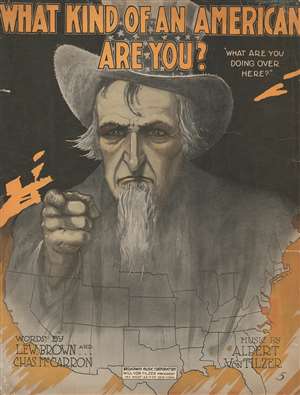
What Kind of an American Are You?
sold
- Digital Map Information
- Suitable for large format printing
- File Size: 16.26 MB
- File Type: ZIP / TIFF
- ICC color profile embedded
- Delivered instantly via download link
This is a 1917 propaganda map of the United States illustrating a cover of sheet music and promoting 'Americanness.' The cover features a map of the entire United States overshadowed by a large portrait of Uncle Sam pointing his index finger at the viewer. The song, written by Lew Brown and Charles McCarron and composed by Albert von Tilzer, is a rousing tune urging Americans to do their part in supporting the effort in World War I. Despite being published during World War I, the song is surprisingly prescient to today's social and political climate. It indirectly calls upon immigrants to be 'more American' and prove their loyalty to the United States. Published in 1917, this song fundamentally upholds the 'us-against-them' mentality that swept over the United States following the declaration of war against Germany - and which seems again on the rise. (more details)