
Bunkindō (sold) (文錦堂)

Bunkindō (文錦堂; fl. c. 1790 - 1870) was a Japanese printer based in Nagasaki. Like several other contemporary Nagasaki printers, Bunkindō developed a specialty in Nagasaki-e, depictions of foreigners and foreign things in Nagasaki, in the 18th and early 19th centuries. It was one of the leading printers in the genre, serving as a window to the outside world during Japan's period of isolation.
AKA: 文錦堂
A Classic Nagasaki-e Work.
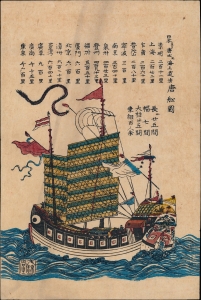
唐船圖 / [Drawing of a Chinese Ship].
sold
- Digital Map Information
- Suitable for large format printing
- Full resolution TIFF file
- ICC color profile embedded
- Delivered instantly via download link
This is a c. 1810 ukiyo-e woodblock depiction of a Chinese ship of the sort that traded at Nagasaki during the Tokugawa Era policy of isolation (sakoku), a classic theme in the Nagasaki-e genre. Although strictly closed to traders from most countries, Japan did conduct some (strictly controlled) foreign trade with Dutch and Chinese merchants at Nagasaki, which permitted a degree of foreign interaction and exchange. (more details)
Ships from Distant Ports.
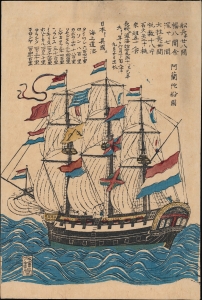
阿蘭陀船圖 / [Drawing of a Dutch Ship].
sold
- Digital Map Information
- Suitable for large format printing
- Full resolution TIFF file
- ICC color profile embedded
- Delivered instantly via download link
A captivating c. 1810 ukiyo-e woodblock depiction of a Dutch ship of the sort that traded at Nagasaki during the Tokugawa Era policy of isolation (sakoku), a classic theme in the Nagasaki-e genre of woodblock prints. Although strictly closed to traders from most countries, Japan did conduct some (strictly controlled) foreign trade with Dutch and Chinese merchants at Nagasaki, which permitted a degree of foreign interaction and exchange, as evidenced by this work. (more details)