
Cuevas Aguirre y Espinosa, Joseph Francisco de (sold)

Joseph Francisco de Cuevas Aguirre y Espinosa (1679 - 1759) was a Mexican lawyer for the Real Audiencia, and city Regidor in Mexico City. He is occasionally identified as an engineer, but he would be entirely unknown, but for his having been ordered by the Viceroy to report on the findings of an engineering survey attempting to contend with the Mexican capital's serious, long-standing problems with drainage and flooding. Whether a career lawyer or career engineer, Aguirre y Espinosa does not appear to have produced any maps of his own, but his efforts on the drainage report resulted in the first printing of any map by Mexican polymath Carlos de Sigüenza y Góngora, whose manuscript of the region around Mexico City - produced around 1691 - would remain the best available for most of the 18th century, despite its many imprecisions.
'... of the utmost typographical and historical importance' - Stevens
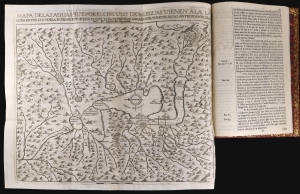
Extracto de los autos de diligencias, y reconocimientos de los rios, lagunas, vertientes, y desagues de la capital Mexico, y su valle.
sold
An essential, groundbreaking work of Mexican geography, this is Joseph Francisco Cuevas Aguirre y Espinosa's foundational 1748 study of the drainage of the region around Mexico City. It is the earliest systematic study of flooding endemic to the Mexican capital. The work contains the first printed version of Carlos Sigüenza y Gongora's map of the area encompassing 90 miles surrounding Mexico City, the first printed map of the region not derived from the 1524 Cortez map, and the first map of the region produced by a Mexican. It has long been recognized for its importance - even the 19th-century bookseller and bibliophile Henry Stevens proclaimed, 'This book is of the utmost typographical and historical importance' both in terms of its content and its superb production. The work is also significant for being printed by a woman, Rosa Maria Teresa de Poveda (c. 1710 - 1755), the widow of deceased printer Jose Bernardo de Hogal. (more details)