
Bry, Jean-Théodore de (sold)
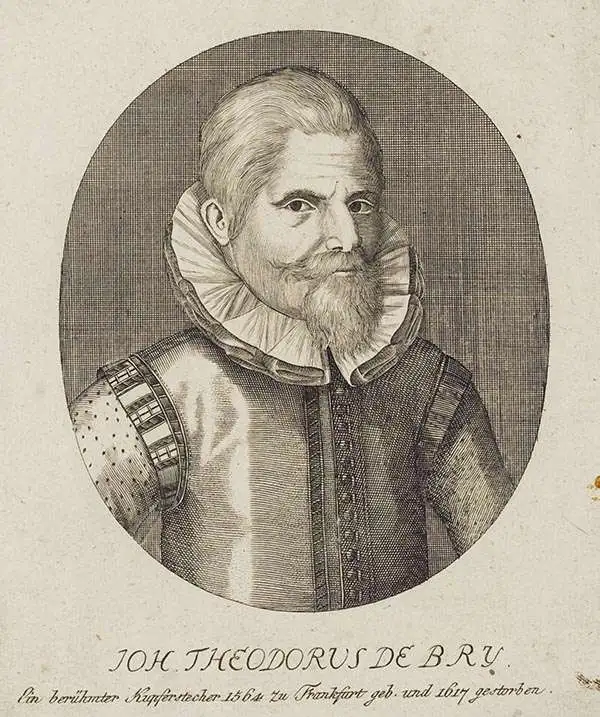
Jean-Théodore de Bry (1561 - January 31, 1623), also known as Johann, was a Flemish-German engraver, goldsmith, and publisher. Jean-Théodore de Bry was the son of Théodore de Bry (1528 - 1598), a highly respected and accomplished engraver active in Liège, Strasbourg, Antwerp, London, and Frankfurt at various points in his life. Jean-Théodore was born during his father's time in Strasbourg and, along with his brother Johannes Israel, assisted his father in engraving for several significant works. When his father, Théodore de Bry, died in 1598, Jean-Théodore took over the family printing house in Frankfurt. In 1613, he moved the firm to Oppenheim, where it published the works of Rosicrucians Jean-Théodore Robert Fludd, Michale Maier, and others. In Oppenheim, he trained his son-in-law, Matthäus Merian der Ältere (1593 - 1650), who also became a prominent engraver. When Oppenheim fell to the Spanish in 1620, the firm returned to Frankfurt. Jean-Théodore de Bry died in 1623, and Merian took over the publishing house.
Rosicrucian Vision of Knowledge, God, and the Universe.
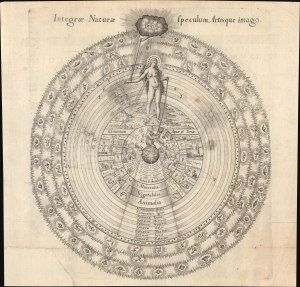
Integrae Naturae Speculum, Artisque Imago.
sold
- Digital Map Information
- Suitable for large format printing
- Full resolution TIFF file
- ICC color profile embedded
- Delivered instantly via download link
This is a rare 1617 Rosicrucian hierarchical diagram organizing the divine, cosmic, natural, and human experience into a structured, symbolic system. It was designed by the English Rosicrucian and alchemist Robert Fludd, who sought to condense the hermetic, Neoplatonic, and alchemical worldviews into a coherent vision of reality. Although rooted in Rennaissance thought, this image offers an enduring visual metaphor for the search for meaning, reflecting the impulse to systematically rationalize human experience. (more details)