
Roberts, Bishop (sold)

Bishop Roberts (? - 1740) was an American artist active in Charlestown, South Carolina. Very little is known of his life, but he advertised his services (portraits, landscapes, heraldry, drawings, engravings; and as well to paint houses) in 1735. He produced a watercolor panorama of the coastline of Charleston sometime between 1735 and 1739. (The original is now held in the Colonial Williamsburg Collection.) A large printed version of this work on four sheets appears to have been engraved by W. H. Toms, which was available as early as 1740. We are aware of one example of this four-sheet panorama to have survived, also at Colonial Williamsburg. Its 1739-40 dating is indicated by announcements printed by Robert’s widow, Mary Roberts, advertising that her husband's subscribers should pick up (and pay for) the prints so that she could settle his estate. Mary Roberts (died 1761) was herself an artist, one of the earliest American miniaturists, and the first recorded woman working in the medium in the colonies.
Earliest Acquirable View of Charleston, South Carolina.
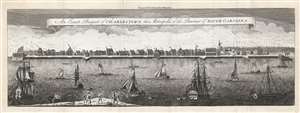
An Exact Prospect of Charlestown, the Metropolis of the Province of South Carolina.
sold
- Digital Map Information
- Suitable for large format printing
- Full resolution TIFF file
- ICC color profile embedded
- Delivered instantly via download link
This is the most important early view of Charleston, South Carolina. This view of Charleston was published in 1779 by the London Magazine. It is one of the few images available to the collector of the pre-Revolutionary colonial south, capturing the city when it was the fourth largest port in the North American British colonies. It is based on the unobtainable rare view of the same title engraved by William Henry Toms (c. 1700 - 1765) in 1739, in turn based on a watercolor painted from life by American artist Bishop Roberts between 1735 and 1739. (This original watercolor is in the collection of Colonial Williamsburg.) The view shows the waterfront of the city as seen from the opposite bank of the Cooper River. It clearly illustrates the town's shoreline batteries, warehouses, and wharves. Several structures are marked with a letter key: these are the Granville Bastion, the courthouse, the council chamber, the Quaker meeting house, the spire of Saint Philip's Church, the Customs House, and at the far-right Craven's Bastion. The waters of the Cooper are filled with ships, ranging from humble rowboats to British warships - underscoring both Charleston's prosperity and military significance. In the foreground, a group of fishermen wrestle a great fishnet ashore. The beautifully engraved sky above the city is teeming with birds. (more details)