
Sinclair, Thomas S. (sold)

Thomas S. Sinclair (c. 1805 - 1881) was an American lithographer. Born in the Orkney Islands, Scotland, Sinclair studied lithography in Edinburgh and other European cities before moving to the United States sometime before 1833. He was established in Philadelphia by 1833, when he drew a dancing scene for the firm of Kennedy and Lucas, which went out of business that same year. In 1838, Sinclair acquired the press of John Collins and opened his own lithography firm. He was among the first lithographers in Philadelphia to experiment with color lithography, beginning in 1843. By 1848, his skills ad advanced to such a degree that he won a silver medal for color lithography at the Franklin Institute's exhibition. Sinclair's brother, William B. Sinclair, joined the firm in 1854, and from that year until 1859 the establishment was known as Thomas Sinclair and Company. His son joined the company at one point also, and then the firm's name changed to Thomas Sinclair and Son. Sinclair died in Philadelphia in 1881.
Illustrates over one hundred different flags from around the world.
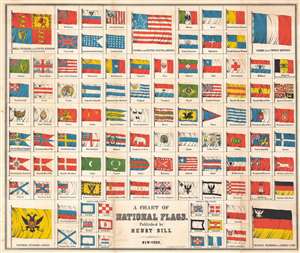
A Chart of National Flags.
sold
- Digital Map Information
- Suitable for large format printing
- DPI: 600
- File Size: 25.56 MB
- File Type: ZIP / TIFF
- ICC color profile embedded
- Delivered instantly via download link
This is an 1851 Henry Bill chart of national flags. Illustrating one hundred five different flags, nations, city-states, companies, and other entities are represented here. The five largest flags, one in each of the four corners and a fifth situated at top center, ... (more details)
The decisive American Civil War naval battle that allowed the Union to capture New Orleans, Louisiana
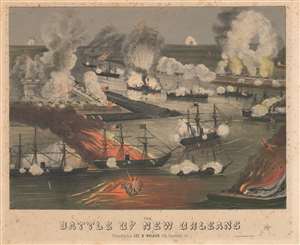
The Battle of New Orleans.
sold
- Digital Map Information
- Suitable for large format printing
- File Size: 10.27 MB
- File Type: ZIP / TIFF
- ICC color profile embedded
- Delivered instantly via download link
This is an 1862 Thomas S. Sinclair lithograph view of the Battle of Forts Jackson and St. Philip during the American Civil War. In the view, Fort Jackson is on the left and Fort St. Philip is on the right and the Confederate soldiers stationed in the forts are trying in vain to turn back a Union fleet heading up the Mississippi River toward New Orleans. Situated on either side of a bend in the Mississippi, the forts were remnants of the age of sail. By placing the forts along a riverbend, a ship propelled by sails would have been rendered effectively stationary as it attempted to navigate the bend, placing it at the mercy of the 177 guns within the two forts. By 1862, however, steam power had arrived, which allowed the Union Navy to run between the two forts while still maintaining power, making them much less easy targets. The Union force is illustrated here making its way up the river between the two forts and firing as its advances. Nearly all the illustrated ships are flying the United States flag. (more details)