
Smart, T. L. (sold)

T. L. Smart (fl. c. 1870 - 1883) was a wood engraver and illustrator active in the United States and Canada from roughly 1870 - 1883. Smart is elusive. He was possibly English or Scottish and may have relocated to Ontario, Canada, in the 1860s or 1870s. Most of his work focuses on Ontario subjects, but he is identified as one of the engravers for John Russell Young's 1879 Around the World with General Grant. There is another Smart, R. M. Smart who also produced engravings for this work, but it is not clear if they are related. Smart typically signed his work as 'TL SMART,' 'SMART SC,' or 'TL SMART SC.' It is unclear what the 'SC' might have referred to.
Anti-corruption 'tear down the machine' political broadside from 1872 Presidential Election.
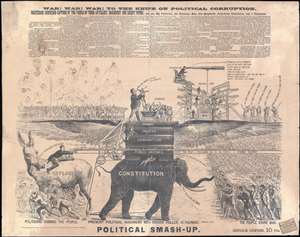
Political smash-up : War! War! War! To the Knife on Political Corruption.
sold
- Digital Map Information
- Suitable for large format printing
- File Size: 48.15 MB
- File Type: ZIP / TIFF
- ICC color profile embedded
- Delivered instantly via download link
This is a rare 1872 broadsheet that promotes an anti-corruption political message intended to bolster the presidential election prospects of retired businessman and Civil War General Thomas Alfred Davies. Davies ran in an unsuccessful 1872 bid for president on a 'tear down the machine' platform, likely a response to rampant corruption in the Republican Grant administration and the New York Boss Tweed Ring.
Davies was born in New York, attended West Point, and served in the Union Army during the Civil War. In 1865, having distinguished himself at the First Battle of Bull Run and the Siege of Corinth, he was promoted to Major General of Volunteers, and in 1866 to Brigadier General. After the war he retired from the army to devote himself to business, becoming wealthy as a realtor and author. Eventually he turned to religion, becoming a pamphleteer for Jesus, but not before his unsuccessful run for president.
Davies was frustrated with what he considered a corrupt political machine designed only to fleece the voting public. Without any formal backing or association, Davies declared himself the candidate for a new party of his own invention, the People's Party (not to be confused the more official People's Party established by William Jennings Bryant in 1892). Beyond this and two other broadsides, there is little evidence of Davies' run for office and his name did not appear on the 1872 ballot. Apparently his 'wing it solo' approach was unable to generate the necessary momentum. (more details)
Davies was born in New York, attended West Point, and served in the Union Army during the Civil War. In 1865, having distinguished himself at the First Battle of Bull Run and the Siege of Corinth, he was promoted to Major General of Volunteers, and in 1866 to Brigadier General. After the war he retired from the army to devote himself to business, becoming wealthy as a realtor and author. Eventually he turned to religion, becoming a pamphleteer for Jesus, but not before his unsuccessful run for president.
Davies was frustrated with what he considered a corrupt political machine designed only to fleece the voting public. Without any formal backing or association, Davies declared himself the candidate for a new party of his own invention, the People's Party (not to be confused the more official People's Party established by William Jennings Bryant in 1892). Beyond this and two other broadsides, there is little evidence of Davies' run for office and his name did not appear on the 1872 ballot. Apparently his 'wing it solo' approach was unable to generate the necessary momentum. (more details)