
Wailly, Charles de (sold)
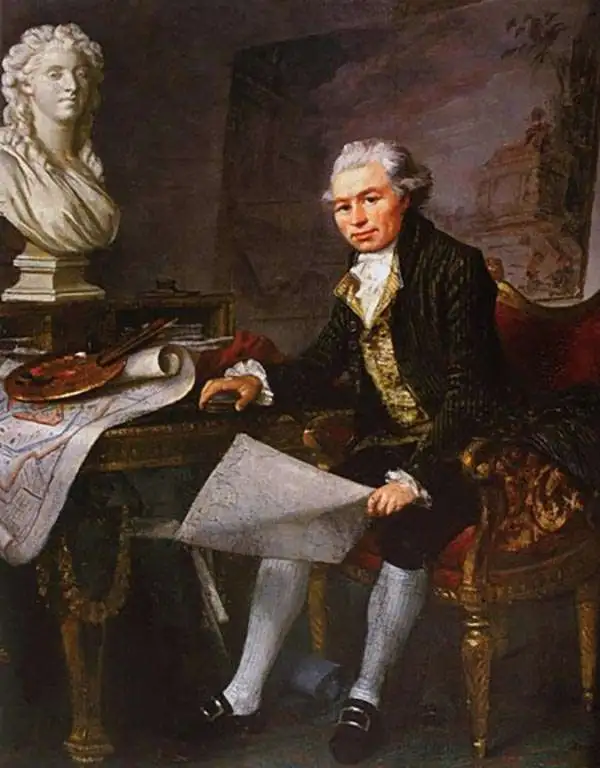
Charles de Wailly (November 9, 1730 - November 2, 1798) was a French architect, civil engineer, and painter, known for his late 18th century neoclassical architecture in and around Paris. Born in Paris, he trained under leading architects of his time and became a member of the prestigious Académie Royale d'Architecture. De Wailly was a key figure in the neoclassical movement, influencing French architecture with a refined sense of proportion and classical form. His notable works include the Théâtre de l’Odéon and renovations of Château de Fontainebleau. He is less well known for his grandiose urban planning visions, likely because none of them came to fruition. De Wailly envisioned a sweeping transformation of the Parisian landscape intended not only to beautify Paris but also to optimize the efficiency of its urban space. His visions included the creation of wide new avenues, the construction of public squares, the erection of monuments, the expansion of housing, the unification of the city’s islands (Cité, Saint-Louis, and Louviers), and improvements to the flow of the Seine. These were presented and met with approval at the Salon of 1789, and may have gone forward, but De Wailly had terrible timing - the troubles later that year (the onset of the French Revolution) put an end to Louis XVI's royal investment in, well, anything.
Unique constructed manuscript plan to renovate Paris by the architect of the Odéon.
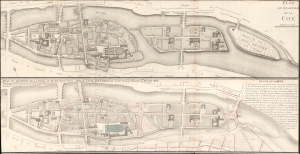
Plan du Quartier de la Cité. / Plan due Quartier de la Cité, de sa Reunion avec L'Isle St. Louis, d'une Garre et d'une Place Consacre a, Louis XVI.
sold
- Digital Map Information
- Suitable for large format printing
- File Size: 14.15 MB
- File Type: ZIP / TIFF
- ICC color profile embedded
- Delivered instantly via download link
A most unique and intriguing 1789 map of the Cité quarter, Paris, with copious manuscript, illustrating the bold plan of French 'Architecte du Roi' and designer of the Odéon, Charles de Wailly, to unite Paris's Île de la Cité with neighboring Île Saint-Louis. The plan, though greeted at the 1789 Paris Salon with much enthusiasm, floundered due to unfortunate timing: it was proposed at the outbreak of the French Revolution (1789 - 1799). It is an epic 'could-have-been' by one of Paris's most famous and influential architects. (more details)