
Abramovich, Lev Markovich (sold)

Lev Markovich Abramovich (1884 - 1948) was a Russian Jewish emigré who lived and worked in Harbin, China, as a typographer, lithographer, and bookbinder. He graduated from a vocational school in Odessa in 1903 and worked in the Echo of China printing house in Shanghai from 1907 until 1910. Abramovich arrived in Harbin in 1910 and he founded the Typo-Lite-Zincoography L.M. Abramovich (Типо-Лито-Цинкографя Л. М. Абрамовича) in 1911. Authors living in 'Russian Harbin' often printed their books directly in printing houses and bypassed formal publishing houses, a practice for which Abramovich's printing firm was suited. Our research indicates that Abramovich's printing house closed in 1943. Abramovich died in Harbin in 1948.
Highpoint of Russian Harbin.
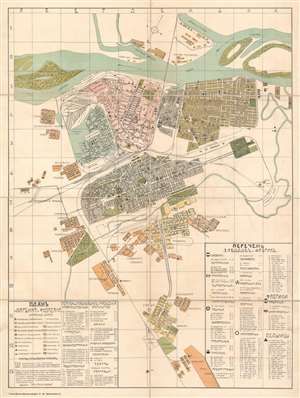
ПЛАНЬ г. ХАРБИНА и ФУДАДЯНА. / Plan of Harbin and Fudadyan.
sold
- Digital Map Information
- Suitable for large format printing
- File Size: 61.88 MB
- File Type: ZIP / TIFF
- ICC color profile embedded
- Delivered instantly via download link
This is a c. 1916 Lev Markovich Abramovich large-scale administrative city plan or map of Harbin (哈尔滨 / Харби́н), China. Composed in art nouveau styled Cyrillic, the map depicts China's most 'Russian' city during the ephemeral period of Russian control between the Russo-Japanese War (1904 - 1905) and Bolshevik Revolution (1917 - 1923). As evidenced by the map's authorship, this was also the highpoint of Judaism in Harbin, then known as the 'Jerusalem of the East'. Harbin Jews, like the mapmaker here, Abramovich, were exiled from Russia, but became influential in Harbin. Orientation is to the northeast, with the Songhua River at top, employing color coding to highlight neighborhoods and an icon system for significant sites, including breweries, banks, consulates, theaters, wells, and government buildings. The all-important railroad lines are illustrated throughout. Although undated, the map can only have been made between 1915 and 1919, reflecting the development of city at that time, as well as the need for a large-scale administrative plan in Russian - as by 1920, Chinese officials had taken over most positions of power and influence and any administrative map would have been in Chinese. (more details)