
Kip, Leonard W. (sold)

Leonard W. Kip (November 10, 1837 - February 27, 1901) was an American missionary active in China during the second half of the 19th century. Kip was born in New York City to a wealthy family, but nonetheless, joined the China Board in his religious devotion. Kip first traveled to China in 1861 with the Chinese Mission of the American Reformed Church and established himself at the Amoy (Xiamen) mission. Kip was extremely zealous in parenthesizing the Christian Gospel and traveled extensively through the region. With is educational background, and extensive travels, Kip became the unofficial geographer of the mission, compiling the first accurate western style map of the Xiamen region. He remained with the mission until 1899, at which point, in ill health he returned to the United States, dying 2 years later, in 1901. There are some, apparently erroneous, reports that he may have died in Xiamen, China.
The best map of Xiamen / Amoy area in its day - made for missionary work!
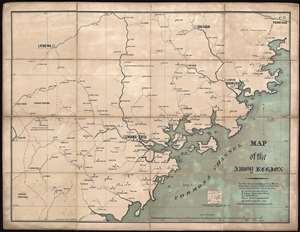
Map of the Amoy Region.
sold
- Digital Map Information
- Suitable for large format printing
- File Size: 44.13 MB
- File Type: ZIP / TIFF
- ICC color profile embedded
- Delivered instantly via download link
Published in 1880, this is the first edition of Dr. Leonard W. Kip's map of missionary activity in the vicinity of Amoy (Xiamen), Fijian, China. Derived directly from Kip's 20 years of missionary activity in the region, this was, when issued, the best map of the Xiamen region yet published. Centered on Amoy, the map covers the Fujian coast roughly from Meizhou Bay to Dongshan Bay. It extends inland roughly as far as the picturesque Longyan (Leng-Na, 龙岩市), the heartland of the Hakka People, with their iconic tulou (土楼) architecture. The map notes countless villages as well as footpaths between villages, notes on the navigability of rivers, mountains, and even, pertinent to missionary work, sites where there are 'several men who seek Christian instruction.' The map also notes the sites where Kip's American Reformed Mission (A) had stations, as well as posts of the English Presbyterian Mission (E), London Mission (L), and missions operated out of Fuzhou (F). (more details)