
Maillard, Nicholas Doran (sold)

Nicholas Doran Maillard (1810 - July 7, 1880) was an Irish barrister active in Dublin, Texas, and London in the mid-19th century. Maillard was born in Dublin, Ireland to James Nicholas Maillard and Catherine Stubber. He received a fine education as a barrister and practiced briefly before moving to Texas. He lived and worked as a newspaper editor in Richmond, Texas, near modern-day Houston. He may have remained in Texas for as little as six months. He was known in Robinson for his friendly demeanor, fine British manners, education, and skill at mixology. He left Robinson for London, claiming sick relatives. Within two years of return, he published The History of the Republic of Texas, reviling Texas and the Texan Revolution, while praising Mexico. It remains unclear why he so despised Texas, but likely the work was sponsored by British bankers, who leveraged enormous debt over Mexico, much of which was secured by Texan lands. After published his history, he moved back to Dublin, where he was active as a barrister, editorialist, and pamphleteer. At some point in the 1860s, he began going by his mother's maiden name 'Stubber', possibly for legal purposes. He died in Ireland in the 1880s, having never returned to the Texas he so reviled.
'Texas cut down to size - a difficult feat even in 1842' - Graff
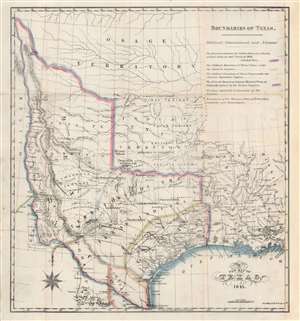
A New Map of Texas 1841.
sold
- Digital Map Information
- Suitable for large format printing
- Full resolution TIFF file
- ICC color profile embedded
- Delivered instantly via download link
An 1841 map of the Republic of Texas by Nicholas Doran Maillard, who hated Texas and Texans pretty much more than anything. Despite Maillard's feelings toward Texas, the map by Day and Haghe is a truly remarkable work unique in addressing Texas's boundaries and claims. It also notes with detail American Indian settlements throughout and offers notes and annotations on fortifications, terrain, mines, and more. Significantly, and progressively for the time, much of the land beyond coastal Texas is defined as the 'Territory of the Texan Indians'. (more details)