
McCandlish, Edward Gerstell (sold)
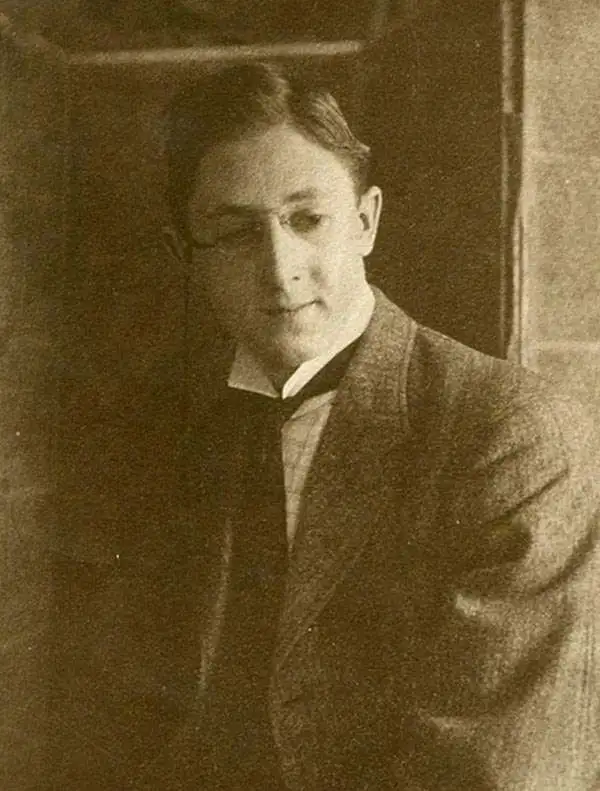
Edward Gerstell McCandlish (March 10, 1887 - December 4, 1946) was an American artist, craftsman, toy-maker, and jack-of-all-trades. Born in Piedmont, West Virginia to Upton Beall McCandlish (1848 - 1915) and Margaret Lindsay Landstreet McCandlish (1855 - 1919), not much is known about McCandlish's childhood. He attended Maryland Agricultural College, the Philadelphia Academy of Fine Arts, and another professional art school in Baltimore. It is said that, early in his life, McCandlish worked as a sailor, lumberjack, and highway laborer. He established himself as a toy-maker in Piedmont and Hancock, West Virginia in the years leading up to World War I. By June 1917, when he was drafted into the 116th Engineers in the U.S. Army, he had moved to Baltimore, Maryland and was working as a painter at a local steel works. McCandlish spent most of his time with the Allied Expeditionary Force (A.E.F.) in France working on camouflage (which was hand-painted at the time) and in painting sets for A.E.F. theatre productions. After returning to the U.S., he began teaching art to wounded and disabled veterans at St. Elizabeth's Hospital in Washington, D.C., and was active in the American Legion Veterans' Organization. After a move to Staten Island, New York, McCandlish and his wife Maybelle Bowen (1899 - 1973), whom he married in July 1919, moved to Stonington, Connecticut, where McCandlish established a new toy company, the Character Toy Guild of Stonington. He received copyrights on several of his new toys in June 1920. During the 1920s and 1930s, McCandlish worked as a cartoonist, illustrator, and children's columnist for the Detroit Free Press and the Washington Post, during which time he and his family lived in Northville and Ann Arbor, Michigan. By 1940, the McCandlish family (which now included seven children) had moved to Van Wert, Ohio, and would soon move to Geneva, New York. While in Geneva, in April 1941, McCandlish received a patent for a new roller skate design. By October 1942, McCandlish had elected to forego life as a commercial artist and instead took a job working at one of Curtiss-Wright's aircraft factories in Buffalo, New York. By early 1945, McCandlish had again moved on, after accepting the position of promotion director of the radio station WHEB in Portsmouth New Hampshire, a position he held until August 1945, when he resigned to form a new company, Allied Arts Inc. He is known for two important pictorial maps, the 'Bootlegger's Map of the U.S.' which went through several editions from about 1920 to 1944, and the exceedingly rare 'Ration Map of the U.S.' published in 1944. He died suddenly on December 4, 1946 near North Brookfield, Massachusetts, and was buried at Arlington National Cemetery.
Comic take on World War II Rationing.
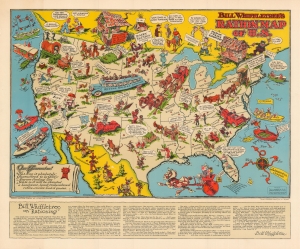
Bill Wiffletree's Ration Map of U.S.
sold
- Digital Map Information
- Suitable for large format printing
- File Size: 39.46 MB
- File Type: ZIP / TIFF
- ICC color profile embedded
- Delivered instantly via download link
A fine example of Edward McCandish's rarest map, his 1944 pictorial 'Bill Whiffletree' Ration Map of the United States. The map offers a humorous satirical perspective on the hotly contested and controversial government rationing program then in effect. Stylistically, the map is similar to McCandish's earlier Bootlegger's Map. As part of the World War II OPA Rationing Program, coupon books were issued for many common household goods including sugar, meat, cheese, fish and milk. Purchases of such items could only be completed with a corresponding coupon. For some, rationing was a patriotic duty, while others were frustrated by want. Some of the humorous commentary drives the conflict home: 'Pappy Don't Even Know What He's A-Layin' Fer - A German, A Revenooer, Er A Japanee'; 'On Exhibition Today Only The Last Idaho Potato'; and 'How About a Light, Pal? Matches is Rationed Over Here.' (more details)
Features a previously unknown pictorial map of New Haven by the artist behind the Bootlegger's Map of America.
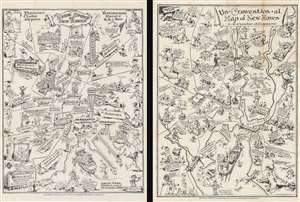
Un-Convention-al Map of New Haven. / High Spots of New Haven.
sold
- Digital Map Information
- Suitable for large format printing
- File Size: 49.02 MB
- File Type: ZIP / TIFF
- ICC color profile embedded
- Delivered instantly via download link
This is an extremely rare 1944 Edward McCandlish and New Haven Chamber of Commerce double-sided pictorial map of New Haven, Connecticut, featuring a an extremely-rare and essentially unknown work by the celebrated artist of the Bootlegger's Map of the United States. This piece is made up of two different pictorial maps of New Haven, one on the recto and one on the verso, each map illustrates sites around New Haven in black and white in McCandlish's signature style. Known for his Bootlegger's Map of the United States, McCandlish only produced three known pictorial maps during his career, the previously mentioned Bootlegger's Map, a Ration Map of the United States, and the Un-Convention-al Map of New Haven, offered here. The only record of the existence of the second map offered here (printed on the verso), High Spots of New Haven, that we have been able to identify is a reference in the Library of Congress Copyright Offices 'Catalog of Copyright Entries' from 1944. (more details)