
Parkinson, Thomas D. (sold)

Thomas D. Parkinson (April, 1835 - May 11, 1906) was an American civil engineer and businessman. Parkinson was born in Massachusetts. He worked as a civil engineer in San Francisco and Oakland in the 1860s and 1870s. He first appears in San Francisco directories as a Civil Engineer in 1865 and remains in subsequent directories until 1867. In 1871 he appears in Virginia City, Nevada. He is back in California in 1877, where he is named as a Civil Engineer in the Oakland Directory. In 1880, Parkinson was appointed Humboldt County Surveyor in Humboldt County, California. He became the manager of the Nevada Land and Cattle Company in 1888 and resigned in 1890 due to accusations of mismanagement and returned to the Bay Area. Several lawsuits, instigated by the investors in the Company and by Parkinson himself, dragged on through the U.S. court system for thirteen years, with one case being decided against Parkinson in 1903. In 1900 he is named in the Oakland Directory as a 'landholder.' He died in San Mateo in 1906.
Mining claims of the Comstock Lode.
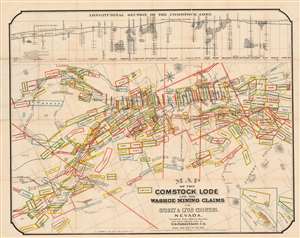
Map of the Comstock Lode and the Washoe Mining Claims in Storey and Lyon Counties, Nevada.
sold
- Digital Map Information
- Suitable for large format printing
- Full resolution TIFF file
- ICC color profile embedded
- Delivered instantly via download link
This is an 1875 T.D. Parkinson and Grafton Tyler Brown map of the Comstock Lode in Nevada. Boxes outlined in several different colors highlight individual mining claims from Silver City north to the North Virginia Townsite and Flowery Ridge. The Virginia and Truckee Railroad winds its way toward Virginia City and the Silver City Branch connects that railroad with Silver City. Streets are illustrated in Virginia City, although none are named. Numerous mills, mine shafts, toll houses, and other sites are identified, including the graveyard and county hospital. The Sutro Tunnel is prominently labeled to the right of center. A longitudinal view of the Comstock Lode appears above the map and illustrates where the silver strikes were located, the depth of many of the mine shafts, and the depth of the Sutro Tunnel. (more details)