
CartoCuriosity - Franklin's Lost Expedition
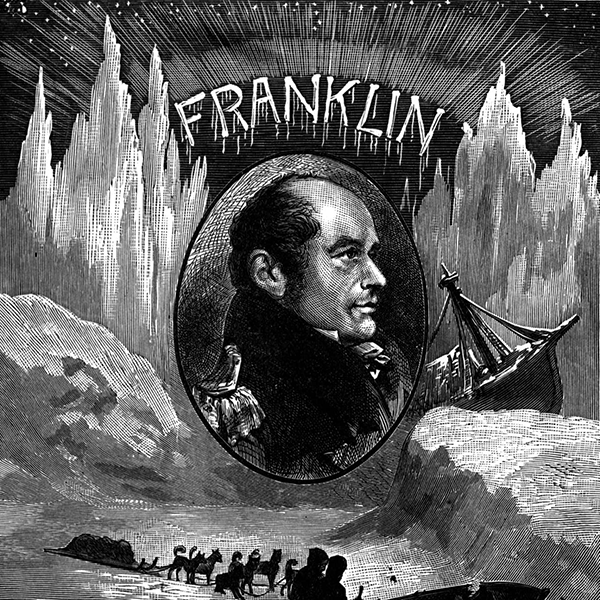
CartoCuriosity - Franklin's Lost Expedition
Franklin failed to complete the Northwest Passage, but the search for him helped map the Arctic world.
The fate of Sir John Franklin's lost expedition is one of the most enduring mysteries in Arctic exploration. In 1845, Franklin sailed from England aboard the HMS Erebus and HMS Terror in search of the elusive Northwest Passage, only to disappear in the Canadian Arctic with all 129 men. The massive international search that followed - led by explorers including John Rae and Francis Leopold McClintock - not only uncovered clues to Franklin's tragic fate but also produced some of the most important maps ever made of the Canadian Arctic. In this episode of CartoCuriosity, Spencer Hunt explores the remarkable story behind the Franklin Expedition, the maps it inspired, and how the search for one lost explorer forever changed the cartography of the Far North.
Featuring Spencer Hunt from Geographicus Rare Antique Maps
Produced by Cory Choy, Christian Cuciniello, and Ivan Bronson
Music by Luke Allen and El Buru. Sound by Silver Sound
2026-04-17
A Closer Look at the Maps
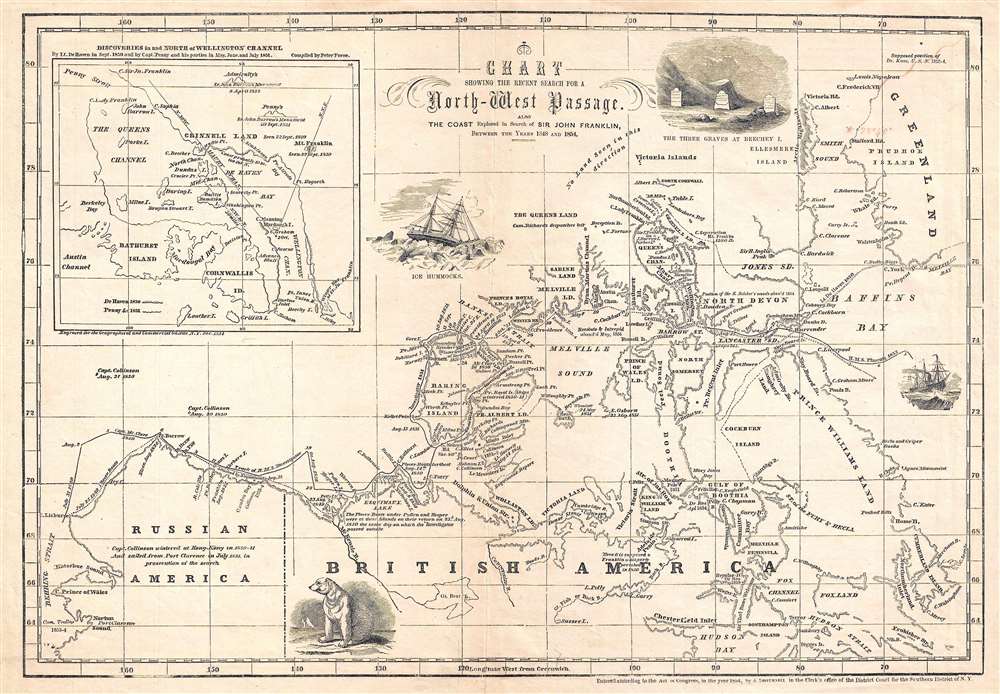
Depicting the many expeditions mounted in search of the Arctic explorer Captain Sir John Franklin.
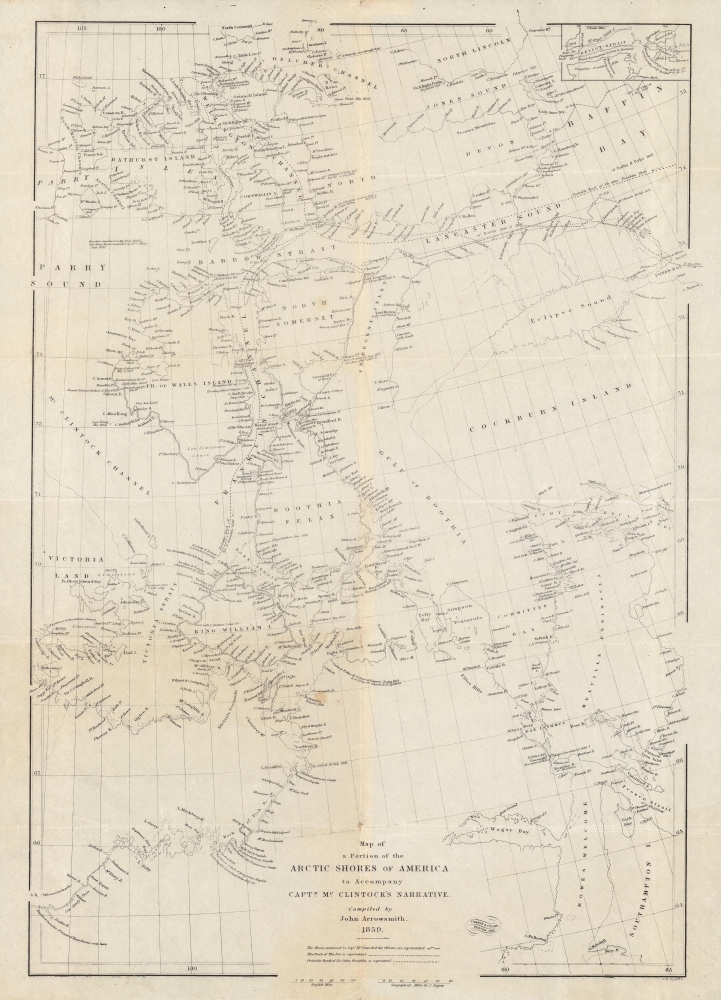
Map of a portion of the Arctic Shores of America to accompany Capt. McClintock's narrative.
The Search for the Northwest Passage
My name is Spencer Hunt, and I am still trying to find a title for what I do at Geographicus. Geographicus is a rare antique map dealer based in Brooklyn, New York. We buy and sell interesting historical documents, and each one tells a story. That is the best part: in the end, I am a storyteller.
This story begins with the exploration of the far North and the search for the fabled Northwest Passage. The idea was simple, at least in theory: a European trader could sail around the northern edge of North America and reach Asia without making the long and dangerous voyage around Cape Horn or the Cape of Good Hope.
The reason was commerce. Asia meant spices, silks, and other valuable goods. A successful voyage to China or the Spice Islands could bring enormous profits, but it could also take years. The longer a ship remained at sea, the greater the risk of disaster. A shorter route to Asia was therefore one of the great commercial dreams of early modern Europe.
Mapping a Dream
On maps, the Northwest Passage appeared in several speculative forms. One of the most famous was the so-called Sea of the West, an imagined inland sea in western North America supposedly connected by rivers to the Atlantic world.
The hope was that a ship might cross the continent by water without ever leaving the boat. When that idea proved false, attention shifted northward: perhaps the passage could be found around the top of the continent.
As explorers pushed into the Canadian Arctic, they encountered a maze of islands, channels, and ice. They gradually learned which lands were islands and which connected to the mainland. But the central problem remained the same: ships could become trapped in the Arctic ice.
Sir John Franklin
One of the men who joined this great Arctic effort was Sir John Franklin, a British Royal Navy officer and experienced explorer. Franklin had already taken part in three Arctic expeditions before embarking on the voyage now remembered as Franklin's Lost Expedition.
In May of 1845, Franklin left Britain with two ships, the HMS Erebus and the HMS Terror, and a crew of 129 men. Their goal was to traverse and map the last unnavigated portions of the Northwest Passage.
The expedition was last seen in July 1845, entering Baffin Bay. Then it vanished.
Lady Franklin and the First Searches
Two years passed with no word from Franklin or his crew. His wife, Lady Jane Franklin, began pressuring the British Admiralty to send search parties.
Franklin was famous. In the 19th century, explorers were public figures, and the fate of his expedition captured widespread attention.
The first major rescue effort began in the spring of 1848, three years after Franklin had departed. It was a three-pronged search: one expedition entered from the Atlantic side, another from the Pacific, and a third followed an overland route along the Mackenzie River toward the Arctic Ocean.
All three found nothing.
The Search Expands
In 1850, five years after Franklin's departure, another large search effort was launched. This time, 11 British ships and two American ships joined the search in the unknown regions of northern Canada.
At last, they found evidence. On Beechey Island, in the Canadian Arctic Archipelago, searchers discovered the graves of three members of Franklin's expedition.
It was the first confirmed trace that Franklin's men had passed through the region. But it did not explain what had happened to the rest of the expedition.
Another Admiralty expedition followed in 1852. It, too, found no decisive answer. By then, the search had become more than a rescue mission. Each expedition was also mapping and charting the Arctic, continuing Franklin's original mission even as hopes of finding survivors faded.
John Rae and Inuit Testimony
In 1854, a Hudson's Bay Company explorer named John Rae was traveling in northern Canada and speaking with Inuit communities. Through these conversations, he learned of dying white men encountered in the Arctic.
Rae also obtained relics from the expedition, including silverware and other items that could be traced to Franklin and his crew.
This Inuit testimony became crucial. It pointed toward the fate of the expedition and introduced disturbing reports of starvation and cannibalism. These claims shocked the British public and caused intense controversy.
After Rae's discoveries, the Admiralty finally declared Franklin and his men dead.
Lady Franklin Refuses to Give Up
Lady Jane Franklin did not accept the Admiralty's decision to abandon the search. She financed private expeditions of her own, including searches led by William Kennedy and Francis Leopold McClintock.
In 1857, she funded an expedition under Captain Francis Leopold McClintock. Two years later, in 1859, McClintock discovered important evidence on King William Island.
There, searchers found graves, relics, and, most importantly, written testimony. The note recorded that Franklin had died in 1847 and that the surviving men planned to abandon the ships and move south.
Franklin died, and the survivors began walking south.
In the end, the searchers found only fragments: graves, relics, silverware, and a written record of catastrophe.
The Ships Are Found
For generations, Franklin's ships remained lost. Then, in the 21st century, they were finally discovered.
In 2014, the HMS Erebus was found on the ocean floor. In 2016, the HMS Terror was discovered. Because they had rested in Arctic waters, both ships were remarkably well preserved.
Today, the northern coast of Canada is far more navigable than it was in Franklin's time. Due to climate change and the retreat of pack ice, ships can now travel routes that once trapped and destroyed wooden exploration vessels.
Franklin's Legacy
Franklin's story captures the age of exploration in all its ambition and tragedy. He had survived three Arctic expeditions and had no reason to believe his fourth would end differently.
Instead, he became trapped in the ice, lost both ships, and died in the Arctic.
Yet the expeditions sent to find him transformed European knowledge of the Canadian North. The search for Franklin mapped islands, channels, and coastlines in extraordinary detail.
In that sense, Franklin's mission was completed, though not by Franklin himself.
Franklin failed to complete the Northwest Passage, but the search for him helped map the Arctic world.
Featuring Spencer Hunt from Geographicus Rare Antique Maps.
Produced by Cory Choy, Christian Cucinello, and Ivan Bronson.
Music by Luke Allen and L. Budu. Sound by Silver Sound.