
CartoCuriosity - Fu Sang, 5th Century Chinese Colony in North America
CartoCuriosity - Fu Sang, 5th Century Chinese Colony in North America
Fact or Fiction? A Chinese Colony in North America 1000 years before Columbus.
In the 18th century, Europe became enamored of a startling idea - that ancient Chinese explorers had reached North America more than a 1000 years before Columbus. Drawn from Chinese administrative records, historical chronicles, and classical poetry, the legend of Fusang ignited debate across the European intellectual world. Whether the tale held a grain of truth or not, it resonated deeply with the era's philosophical and moral values, challenging prevailing notions of discovery, civilization, and the origins of the American continent and its indigenous peoples.
Kevin J. Brown, Cory Choy, Tom Fama, Christian Cuciniello
2025-02-13
A Closer Look at the Maps
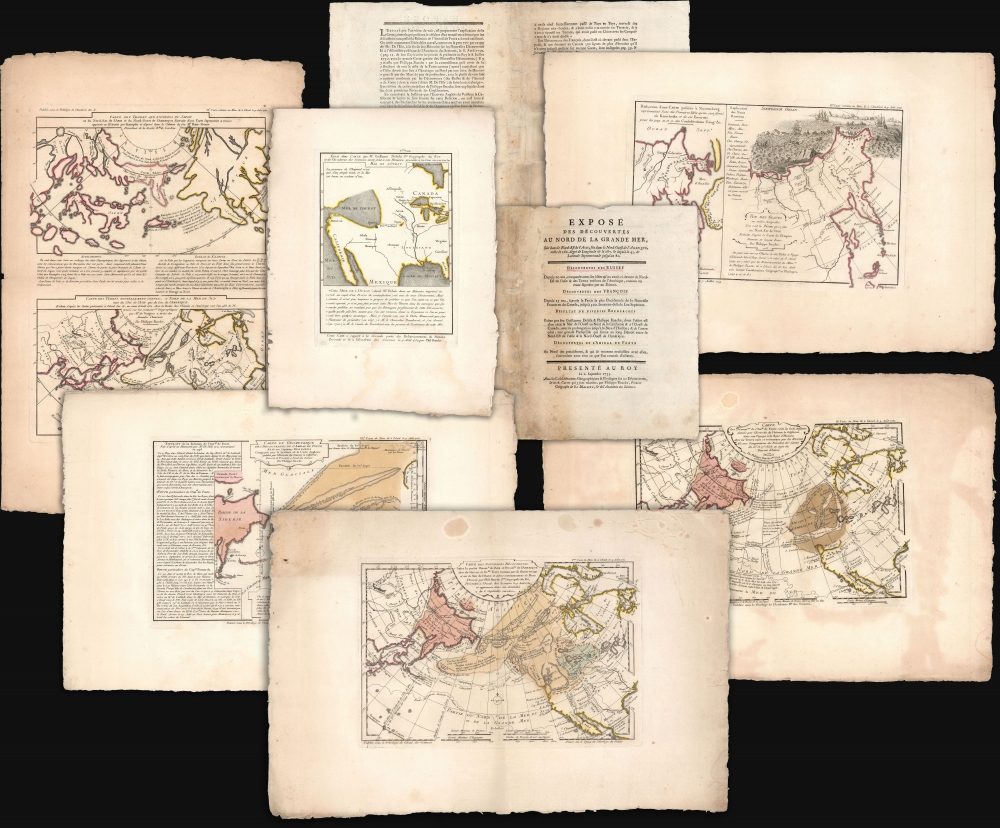
Thorough, early defense of the Sea of the West and the Northwest Passage.
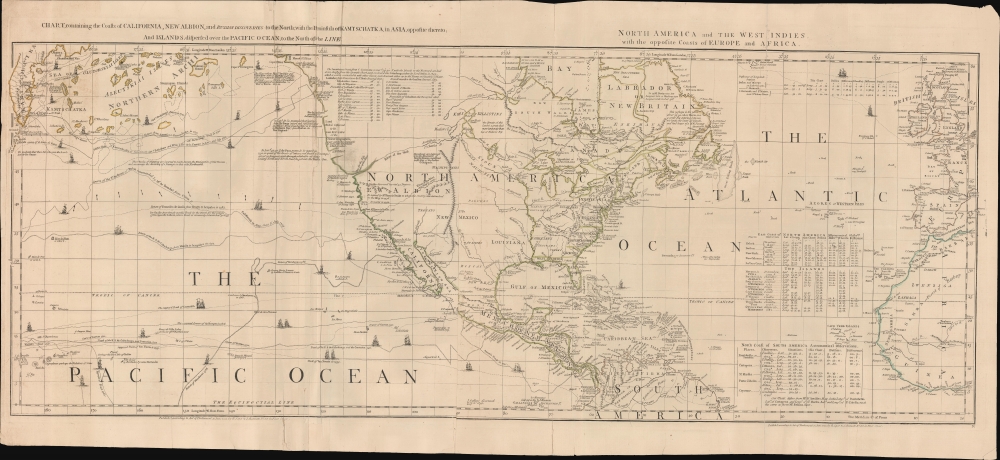
The sum of 18th century geographical knowledge about North America.
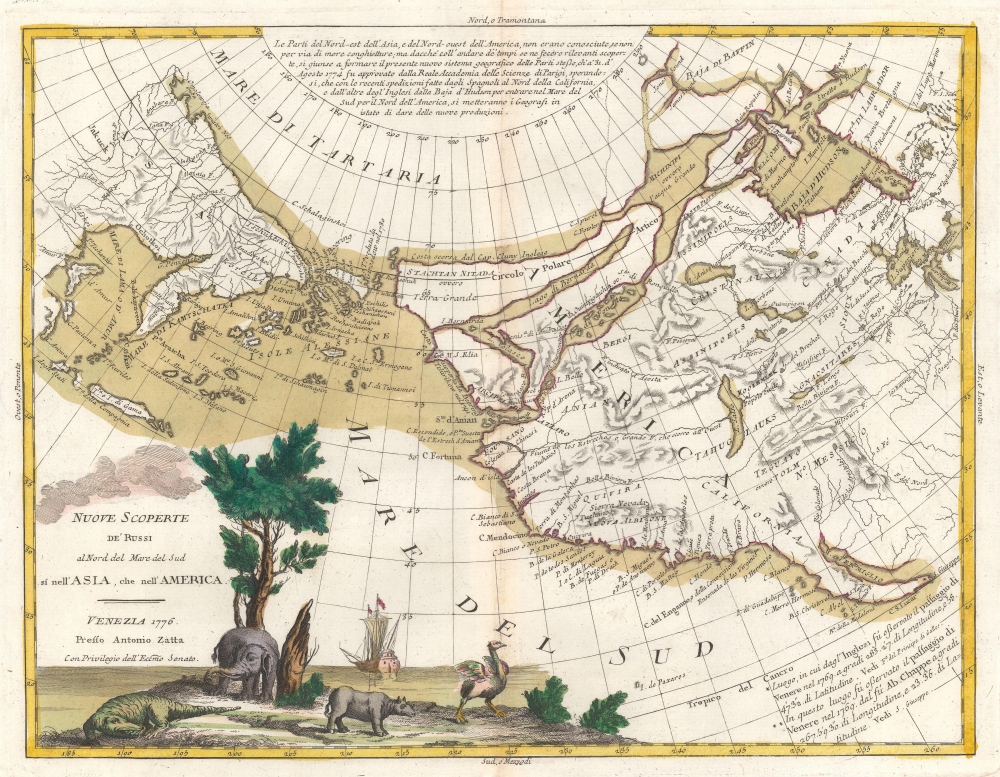
Nuove Scoperte De'Russi al Nord del Mare del Sud si nell'Asia, che nell'America.
Podcast Summary:
A story of lost geography, speculative cartography, and the imagined reach of ancient China
Imagine poring over an old map of a familiar place. You recognize the names, the coastlines, the landmarks— and then something stops you. A place you have never seen before. Something that doesn’t quite belong. What is it?
Historical cartography is filled with such anomalies—features that provoke curiosity and demand explanation. In this episode of CartoCuriosity, Kevin Brown of Geographicus Rare Antique Maps explores one of the most intriguing: Fusang, a supposed pre-Columbian Chinese land in the Pacific Northwest.
The Allure of the Unknown
When examining historical maps, the eye is naturally drawn first to what is known—familiar geography, established places. But it is the unknown that truly captivates. Sometimes it is a kingdom never heard of, a promontory that never existed, or an inland sea that appears briefly and then vanishes from the cartographic record.
Understanding these anomalies—why they appear and why they disappear—is one of the most fascinating aspects of studying maps.
“It’s what you don’t know on a map that is often the most exciting.”
Kevin Brown, owner of Geographicus Rare Antique Maps, specializes in antiquarian cartography spanning the 15th through mid-20th centuries. His work regularly brings him into contact with rare and sometimes perplexing representations of the world.
A Map That Raises Questions
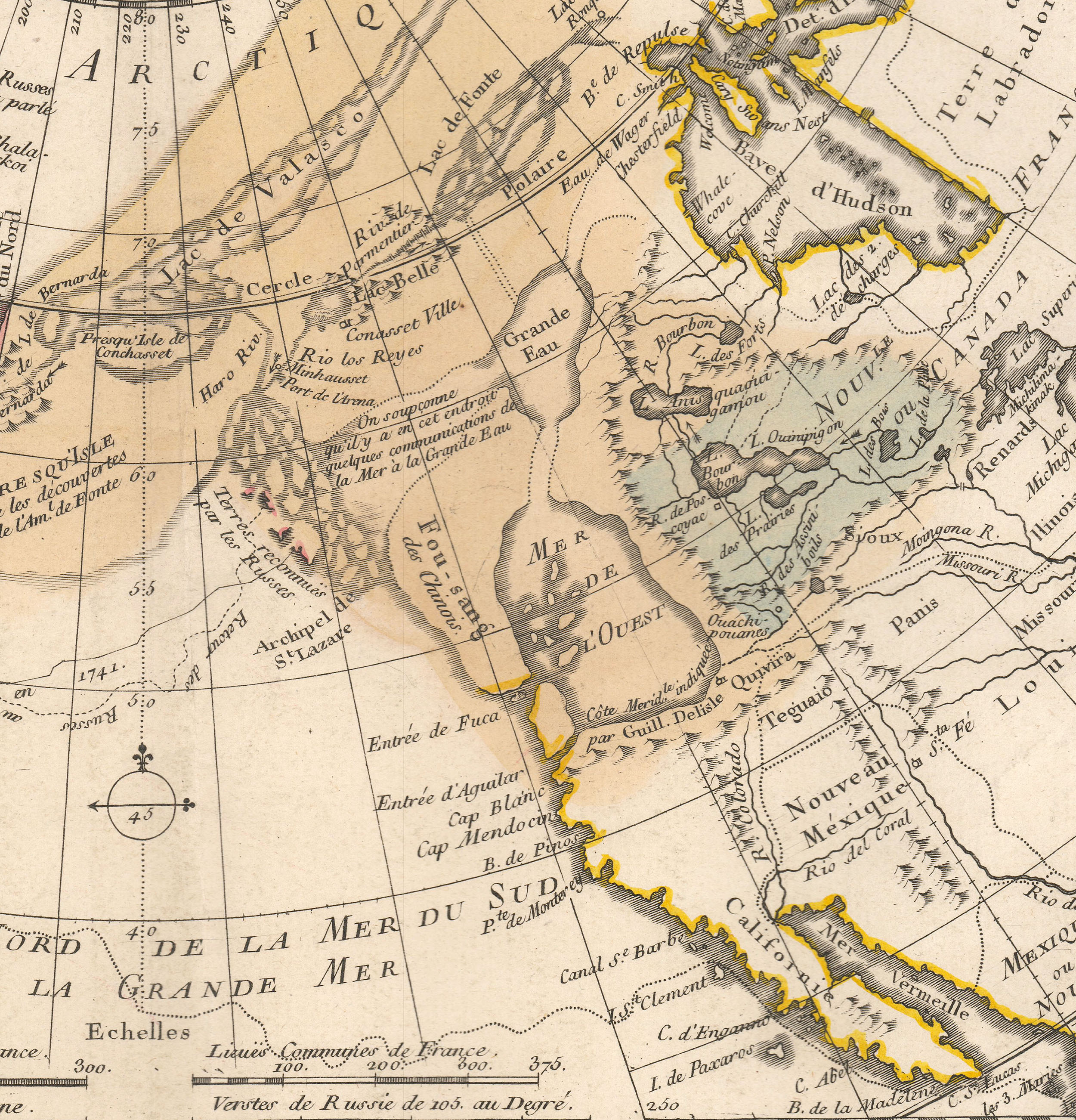
One such example is a 1753 map of the North Pacific by the French cartographer Philippe Buache, presented to the French Academy of Sciences.
Portions of the map are strikingly accurate. Asia is well rendered—Siberia, Kamchatka, the Kuril Islands, and even northern Japan are recognizable. Parts of North America, such as Hudson Bay and Baja California, are also familiar.
But moving north along the western coast, the geography becomes increasingly speculative. A vast inland sea occupies much of what is now the western United States and Canada. And beside it appears an unfamiliar label:
“Fusang des Chinois”
What Was Fusang?
Fusang was believed by some 18th-century scholars to represent a Chinese colony in the Americas, based on interpretations of ancient Chinese texts.
The idea gained traction in France following the work of orientalist Joseph de Guignes, who drew on a 5th-century account describing a Buddhist monk named Hui Shen. According to the narrative, Hui Shen traveled east across the Pacific and discovered a land called Fusang around 499 AD.
His description was remarkably detailed—covering climate, vegetation, governance, and daily life— and some scholars believed these descriptions aligned with indigenous cultures of Mexico.
Botanical Clues
One of the most intriguing aspects of Hui Shen’s account is his description of the “Fusang tree.” He describes a plant with edible shoots and red fruit that remains preserved throughout the year.
Some modern interpretations suggest this could resemble:
- Nopal (prickly pear cactus), widely used in Mexican cuisine
- Agave (maguey), a foundational plant in indigenous Mexican culture
Agave, in particular, aligns with several elements of the description—it produces fibers, food, drink (such as mezcal), and even building materials. Its tall flowering stalk also bears a resemblance to bamboo, another comparison made in the original text.
Why the Theory Took Hold
The Fusang hypothesis gained popularity in 18th-century France not necessarily because it was proven, but because it was useful.
European scholars at the time were grappling with fundamental questions:
- How were the Americas populated?
- How could advanced civilizations exist so far from the Biblical narrative?
- Could known civilizations explain unknown ones?
China, long regarded in Europe as a sophisticated and ancient civilization, offered a compelling answer. The idea that Chinese explorers had influenced or even colonized parts of the Americas was intellectually attractive.
The Decline of Fusang
Over time, the theory faced increasing scrutiny. Scholars such as Heinrich Julius Klaproth produced detailed critiques, dismantling the linguistic and historical arguments supporting Fusang.
At the same time, real-world exploration of the Pacific Northwest replaced speculation with observed geography. As maps became more accurate, Fusang quietly disappeared.
On Western maps, it existed for only a few decades.
Did Fusang Exist?
The question remains open to interpretation.
There is ongoing debate about whether there may have been early trans-Pacific contact. While such contact is plausible, evidence of sustained cultural influence remains inconclusive.
“The more interesting question is not whether China discovered America before Columbus, but why the idea of Fusang was so compelling to European thinkers.”
Ultimately, Fusang tells us less about ancient China and more about 18th-century Europe— its intellectual ambitions, its assumptions, and its need to explain the unknown.
Featuring Kevin J. Brown, Geographicus Rare Antique Maps.
Produced by Cory Choy, Christian Cucinello, and Tom Fama.
Music by Luke Allen and L. Budu. Sound by Silver Sound.