
CartoCuriosity - The Zendian Problem
CartoCuriosity - The Zendian Problem
Invading Cuba, cartography, game design, and military intelligence.
What if one of the most remarkable fantasy maps ever created wasn’t designed for a novel or a game, but for the CIA? In this episode of CartoCuriosity, Kevin Brown of Geographicus Rare Antique Maps uncovers the extraordinary story of The Zendian Problem, a top-secret Cold War cryptography training exercise created by eccentric American cryptologist Lambros D. Callimahos. Blending fantasy cartography, military intelligence, codebreaking, espionage, and geopolitical strategy, the fictional Kingdom of Zendia became an immersive world where intelligence officers learned to analyze maps, decipher encrypted communications, and anticipate military operations. Through a rare surviving set of Zendian maps, this episode explores the surprising intersection of cartographic history, cryptology, Cold War history, and one of the most unusual intelligence training programs ever devised.
Featuring Kevin J. Brown of Geographicus Rare Antique Maps
Produced by Cory Choy and Christian Cuciniello.
Music by Luke Allen and El Buru. Sound by Silver Sound
2026-01-09
A Closer Look at the Maps
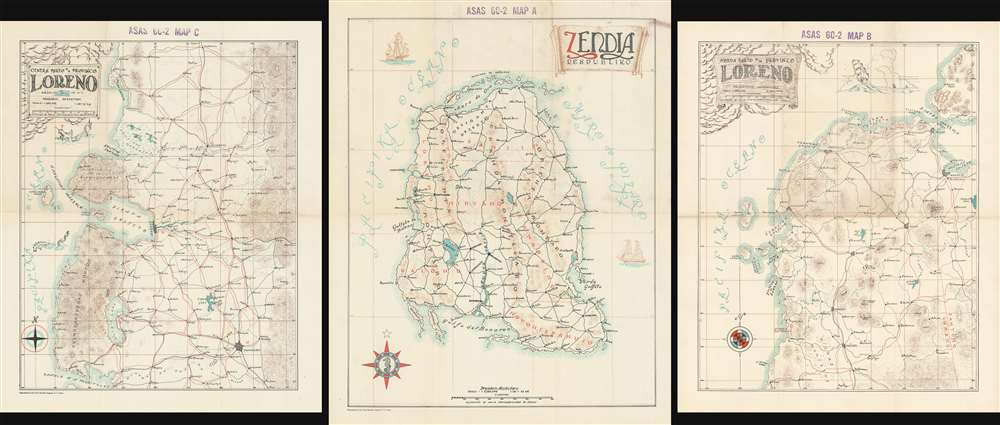
Eccentric genius cryptanalyst L. D. Callimahos' pedagogical puzzle, 'The Zendian Problem,' representing a 'Top Secret' proxy war game anticipating the invasion of Cuba.
Fantasy cartography meets Cold War intelligence
In this episode of CartoCuriosity, Kevin Brown of Geographicus Rare Antique Maps recounts the discovery of a strange set of maps tied to a little-known, classified chapter of American Cold War history.
An Unexpected Discovery
As a dealer in antiquarian maps, much of the work involves constant searching— auction sites, obscure listings, and overlooked collections.
While exploring an interest in late 20th-century fantasy maps—those included with video games in the 1990s and early 2000s— Kevin encountered something unusual: a group of maps labeled Zendia.
The name meant nothing. But the maps were intriguing—and affordable—so he took a chance and purchased them.
For nearly a year, they sat unexamined. Then came the obvious question:
What is Zendia?
Enter Callimahos
The answer begins in 1941, during the height of World War II, with a man named Lambros Demetrius Callimahos.
Callimahos was no ordinary recruit. Born in Alexandria to Greek parents and raised in the United States, he was a polymath—trained in law at Rutgers and music at Juilliard.
He was also eccentric. Famously so.
When he presented himself to a U.S. Army recruiting office in Washington, D.C., he arrived dressed like a theatrical villain: top hat, cape, curled mustache.
And he declared that he was there to solve America’s intelligence problems.
Remarkably, they listened.
A Master of Cryptology
Callimahos was a brilliant cryptologist—deeply engaged in the study of codes and codebreaking.
During World War II and into the Cold War, cryptology became one of the most critical and intellectually demanding fields in military intelligence.
Unlike physical sciences, cryptology is bounded only by imagination— an abstract discipline of limitless complexity.
Callimahos thrived in it.
Eventually, he was tasked with training elite intelligence personnel, teaching small groups of carefully selected students.
The Zendian Problem
At the center of his teaching method was a remarkable creation: The Zendian Problem.
Zendia was a fictional kingdom, constructed in extraordinary detail.
- A fully realized geography
- Political structures and leadership
- A tyrannical ruler—modeled, perhaps, on Callimahos himself
- A network of roads, cities, and strategic locations
Callimahos even encouraged students to refer to him as “Caudillo”—“Great Leader.”
Students were given:
- A set of Zendian maps
- Intercepted coded messages
- A fixed time period to analyze and respond
Their task was to:
- Break the codes
- Interpret troop movements
- Develop intelligence assessments
- Recommend strategic responses
It was a fully immersive simulation—part game, part training exercise.
The Maps of Zendia
The surviving Zendian materials include three maps:
- A primary map of the Kingdom of Zendia—an acorn-shaped island
- Two regional maps with increasing detail
These maps feature:
- Mountains, rivers, and lakes
- Strategic road networks
- Named regions like the “Bloody Gulf” and pirate-controlled bays
Though fictional, the geography feels deliberate—and possibly inspired by real-world locations.
A Cold War Shadow
Some evidence suggests that Zendia may have been loosely modeled on the Isle of Pines (modern Isla de la Juventud) south of Cuba.
During the Cold War, the United States considered using this island as a base for a Cuban government-in-exile—an alternative to Castro’s regime.
That plan was never realized. Instead, tensions escalated toward events such as the Bay of Pigs.
Whether Zendia directly reflects these geopolitical ideas remains speculative, but the parallels are striking.
A Secret Legacy
The Zendian Problem was classified. It was never intended for public consumption.
What survives today comes from:
- Former students’ recollections
- Declassified documents
- A handful of surviving maps
One example of the main Zendian map is reportedly displayed at CIA headquarters in Langley.
Complete sets are extraordinarily rare.
The set discovered by Geographicus was ultimately acquired by Texas A&M University, making it the only known complete set in an institutional collection.
Fantasy with a Purpose
The Zendian Problem represents a fascinating intersection of:
- Cartography
- Game design
- Psychology
- Military intelligence
It is, in essence, a fictional world built not for entertainment, but for training minds to operate in uncertainty.
A map that was never meant to be believed—only to be solved.
Featuring Kevin J. Brown, Geographicus Rare Antique Maps.
Produced by Cory Choy and Christian Cucinello.
Music by L. Budu and Luke Allen. Sound by Silver Sound.