
1968 Office of Documents and Studies City Plan or Map of Abu Dhabi, w/ Book

This item has been sold.
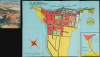
مَدِينَةُ أَبُو ظَبِي الحَدِيثَة [Modern Abu Dhabi City]. / عَامَانِ زَاهِيَان فِي تَارِيخِ إِمَارَةِ أَبُو ظَبِي [Two Glorious Years in the History of the Emirate of Abu Dhabi].
Abu Dhabi on the Cusp of Independence and Modernization.
Choose a Collection:
This Item
Enquire
Abu Dhabi on the Cusp of Independence and Modernization.
This is a rare 1968 folding map of Abu Dhabi, appearing in the scarce Arabic edition of the Two Glorious Years in the History of the Emirate of Abu Dhabi. The map and book were published in a period of rapid transformation for the emirate, which was preparing for independence and implementing the early phase of a radical modern urban plan.A Closer Look
The map, oriented with northwest at top, covers the main urban area of Abu Dhabi (noticeably referring to it as 'Modern Abu Dhabi City' مَدِينَةُ أَبُو ظَبِي الحَدِيثَة) and recording the 'Arabian Gulf' (الخَلِيج العَرَبِي) rather than the Persian Gulf at top. It notes green spaces, the waterfront Corniche (كُورْنِيش), palaces (including the centrally-located Al Manhal Palace), hospitals, and hotels. Great attention is paid to infrastructure and economic initiatives, such as power stations, water reservoirs, and special industrial zones. Planned but unbuilt future roads are marked with dashed lines. The inset at bottom-right covers much of the emirate, including areas beyond the existing city, also indicating planned future land reclamation and development up to an existing seawall (الحائط البحري).It is difficult to exaggerate the pace of urban development in the years since this map's publication. To take just one example, Al Bateen, described here as a 'village' (قرية البطين) is now completely developed, home to ultra-modern, luxurious high-rise hotels and apartments. Indeed, today the entire area covered by the main map and the inset map has become home to dense urban development, as the city's population has grown from some 50,000 at the time of publication to nearly 4,000,000 today (most of whom are expatriates).
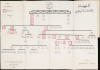
Aside from the map, the book also contains a genealogy of the ruling Al Nahyan (آل نَهْيَان) family of Abu Dhabi dating back to the founder of the House of Nahyan, Isa (Dhiyab bin Isa Al Nahyan) in the late 18th century. Within the family tree, the names of the emirate's rulers are outlined in red with their reign dates and their order in the succession, culminating with Sheikh Zayed bin Sultan Al Nahyan (or simply, Zayed زايد), the 14th ruler of Abu Dhabi.
Abu Dhabi on the Eve of Independence and the Formation of the U.A.E.
In the mid-twentieth century, Abu Dhabi was one of several Trucial States (also known as Trucial Oman) along the Persian Gulf coast under British protection, a status that dated back to the early nineteenth century when Britain sought to secure maritime routes to India (technically, the states were part of the East India Company's Persian Gulf Residency and then the Raj, with the Indian rupee being the de facto currency among the territories). The discovery of oil in 1959 transformed Abu Dhabi from a poor pearling and trading society into a state of growing economic and political significance, a development aided by the ascendency of Sheikh Zayed to the rulership of Abu Dhabi in 1966. In 1968, Britain suddenly announced its intention to withdraw from 'east of Suez' by 1971, allowing for the independence of the Trucial States but also relinquishing any obligations for protection. Sheikh Zayed took the lead in organizing a new political framework to ensure stability after the end of British oversight, negotiating the formation of a federation that would balance local autonomy with collective security and development. These efforts culminated in the creation of the United Arab Emirates on December 2, 1971, one day after formal independence from Britain. Abu Dhabi, the largest and wealthiest emirate, became the capital of the new federation, and Sheikh Zayed was chosen as its first president.This transformational period was also notable for the development of an ambitious urban plan for the city. In 1967, Sheikh Zayed commissioned the Japanese urban planner Dr. Takahashi Katsuhiko (高橋克彦, 1937 - 2017) to design the primary master plan for the capital. Takahashi engaged in daily consultations with Sheikh Zayed to map out the emerging city. Forsaking more restrictive European garden-city proposals, Takahashi drew on concepts from Japanese Metabolism, which envisioned cities as living, expanding organisms, to translate Sheikh Zayed's vision into an expansive orthogonal grid system defined by wide avenues, structured public parks, and the iconic coastal Corniche. This plan established flexible main traffic corridors and repeatable superblocks designed to accommodate expected future population growth. Takahashi's blueprint was later built upon and refined by Egyptian architect Dr. Abdulrahman Makhlouf (1924 - 2021 ; عبد الرحمن حسنين مخلوف), laying the structural backbone of contemporary downtown Abu Dhabi and laying the groundwork for the city's emergence as a regional and global hub.
Publication History and Census
This map was produced by Abu Dhabi's Documents and Research Department (مكتب الوثائق و الدراسات), using maps from the municipal Town Planning Section, and was published in the 1968 book Two Glorious Years in the History of the Emirate of Abu Dhabi (عامان زاهيان في تاريخ إمارة أبو ظبي). This account was prepared by the Ruler's Office and released on August 6, marking the second anniversary of Sheikh Zayed's accession as Ruler of Abu Dhabi. The publication reviews the achievements of the 1966-68 period, while also presenting Sheikh Zayed's ambitious goals for education, infrastructure, public health, housing, communications and other aspects of life, comprising a section on the 1967-1972 five-year plan. It contains dozens of contemporary black and white photo illustrations showing all aspects of life in the Emirate, including Sheikh Zayed's official meetings and engagements, agriculture, utilities and infrastructure, oil industry, travel, traditional life, construction and more, featuring statistics on the Emirate's economy, industry, agriculture and population.Although the English-language edition of this book (titled Two Glorious Years in the History of the Emirate of Abu Dhabi) is somewhat well-distributed in institutional collections, this rare Arabic edition is only held by the U.A.E.'s Department of Culture and Tourism, the University of Balamand, the American University of Beirut, the Mohammed Bin Rashid Library, and the United Arab Emirates University.
Condition
Very good, with light wear along fold lines. Book is in very good condition, with some general shelfwear, final three leaves loose. 4to. (24.5 x 17 cm)
References
OCLC 784454823, 1158760401.