
1962 Hakim / Dar al-Qalam Arabic Wall Map of the Arab World

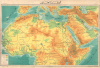
الوطن العربي / [The Arab World].
Beginning of the End of Pan-Arabism
Beginning of the End of Pan-Arabism
This is a scarce 1962 Arabic-language wall map of the Arab World and environs, prepared by Dr. Muhammad Sobhi Abdel Hakim and colleagues and published by Dar al-Qalam in Cairo. The map was prepared at the height of the pan-Arab movement that emerged after World War II (1939 - 1945), shaped by the dynamics of Decolonization and the early Cold War (1947 - 1991).A Closer Look
This map employs a Lambert Conformal Conic Projection that covers from southern Europe to central Africa (Kenya, the Congo) and from the Atlantic Ocean in the west to Persia in the east. A red line outlines the Arab world, encompassing all of North Africa, including Mauritania and Sudan, as well as Arabia, Iraq, and the Levant. Color-shading is used to indicate elevation both above and below sea level, making this primarily a physical map, though with political borders, capital cities, rail lines, and oil pipelines indicated. The elevations of some of the tallest mountains in the region are noted. Egypt is labeled as the United Arab Republic (الجمهورية العربية المتحدة), while Syria (سوريا) is not, reflecting its secession from the polity after the September 1961 coup d'etat. The map is likewise up-to-date on the evolving and complex divisions of southern Arabia, split at this time between the Aden Protectorate, North Yemen, and the Protectorate of South Arabia, although the use of 'Yemen' (اليمن) for North Yemen makes it unclear if this was produced before or after the September 1962 coup that overthrew the monarchy and established a republic in the pan-Arab style.Pan-Arabism
In the 1960s, Pan-Arabism reached its height as a political and cultural movement aimed at uniting the Arab world under shared language, history, and identity, with Egypt's Gamal Abdel Nasser (1918 - 1970) as its most prominent champion. Nasser promoted Arab socialism, independence from Western influence, and solidarity with the Palestinian cause, gaining immense popularity through measures such as the nationalization of the Suez Canal (1956). His rhetoric was broadcast widely throughout the region via the 'Voice of the Arabs' radio station. The short-lived United Arab Republic (1958 - 1961), a union between Egypt and Syria, symbolized both the appeal and difficulties of Arab unity.Pan-Arabism also inspired intervention abroad, such as Egypt's role in the North Yemen Civil War (1962 - 1970), and helped bring about the creation of the Palestine Liberation Organization (1964) under Arab League sponsorship. However, the decisive Six-Day War (1967), in which Israel dealt a crushing defeat to Egypt, Syria, and Jordan and seized additional territory, including East Jerusalem, shattered much of the credibility of Pan-Arabism, exposing its limitations and undermining confidence in Nasser's vision. Although Nasser remained an iconic leader until his death in 1970, the war cemented Pan-Arabism's decline as many Arab states shifted toward narrower state-based nationalism, and also opened the door for the emergence of Islamism as an alternative ideology.
Publication History and Census
This map was prepared by Dr. Muhammad Sobhi Abdel Hakim (دكتور محمد صبحي عبد الحكيم), with colleagues Yusuf Khalil (يوسف خليل), Halim Jirish (حليم جريش), and Abdel Aal Rashdan (عبد العال رشدان). It was printed by the short-lived (c. 1960 - 1964) and curiously named NATO Press, and was published by Dar al-Qalam (دار القلم , House of the Pen) in Cairo in 1962. It is labeled at top-left as 'Arab World No. 1' and at top-right as 'First Group,' suggesting that it was the first in a series of maps, though it is unclear if other maps in this series were indeed produced, and catalog records of Dar al-Qalam's output in the following years suggest not. The present map is noted in the OCLC among the holdings of Harvard University, the University of Utah, Yale University, and the Qatar National Library.Cartographer
Dr. Muhammad Sobhi Abdel Hakim (June 4, 1928 - March 3, 2009; دكتور محمد صبحي عبد الحكيم) was an Egyptian geographer, academic administrator, and politician. He was born in the Shubra District of Cairo and studied geography at the University of Cairo, earning a Bachelors (1949), Masters (1953), and PhD (1959) there. He then went on to teach at the same university, rising to the position of Head of the Geography Department in 1971, then the Dean of the Faculty of Arts, and eventually Vice President of the university. Hakim then took on several government positions and from 1980 to 1985 served as the Speaker of the Shura Council, the upper chamber of Egypt's legislature at the time. He published more than a dozen books and many articles over the course of his career, was a leading figure among geographers in the Arab world, and was highly decorated by the Egyptian state for his public service. Further Details...
Condition
Good. Laid down on archival tissue. A few margin repairs and points of soiling. Closed tear, stabilized, from left margin above legend.
References
OCLC 811345752.