
1913 Waterlow Republic of China Bond, Reorganization Gold Loan

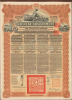


The Chinese Government Five Per Cent. Reorganisation Gold Loan of 1913 for L25,000,000 Sterling.
Foreign Funds and Yuan Shikai's Power Grab
- Digital Map Information
- Suitable for large format printing
- Full resolution TIFF file
- ICC color profile embedded
- Delivered instantly via download link
Foreign Funds and Yuan Shikai's Power Grab
This is a 1913 government £20 bond printed by Waterlow and Sons and issued by the new Republic of China to finance the Chinese Reorganization Gold Loan of 1913. It is a relic of an oft-forgotten period of the early Chinese republic, defined by dynamism and optimism but saddled with a host of problems which it struggled to overcome.A Closer Look
The bond includes text in four languages - English, French, German, and Russian - though not Chinese or Japanese, despite Japan being party to the loan. Changes are made in the text to account for differences in currency exchange rates between pounds sterling, francs, marks, rubles, and yen. The central vignette at top depicts Mercury (god of financial gain and commerce) holding his staff (caduceus) overlooking scenes combining agriculture, industry, and commerce. A smaller vignette at left shows Chinese rice farmers before a pagoda while that at right portrays a pavilion and temple. At bottom is a large seal of the Beiyang Government (Republic of China) along with the signature of the Minister of Finance (practically illegible, but likely Xiong Xilin 熊希齡 or perhaps his predecessor Zhou Xuexi 周學熙) and the Chinese Minister in St. Petersburg (Liu Jingren 劉鏡人). Following the main bond sheet, the subsequent three sheets include information on the conditions of the bond, amortization tables (in four currencies), and a leaf of detachable coupons (again with an image of Mercury).The Chinese Reorganization Gold Loan of 1913
This bond was issued as part of the Chinese Reorganization Gold Loan of 1913. This agreement was signed between President Yuan Shikai (without parliamentary approval) and a five-nation banking consortium known as the 'China Consortium' to pay debt accrued under the Qing, fund the new republic's administration, and stabilize the government. The United States was initially part of the scheme (an earlier China Consortium of the late Qing period) along with Britain, Germany, and France, but withdrew by 1913, being replaced by Russia and Japan. The loan was meant to be secured by the revenues of the Salt Administration of China. In reality, these had already been allocated elsewhere (secured against an earlier foreign loan), and nominally backed up by the revenues of the well-run but likewise already overburdened Maritime Customs Service. In other words, even aside from Yuan's skullduggery, the entire enterprise was on shaky financial grounds from the start. The loan defaulted in 1939 and was never repaid, as by that time China was at war with Japan and Europe at war with Hitler. The money itself was not properly accounted for, and much of it was likely appropriated by Yuan to pay for the expansion and modernization of his Beiyang Army, that is, to strengthen his own authority.Wider Historical Context
The Republic of China emerged from the Xinhai Revolution, which broke out in October 1911 and brought a dramatic end to more than two millennia of imperial rule. Although Sun Yat-sen was inaugurated as the republic's provisional president in January 1912, the revolutionary government lacked both military power and financial stability, largely due to the overwhelming debts incurred by the Qing Dynasty (some of which resulted from indemnities owed to foreign governments). To prevent civil war and secure the abdication of the last Qing emperor, Sun yielded the presidency to Yuan Shikai, a Qing military commander who controlled the formidable Beiyang Army. Yuan assumed office in March 1912, but his autocratic style quickly clashed with the democratic ideals of the newly formed Kuomintang (KMT). Tensions erupted in March 1913 following the assassination of KMT leader Song Jiaoren, a plot widely attributed to Yuan, just after the KMT had won China's first parliamentary elections.Desperate for capital, primarily to pay and maintain the loyalty of his troops without relying on a hostile parliament, Yuan looked to foreign powers for financial salvation. In April 1913, bypassing the National Assembly (國會) entirely, Yuan signed the contentious £25 million Reorganization Loan with the Five-Power Banking Consortium. This move was highly contentious, both because Yuan circumvented the assembly and because the loan's repayment terms were overly favorable to foreign creditors. In the end, the loan gave Yuan the financial independence needed to crush his domestic opponents. When KMT loyalists launched the failed 'Second Revolution' in mid-1913 to stop his expansion of power, Yuan's troops easily suppressed the rebellion. By the end of 1913, Yuan had outlawed the KMT, dissolved the parliament, and effectively transformed the young republic into a personal dictatorship. However, it ultimately disintegrated rather than reconstituting a strong central government, plunging China into the 'Warlord Era.' To be fair, Yuan's image as a traitor and tyrant was largely shaped by his enemies in the KMT who later gained power, and their Communist successors; the most recent and well-researched biography of him in English is more forgiving (Patrick Fulian Shan, Yuan Shikai: A Reappraisal, University of British Columbia Press 2018).
Publication History and Census
This bond sheet was printed by Waterlow and Sons in London on behalf of the Republic of China. British and Belgian stamps near the title and vignettes at top give some sense of its provenance. The bonds were issued in amounts of £20 and £100 in several color schemes; these do not correspond to the amounts of the bonds and may reflect when they were printed in a series (serial number). Regardless of color scheme or amount, we do not locate any institutional examples of similar bond sheets.Cartographer
Waterlow and Sons (1810 - 1961) was a British engraving and printing concern active in London specializing in currency, postage stamps, bond certificates, and occasionally maps. The firm was founded by James Waterlow (1790 - 1876) in 1810 on Birchin Lane, London, as a legal document printer and copyist. By 1852, they had expanded into stamps and his sons, Albert, Alfred, Sydney, and Walter joined the business. One year after James Waterlow's death, in 1877, infighting among the sons led Alfred Waterlow to split off, forming Waterlow Brothers and Layton. The rift was settled by 1920, and the two firms once again merged under the Waterlow and Sons imprint. They were involved in the Portuguese Bank Note Affair of 1925, wherein the Portuguese fraudster Artur Virgílio Alves Reis convinced the firm to print 200,000 banknotes of 500 Portuguese Escudos each, amounting to roughly 88% of Portugal's GDP. The affair was settled in court with a ruling against Waterlow. In 1928, Waterlow lost its most lucrative contract, printing English banknotes, and began to fall into decline. In 1961, they were acquired by Purnell and Sons who, shortly afterwards, sold the firm to De La Rue. Ironically, De La Rue acquired the contract to print Bank of England banknotes again in 2003 – 75 years after Waterlow lost it! Further Details...
Condition
Very good. A bit of tape on back. a few coupons missing from back - see image.