
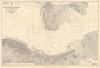
1960 / 1966 Admiralty Chart of Hong Kong Harbor


This item has been sold.
China South East Coast, Hong Kong Harbour.
The Heart of Hong Kong.
The Heart of Hong Kong.
A splendid nautical map of Victoria Harbour in Hong Kong, produced by the British Admiralty's Hydrographic Office in 1966. It provides a detailed picture of the harbor, the heart of Hong Kong, and the lands to either side.A Closer Look
Compared to similar Admiralty charts of Hong Kong (such as 'Hong Kong Waters East' and 'Hong Kong Waters West,' also sold by us), the present chart focuses squarely on Victoria Harbor, that is, the waters between the tip of the Kowloon Peninsula (Tsim Sha Tsui) and the most developed part of Hong Kong Island (then known as Victoria, now the neighborhoods of Central and Wan Chai). The reduced scale employed here allows a fantastic level of detail, down to individual buildings, including schools, government offices, hospitals, barracks, diplomatic missions, houses of worship, markets, warehouses, and more. The basic layout of the city is easily recognizable and some areas retained particular functions even after undergoing major changes, such as the dedication of the area around Morrison Hill to sporting facilities. Land reclamation and the leveling of hills has resulted in notable changes in the coastline and topography of the city. In particular, the shallow waters shaded blue here have been filled in to free up space in the densely-packed city.A wealth of nautical information is indicated, including soundings, compasses with magnetic variations, anchorages, lights, hazards, shoals, buoys, and more. Handwritten annotations within the compass at left were likely added in the months after the chart's printing in 1966. Nearby, a printed annotation notes the location of an ocean terminal built near Kowloon Railway Station. The adjoining passenger and ferry piers, dedicated to the iconic Star Ferry, were at the time the only means of mass transit between Kowloon and Hong Kong Island. The chart's assiduous attention to detail was warranted. At the time, the harbor teemed with ships of various types, sizes, and ages, engaged in transportation, trade, fishing, and leisure activities.
Publication History and Census
This chart was initially published by the Admiralty in 1916 and updated regularly thereafter, with new editions appearing to 1949, major corrections to 1960, and minor corrections to 1966. The 1960 printing of the chart is only known to be held by the National Maritime Museum (U.K.), while the University of Chicago holds an example dated to 1958 (OCLC 904771444).Cartographer
The British Admiralty Office (1795 - Present), or the United Kingdom Hydrographic Office, is the Branch of the English government responsible for commanding the British Navy. In 1795, King George III created the United Kingdom Hydrographic Office, known as the U.K.H.O., to provide high-quality nautical charts for the Royal Navy. Before the Admiralty's founding, surveying and creating nautical charts was primarily a commercial venture, and the cartographer himself often financed the printing of his own material. Even the great navigator Cook is known to have scrambled for funds to publish his own seminal charts - the most important and advanced of the period. The system of privately funded nautical mapping and publishing left vast portions of the world uncharted and many excellent charts unpublished. King George III, responding to significant losses in trade revenue from shipwrecks and delays caused by poor charts, recognized the need for an institutionalized, government-sponsored cartographic agency: the Admiralty. The first head of the Admiralty, a position known as Hydrographer, was the important cartographer Alexander Dalrymple. Dalrymple began by organizing and cataloging available charts before starting the laborious process of updating them and filling in the blanks. The first official Admiralty Chart appeared in 1800 and detailed Quiberon Bay in Brittany. By 1808, Captain Thomas Hurd became Hydrographer. Hurd advocated selling Admiralty charts to the general public and, by the time he retired in 1829, had issued and published about 736 charts. Stewardship then passed to Rear Admiral Sir Francis Beaufort. Under Beaufort's administration, the Admiralty truly developed as a "chart-making" rather than a "chart-cataloging" institution. Beaufort held his post from 1829 to 1854. In his 25 years at the Admiralty, Beaufort created nearly 1,500 new charts and sponsored countless surveying and scientific expeditions, including the 1831 to 1836 voyage of the H.M.S. Beagle. By 1855, the Admiralty's chart catalog listed some 1,981 charts. Further Details...
Condition
Excellent.
References
OCLC 538236121.