
1940 Shōnen Club Broadside of Japanese Imperial Navy and Army Assets

This item has been sold.
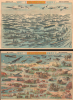
帝國軍艦大畫報 / 帝國陸軍兵器大畫報 / [Imperial Warship Pictorial / Imperial Army Weapons Pictorial].
Japanese Military Hardware on the Eve of the Pacific War.
- Digital Map Information
- Suitable for large format printing
- Full resolution TIFF file
- ICC color profile embedded
- Delivered instantly via download link
Japanese Military Hardware on the Eve of the Pacific War.
This is a striking 1940 Shōnen Club double-sided sheet depicting Japanese military hardware during the Second-Sino Japanese War (1937 - 1945) and on the eve of the Pacific War (1941 - 1945), part of World War II. It reflects the degree to which militarism had become quotidian in Japan, on a total mobilization footing since 1938 due to its full-scale war in China. More subtly, it also represents the deep rivalry between the Imperial Japanese Navy (IJN) and Imperial Japanese Army (IJA) that hamstrung Japan's war effort.A Closer Look
The sheet is two-sided, with the 'recto' including illustrations of Japan's naval fleet of battleships, destroyers, cruisers, aircraft carriers, airplanes, submarines, transport ships, and other vehicles. Each vessel is named and labeled with its type and class of ship (such as 'First Class Cruiser 一等巡洋艦). Though they present an imposing display, the vast majority of these ships, especially the surface vessels, would be sunk by the end of the Pacific War, with only a small handful of survivors, such as the battleship Nagato (長門), at bottom-right here. It is worth noting that the IJN had a significant fleet of aircraft, not just those launched from aircraft carriers or seaplanes, but also (more often) airplanes taking off from airfields on islands and coastal bases. This was due in large part to the bitter animosity and lack of coordination between the IJN and IJA (discussed more below). Indeed, the sheet's lack of a clear recto-verso indication or a dominant title is likely due to the publisher's desire not to offend either side in this rivalry.The 'verso' provides a similar demonstration of the weapons and equipment of the IJA, including a wide range of artillery, communications equipment, engineering works, aircraft, and even mobile cooking units. At this time, the army was deeply engaged in a full-scale war in China that was becoming a quagmire, and Japanese society was fully mobilized for the fight. Although IJA troops fought in major battles in the Pacific Theater (such as Guadalcanal, Iwo Jima, and Okinawa), the bulk of the army was engaged in China or adjacent theaters (Burma, Manchuria), while the IJN primarily handled the Pacific War.
Text in the margins of both sides of the sheet explains the military equipment represented and encourages viewers to find related articles on the Japanese military in the accompanying issue of Shōnen Club. The familiarization of boys with the military (and girls with associated homefront tasks) was a key function of Japanese children's literature from the Meiji period onwards, though it was certainly intensified in the 1930s. By the end of that decade, Japan was on a total war footing due to the war in China, with the country functioning as a military dictatorship and all public life revolving around the war effort.
Historical Context
During the 1930s, ultranationalist military factions hijacked the civilian government in Japan through a series of political assassinations and attempted coups. Driven by a desire for regional hegemony and a desperate need for natural resources, the empire shifted to a total war economy, launching the invasion of Manchuria in 1931 and a full-scale war with China in 1937. As Japan prepared for an inevitable clash with Western powers, its naval planners found themselves severely constrained by the Washington Naval Treaty of 1922, which imposed a strict 5:5:3 capital ship tonnage ratio favoring the United States and Great Britain. Recognizing that they could not match the West in sheer battleship numbers, the IJN pivoted heavily toward a loophole in the treaty: the aircraft carrier. By converting unfinished battlecruiser hulls into massive carriers like the Akagi and Kaga, the IJN developed an advanced, asymmetric naval doctrine centered on long-range aviation to attack the American fleet from afar.However, Japan's rapid militarization was fundamentally crippled from within by the toxic, bitter rivalry between the IJN and the IJA. Rather than operating as a unified force, the two branches acted like hostile states, competing fiercely for domestic political power, industrial resources, and the favor of Emperor Hirohito. This ideological rift manifested in two diametrically opposed grand strategies: the Army championed Hokushin-ron (the 'Strike North' doctrine) aimed at conquering the Soviet Union and China, while the Navy advocated for Nanshin-ron (the 'Strike South' doctrine) to seize the resource-rich European colonies in Southeast Asia and the Pacific. Because there was no unified command structure to force cooperation (both branches reported directly to the Emperor), this institutional paranoia resulted in catastrophic duplication of effort, including the calamitous 'strategy' of fighting the world's largest industrial power (the U.S.) and the world's most populous country (China) at the same time. The two branches hoarded steel, developed incompatible technologies, and built separate industrial pipelines, ensuring that while Japan possessed one of the world's most innovative carrier fleets, its fractured military leadership was ultimately incapable of waging a coordinated global war.
Publication History and Census
This sheet was published on January 1, 1940 (Shōwa 15), as a New Year's supplement to Shōnen Club (or Youth Club, 小年俱樂部), a major Japanese periodical for children of the era. The artwork for the naval side of the sheet was undertaken by Murakami Matsujirō (村上松次郎) while the army side was drawn by Iizuka Reiji (飯塚羚兒), both of whom were artists specializing in these sorts of military illustrations. It was edited by Sudo Keizo (須藤惠三) and printed by Hinaga Teizo (日永悌三) of the firm Yukosha. The work was published by Kodansha, the publishing powerhouse behind Shōnen Club. This work is not independently cataloged in the OCLC, while examples are held by the National Museum of Japanese History, the National Showa Memorial Museum, and the Hubei Museum of War of Resistance by the Army and the People in Wuhan.Cartographers
Murakami Matsujirō (村上松次郎; November 27, 1897 - April 27, 1962) was a Japanese illustrator who primarily produced works for children's books and magazines, best known for his works with naval and nautical themes. He was born in Tokyo and loved to sketch from a young age, often drawing ships while on fishing trips. After completing high school, he studied Western painting under Tsurunosuke Takeuchi (武内鶴之助; 1881 - 1948), but gradually moved into illustrations for popular publications instead. By 1924, he was in charge of illustration for the magazine Ai no Izumi (愛の泉). In the late 1920s, Murakami began to produce illustrations for Kodansha publications, especially Shōnen Club (小年俱樂部). By the mid-1930s, Murakami's reputation as an illustrator for children's books and magazines was well-established and he was involved in the production of a wide range of detective stories, science fiction works, and adventure stories. As with many other popular artists of the era, his work took on increasingly militaristic themes in the late 1930s. In 1938, Murakami was attached to the Imperial Japanese Army as a painter and contributed illustrations of the war to magazines back home. After the Pearl Harbor attack, he became a member of the Imperial Japanese Navy's press corps and even became a commissioned officer in the navy while also illustrating postcards and pamphlets for Nippon Yusen Kaisha (NYK Line). One notable work from this time is 'Sinking of U.S. Aircraft Carrier Lexington' (米航母レキシントン号撃沈), referring to the severe damage inflicted by Japanese planes on the ship, which had to be scuttled, by Japanese airplanes during the Battle of Coral Sea in 1942. After the war, Murakami continued to illustrate on nautical themes but less often for children's publications, instead contributing illustrations for promotional calendars issued by steamship companies and a magazine published by the All-Japan Seamen's Union. Further Details...
Iizuka Reiji (飯塚羚兒; March 3, 1904 - February 23, 2004) was a Japanese artist and illustrator best known for his works in children's books and magazines. Iizuka was born in Yokohama and moved with his family to Tokyo during his childhood. While there, he came under the influence of two uncles who were painters, Kishinami Ryūkei (岸浪柳渓; 1855-1935) and Kishinama Shōtō (岸浪松濤; dates unknown). He also studied under the Western-style painter Tōjō Shōtarō (東城鉦太郎). Due to destruction caused by the Great Kanto Earthquake in 1923, he had to leave Tokyo, settling first in Fukushima Prefecture as a teacher and then traveling and working in Saipan and Manila. In 1926, he returned to Japan and the following year began to publish illustrations in Kodansha publications, namely the children's periodicals Shōnen Club (少年倶楽部) and Yonen Club (幼年倶楽部). In the following years, he produced cover illustrations for publications put out by Hakubunkan and other major publishers. During the 1930s, his works increasingly dealt with military topics and after Japan entered into a full-scale war in China in 1937, Iizuka worked for the Ministry of the Navy producing propaganda illustrations of ships, sometimes traveling on ships for extended periods. After the Second World War, he illustrated many science fiction works, adventure novels, and detective novels. In 1955, Iizuka nominally retired from popular illustrations to focus on oil painting though he still continued to produce occasional illustrations during the remainder of his long life. Further Details...
Yukosha (株式會社有恆社; 1872 - 1943) was a Japanese paper manufacturing company and occasional publisher that existed in the Meiji and Taisho eras. In 1874, it was a pioneer in the Japanese paper industry, being the first company in Japan to produce Western-style paper, using an imported paper machine. Established in 1872 by the Asano family, the former lords of the Hiroshima domain, it was gradually absorbed by the Oji Paper Co. (王子製紙株式會社) between 1918 and 1924. Oji continued to operate Yukosha's mills until they were switched over to producing munitions during World War II and converted to other purposes after the war. Further Details...
Kodansha (株式会社講談社, 1909 - Present), also known in the early Shōwa period as Dai Nippon Yūbenkai Kōdansha (大日本雄弁会講談社), is a Japanese publishing house founded in 1909 by Seiji Noma (野間淸治). Seiji founded Kodansha as a spin-off from the Dai-Nippon Yūbenkai (Greater Japan Oratorical Society) and produced the literary magazine Yūben as its first publication. The name Kodansha, a derivative of the defunct magazine Kōdan Club (Storytelling Club), in 1911, which it merged with the Dai-Nippon Yūbenkai. In 1925, Kodansha launched King (キング) , the first magazine to sell 1,000,000 copies in its first printing. Kōdansha published several other magazines including Women's Club (婦人倶樂部) and Boy's Club (少年倶樂部) and had become a major shaper of Japanese culture and public opinion by the 1930s, controlling 70% of the magazine market. Kōdansha suffered difficulties during the war period, due to both intense censorship and the 1938 death of both Noma Seiji and his son, Noma Hasashi (野間恒), within weeks of one another. Still, the company survived the wartime era and, after a period of difficulties during the U.S. Occupation due to Kōdansha's endorsement of militarism, benefitted from a postwar publishing revival. Although King and other magazines ceased publication in the postwar period, Kōdansha branched into other areas, including manga and music recording, and is now the largest publisher in Japan. Further Details...
Condition
Good. Overall toning. A few minor repairs on land-vehicles side, including slight loss at center.