
1804 Harris Didactic 'New Game of Emulation'

The New Game of Emulation...
Teaching virtue and vice.
- Digital Map Information
- Suitable for large format printing
- Full resolution TIFF file
- ICC color profile embedded
- Delivered instantly via download link
Teaching virtue and vice.
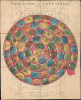
This is a curious 1804 game board published by John Harris in London. It is a characteristic game-of-goose model didactic game of the Georgian Era, designed to instill in children an 'abhorrence of vice and a love of virtue.'A Closer Look
The spiral-shaped game board consists of 66 oval-shaped spaces commencing at right and continuing in counter-clockwise fashion towards the final space at center, representing Virtue in what is likely the goddess Arete / Virtus (though the content is different, the design and striking color is reminiscent of Harris' 1809 game 'Geographical Recreation,' previously sold by us as GeographicalRecreation-harris-1809). The game originally included counters, markers, and a teetotum (spinning top), which allowed players to advance through the game. A rulebook ('Rules and directions for playing the New Game of Emulation') explained the meaning of the 66 spaces in addition to the rules of the game.Historical Context
The Georgian Era (1714 - 1830) in Britain saw the birth of the modern didactic board game. Heavily influenced by Enlightenment thinkers like John Locke, who argued that children should be led to knowledge through play rather than strict rote memorization, enterprising British booksellers and mapmakers began producing games that explicitly merged amusement with instruction. These games were typically structured as 'race games,' adapting the mechanics of the ancient Game of the Goose, where players traversed beautifully hand-colored, engraved tracks mounted on cloth or linen that taught specific academic subjects, including geography, English/British history, and games designed to shape a child's moral and spiritual character to align with burgeoning middle-class values, as here. Games like John Jefferys' 'The Journey of Life' (1759), widely considered the first commercially printed board game in England, and subsequent works by prominent publishers like John Wallis, William Darton, and John Harris, guided players through a minefield of virtues and vices. Landing on spaces like 'Industry' or 'Prudence' would advance a player closer to the winning destination of 'Virtue,' while landing on 'Idleness' or 'Profligacy' would penalize them or send them backward. To avoid the moral taint of gambling, these games strictly eschewed traditional dice, which were heavily associated with tavern vices. Instead, players spun a teetotum, ensuring that the gameplay remained a wholesome activity for the family drawing room.Publication History and Census
This game was published by John Harris in 1804 (it should not be confused with a later, c. 1827-1830, game of the same name published by D. Carvalho). The present map game is listed among the holdings of 8 institutions in the OCLC, as well as the Victoria and Albert Museum, and is scarce in the market.Cartographer
John Harris (1756 - 1846) was an English children's book publisher active from the end of the 18th through the mid-19th century. He worked as an apprentice for Thomas Evans and then worked for John Murray for a short time and then moved to John Newbery's publishing house. Harris bought the Newbery firm in 1801 and renamed it using his own name. Newbery had focused on Evangelical material, but Harris recognized that lighter, more playful items sold better. He published The Comic Adventures of Old Mother Hubbard and Her Dog in 1805, firmly departing from Newbery's original business model. Harris also included copperplate illustrations on every page, another departure from Newbery's sparse use of woodcut illustrations. Harris continued to publish amusing and entertaining books, many meant for children. He had a catalog of 419 titles by 1809. He renamed the firm J. Harris and Son in 1819 and turned the firm over to his son in 1824. Griffith and Farran bought the firm in 1843. Further Details...
Condition
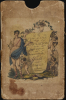
Good. Dissected and mounted on linen. Toning and soiling. Wear to linen fold lines with areas of reinforcement. Accompanied by original slipcase.
References
OCLC 33894331, 1582436941. Young Victoria and Albert Collection Accession Number E.573andPART-1940.