
1901 (1915) U.S. Geological Survey Topographic Map of New York City

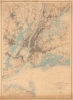
New York City and Vicinity.
Just after Consolidation.
- Digital Map Information
- Suitable for large format printing
- File Size: 94.06 MB
- File Type: ZIP / TIFF
- ICC color profile embedded
- Delivered instantly via download link
Just after Consolidation.
Produced soon after New York City's consolidation of the five boroughs, this large-format 1901 (reprinted 1915) topographic map of New York City and vicinity was produced by the U.S. Geological Survey. In addition to topographic information, it provides an excellent snapshot of the city at the turn of the 20th century.A Closer Look
Coverage includes portions of Westchester County, New Jersey, Long Island, and all five boroughs of New York City. Topography is displayed throughout and coastal wetlands, especially in Jamaica Bay, New Jersey, and Staten Island, are indicated with blue ink. The urban grid of New York and other cities are illustrated, along with roads, railways, electric railways, piers, and administrative boundaries.Some individual buildings are drawn and easily recognizable, such as the American Museum of Natural History and New York City Hall. As the map was originally produced in 1901, it includes the Brooklyn Bridge but not the Williamsburg, Manhattan, or Queensboro Bridges, built in the intervening years. As the population of the city was growing at a remarkable pace in the early 20th century, Queens, Brooklyn, and the Bronx also saw significant new development between 1901 and 1915.
Publication History and Census
This map was first published in 1901, soon after the city's consolidation in 1898, combining and updating quadrangle maps of the U.S. Geological Survey undertaken in the late 1880s. It was then reprinted by the Geological Survey in 1915 without significant changes. Aside from its size, this example is notable for being laid on linen.Cartographer
The United States Geological Survey (March 3, 1879 - present), commonly abbreviated USGS, is an American federal scientific bureau and civilian mapping agency within the Department of the Interior, established in Washington, D.C., and subsequently headquartered in Reston, Virginia. Congress created the Survey to classify public lands and investigate the geological structure, mineral resources, and products of the national domain, replacing separate western investigations with a permanent scientific organization. Its first director, Clarence King (1842 - 1901), organized geological investigations and recruited experienced scientists and topographers from earlier federal surveys. Under his successor, John Wesley Powell (1834 - 1902), director from 1881 to 1894, topographic mapping expanded from support for individual geological investigations into a nationwide undertaking. Congressional authorization in 1882 to continue preparation of a geological map of the United States extended the Survey's work into the eastern states, while systematic topographic mapping received authorization in 1884. Henry Gannett (1846 - 1914), the Survey's chief geographer, helped establish enduring methods and standards for this work. Its topographic quadrangles represented terrain through contour lines alongside drainage, settlements, roads, and other features, furnishing a common geographic foundation for scientific investigation and practical land use. During the 20th century, the Survey's mapping evolved from field surveying and compilation toward aerial photography, photogrammetry, and digital geographic information systems. A formal program begun in 1947 to map the conterminous United States at 1:24,000 scale culminated in nationwide coverage in 1992, comprising more than 55,000 maps. The Survey also produced geological and thematic maps and assembled national geographic information. In 2009 it introduced US Topo, a digitally generated successor to its traditional topographic quadrangles. Its continuing cartographic work includes The National Map, digital topographic products, and public access to historical quadrangles, alongside broader investigations of water, ecosystems, mineral and energy resources, and natural hazards. Further Details...
Condition
Laid on original old linen. Overall toning. Some additional toning along bottom 2 inches. Repaired tear from bottom margin extending as far as scales.
References
OCLC 15288028.