
1911 Rummell Futuristic View of Manhattan, New York City

This item has been sold.
King's Views of New York / Future New York...
Imagining the Future Metropolis.
- Digital Map Information
- Suitable for large format printing
- Full resolution TIFF file
- ICC color profile embedded
- Delivered instantly via download link
Imagining the Future Metropolis.
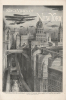
This is a fascinating 1911 Richard Rummell view of Manhattan, as he imagined it would appear in the not-so-distant future. It is a striking work of early 20th-century Futurism, which imagined an almost limitless continuation of progress due to industrial and scientific advances.A Closer Look
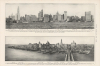
This view looks out into the remarkable urban density of an imagined future Manhattan, filled with skyscrapers reminiscent of the tallest buildings in Manhattan at the time, such as Singer Tower, the Woolworth Building, and the Metropolitan Life Tower, which, like the building at right, has a clock some three-quarters height. The thoroughfare at left, likely inspired by Broadway, maintains both streetcars and elevated railways, as well as a roadway for automobiles and sidewalks for pedestrians. Perhaps most striking are the elevated streetcars and railways running amidst and straight through the skyscrapers towards the top of the image, connecting to bridges in the background at right (presumably linking with Brooklyn, also home to some mega skyscrapers). Above the city, airplanes and dirigibles of different sizes and designs sail just above the tops of buildings. The verso includes panoramic photographs of Lower Manhattan taken from across the Hudson River (Jersey City) and East River (Brooklyn).King's 'Views' and Future New York
At the turn of the 20th century, publisher Moses King (1853 - 1909) became the preeminent chronicler of New York City's explosive growth. His King's Views series were lavish, folio-sized publications filled with hundreds of illustrations and photogravures that captured the city transitioning into the archetypal modern metropolis, complete with skyscrapers and mass transit. While much of his work was documentary, King is perhaps most famous for the futuristic visions he commissioned from Harry M. Pettit (1908) and Richard Rummell (1911), which predicted a city of impossible density and height. Rummell based his work on Pettit's but made additions and changes, in part based on the rapid technological changes in just the three years between their works. For instance, he mostly replaced Pettit's dirigibles with massive airplanes and imagined even taller skyscrapers in greater density with more mass transit lines running under, around, and through. These works of 'urban science fiction' fit within a broader and popular trope of the day, also embodied in the works of artists like Albert Robida and Louis Biedermann, the latter of whom, in 1900, issued a bird's-eye view of Lower Manhattan as he imagined it would appear in 1999.Publication History and Census
This view was originally drawn by Richard Rummell as the cover image for the 1911 edition of King's Views of New York, which itself was based on a 1908 image that appeared on the cover of King's Dream of New York drawn by Harry M. Pettit. The same illustration without the title text also appeared on the cover the newspaper The Delineator in 1911. However, this example appears to be from a later edition of King's Views of New York, appearing not as the cover but as the first image inside the text block, and based on the copyright date (1914) of the top photograph on the verso most likely is from the 1915 edition. More than one printing of this view exists from the 1915 edition; surviving examples of that edition display different covers, while this sheet itself has slightly different arrangements of the text or copyright information (see examples digitized by the Internet Archive and HathiTrust for comparison). Regardless of printing, this view is not independently cataloged with any institution, while the 1915 edition of King's Views of New York (in any printing, OCLC 3461502) is cataloged at 18 institutions.Cartographer
Richard W. Rummell (1848 – June 4, 1924) was an American artist active in Brooklyn during the late 19th and early 20th century. Rummell was born in Canada, the son of German immigrant Frank X. Rummell and his wife Eliza Rummell. He immigrated to the United States as a youth settling with his parents in Buffalo. He relocated to Brooklyn when he was in his mid-30s, setting up an illustration office at 258 Broadway in Manhattan. Rummell is best known for his series of views of American colleges completed around the turn of the century. Since Rummell's views universally appear to be drawn from an altitude of about 300 feet, it has been speculated by many art historians that he worked from a balloon. Rummell was also a bit of a futurist and among his more interesting works are a series of speculative images of the New York of tomorrow, with vast airships, trains running over the tops of skyscrapers, and elegant sky bridges. In the 1950s, the original printer's plates for many of Rummell's university views were rediscovered in a Brooklyn warehouse. Rummell's Brooklyn home was located at 45 Bay 28th Street and later 73 Hanson Place. In addition to his work as a visual artist, he was an accomplished actor and an avid yachtsman. He founding member of the Bensonhurst Yacht Club, where his yacht, the Careless was usually docked. He was also a member of the Royal Arcanum fraternal order. Rummell was survived by his wife, Emmeline Rummell, daughter, Chrissie Atkinson, and two sons, John Tribel Rummell, and Richard Rummell Jr., who became a famous Florida architect. Further Details...
Source
King, M., King's Views of New York, (New York, NY: Moses King) 1915.
Condition
Very good.