
1889 Humbert View of Paris, Exposition Universelle, Eiffel Tower

This item has been sold.
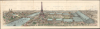
L'Exposition à vol d'oiseau vue prise de la Tour Eiffel : plan Conty.
Eiffel Tower: La dame de fer.
- Digital Map Information
- Suitable for large format printing
- Full resolution TIFF file
- ICC color profile embedded
- Delivered instantly via download link
Eiffel Tower: La dame de fer.
This is a rare c. 1889 view of the grounds of the Exposition Universelle in Paris. It is notable for being an early depiction of the Eiffel Tower, which was opened to the public and quickly became the major attraction of the Exposition.A Closer Look
The view, oriented towards the northeast, looks over the grounds of the 1889 Exposition Universelle, with the Eiffel Tower standing prominently towards the left. Aside from the Eiffel Tower, the Gallery of Machines (Galerie des Machines) on the right was nearly as stunning as the tower in its ambitious scope. Other galleries were dedicated to individual countries or to specific industries, ranging from mining and weapons to the arts and luxury goods such as perfumery. The outdoor space was filled with gardens, fountains, and promenades.Beyond the grounds of the fair, different locations throughout Paris are indicated, with some being illustrated, most prominently the Palais (now Place) du Trocadero across the Seine from the tower and fairgrounds. In the distance, landmarks of contemporary Paris, from church steeples to the Palais de l'Industrie (demolished shortly afterward) and the hills of Montmartre, are labeled.
At the bottom left is a smaller version of the Statue of Liberty (statue de la Liberté) on the Île aux Cygnes. This was offered by a group of Franco-American funders to celebrate the centenary of the French Revolution, as the larger Statue of Liberty (designed in part by Gustave Eiffel) had been offered to the Americans in 1876 on the centenary of the American Revolution. From the original location seen here, closer to the Eiffel Tower, the statue was moved to the opposite end of the island in 1937.
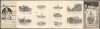
The verso contains several vignette illustrations of landmarks throughout Paris, while the title panel focuses on the Eiffel Tower. The back panel advertises the Conty guidebook to the Exposition titled L'Exposition en Poche.
The 1889 Exposition Universelle
Held in Paris, France, from May 5 through October 31, 1889, the Exposition was the fourth World's Fair held in Paris. It witnessed the unveiling of the Eiffel Tower, which was, then as now, a marvel of engineering. Though its construction was doubted and its design disparaged by a group of artists, the tower proved extremely popular with the public, 30,000 of whom climbed more than 1700 steps to the top in the three weeks when the tower was open to the public but its lifts were not yet operational.The fair welcomed over 32,000,000 visitors and took place on the Champ de Mars, the parade ground in front of the École Militaire. Other notable structures include the Gallery of Machines, a hall dedicated to science and technology (where some of Thomas Edison's most recent inventions were exhibited), and the Palaces of Liberal Arts and Fine Arts. One of the more popular attractions was the 'Street of Cairo' ('Rue de Caire') which recreated the architecture and street life of Cairo, Egypt.
Publication History and Census
This view, a hand-colored etching, was prepared by an artist named Humbert, most likely painter Jacques-Ferdinand Humbert (1842 - 1934) and printed by the Imprimerie Motteroz for Henry Auxcouteaux de Conty's Plan Conty series. A similarly titled work, Plan Conty L'Exposition pratique (digitized by the Bibliothèque nationale de France), also very rare, was published by Broise and Courtier, but its content is significantly different, consisting of plans rather than a view of the fairgrounds. We have only been able to locate one other example of this view, cataloged at the Canadian Centre for Architecture Library.Cartographers
Ferdinand Humbert (Jacques-Ferdinand Humbert; October 8, 1842 - October 6, 1934) was a French painter known particularly for his portraiture and his series of wall painting at the Panthéon. He was born in Paris and strongly influenced by his uncle, Jean Charles Ferdinand Humbert (1813 - 1881), a well-known landscape painter of the era. The younger Humbert studied at the École nationale supérieure des Beaux-Arts with the painters François-Édouard Picot, Alexandre Cabanel and Eugène Fromentin. He began displaying works at the Paris Salon in 1865 and shortly thereafter won several awards from the Salon. From 1874 until 1900, Humbert worked on a series of large wall paintings at the Panthéon titled 'Pro Patria' telling the history of France and Paris, while celebrating republican values. He also served as a professor at his alma mater and was made a Commander in the Légion d'honneur. In 1898, he opened the Académie Humbert on the Moulin Rouge in Montmartre, taking on a multinational group of promising students who would go on to define the Fauvist and other post-Impressionist movements. Further Details...
Henry Auxcouteaux de Conty (Henry de Conty; 1828 - 1896) was a publisher of tourist guidebooks in the late 19th century. Not as well-known as some contemporaries like Baedeker, Conty was nevertheless a major figure in the world of Francophone tourist literature. He began publishing in 1860, just as France's railway network was expanding rapidly, making travel more accessible to the middle class. His guides were noted for their colloquial tone (contrary to more academic competitors like Guides Joanne) and practicality, distilling essential information like prices, schedules, and reliable hotels. Likewise, the Guides Conty prioritized portability in a traveler's pocket. With these guides, Conty helped to encourage the French public to explore beyond the traditional borders of Paris and the Loire Valley. He also published a series of guidebooks for the international expositions held in Paris in the late 19th century, aids to the provincials coming to Paris in a reverse of the usual direction of tourist travel. Further Details...
Jean-Claude Motteroz (1830 - 1910) was a printer active in Paris in the late 19th and early 20th century. Motteroz was born into a family of printers in Saône-et-Loire, but nonetheless focused on a variety of trades, from bricklayer to locksmith, before settling on a carer as a typesetter. He worked in Saint-Étienne, then in Lyon, then as lithographer in Paris, and a pressman in Dijon. In 1874, he established an atelier (Imprimerie Motteroz) in Paris specializing in photolithography, a very cutting-edge technology at the time, on which he wrote two pieces that were influential in the printing world. Motteroz printed a wide variety of works, including opera and theater playbills and schoolbooks that were adopted by the French municipal schools. He also developed a distinctive typeface that was adopted by other printers in the late 19th century. Late in his life (c. 1906), the firm changed its name to Imprimerie Motteroz et Martinet, seemingly a merger with another firm, Imprimerie Martinet, which had operated since 1847. After Motteroz's death, the firm continued again as Imprimerie Martinet and continued until about 1916. Further Details...
Condition
Very good. Light soiling. Light wear along original fold lines. Vignette views on verso.
References
OCLC 83656311.