
1890 Lugard Map of the Sabaki River and Environs, Kenya

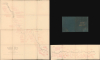

Rough Road Chart of Sabakhi Route from Makangeni to Machagos.
The Foundation for British Rule in East Africa.
- Digital Map Information
- Suitable for large format printing
- Full resolution TIFF file
- ICC color profile embedded
- Delivered instantly via download link
The Foundation for British Rule in East Africa.
This rare 1890 map of Kenya illustrates Frederick Lugard's first expedition along the Sabaki River between Mombasa and Machakos. The expedition and Lugard's subsequent public pressure campaign were important steps in establishing a British 'sphere of influence' and, eventually, protectorates over Kenya (British East Africa) and Uganda.A Closer Look
This map is divided into two sheets, with a main sheet measuring 32.75 x 26.75 inches and a smaller panel on the right measuring 8 x 26.5 inches. It traces the progress of Lugard's first expedition up the Sabaki River from February 15 through March 15, 1890, covering from Makangeni / Stockade No. 1 at right, located 82 miles from Mombasa, all the way to Machakos, 230 miles from Mombasa as the bird flies, and only 35 miles from Nairobi, which did not yet exist but would develop into a major city in the early 20th century. All along the route, which eventually diverges from the Sabaki River and follows the Wakufukoa River to Machakos, notes appear in black ink on terrain, elevation, water sources, the course of rivers, paths, Masai war paths, caravan routes, settlements ('cultivation and villages'), and the locations of stockades established by Lugard's party. Red ink provides more detailed information on terrain (including a seeming reference to Mt. Kilimanjaro - 'Kilima Njaro'), flora, fauna, the course of the river, and other useful details for any future travelers along this route.Lugard's First and Second Sabaki Expeditions
In December 1889, Captain Frederick Lugard, working in the service of the Imperial British East Africa Company (IBEAC), undertook his first major expedition along the Sabaki River in modern-day Kenya, with a party consisting mostly of Swahilis, a small contingent of Persian attendants for pack animals, and four Europeans aside from Lugard, including George Wilson (credited here) and Fenwick de Winton (son of Francis de Winton, for whom we have a biography). Lugard's primary objective was to survey and establish a reliable, well-watered trade route from the coastal port of Mombasa inland toward Machakos, bypassing the treacherous Taru Desert. Along the Sabaki River system, Lugard constructed a chain of fortified supply posts, negotiated treaties with local leaders, and actively disrupted regional Arab-Swahili slave trading routes. This initial expedition established the first physical footholds and a logistical corridor for British corporate administration, extending from the coast into the East African hinterland. Machakos briefly served as a critical node in this extending network, but was soon eclipsed by Nairobi at the turn of the 20th century with the construction of the Uganda Railway.Building upon this coastal-to-interior corridor, Lugard embarked on his second expedition in August 1890, marching further west into Buganda (modern-day Uganda) to secure British influence against expanding German territorial ambitions. Navigating intense religious civil strife among Protestant, Catholic, and Muslim factions in Buganda, Lugard established Fort Kampala, negotiated a pivotal treaty with Kabaka Mwanga II, and integrated abandoned Sudanese soldiers into his forces to enforce order. This second venture mapped vast stretches of the African Great Lakes region and consolidated IBEAC's control over the strategic headwaters of the Nile.
Together, the Sabaki River expedition and the trek to Buganda laid the strategic, administrative, and cartographic foundations for formal British rule. While these journeys proved that controlling the interior was geopolitically viable, they also drove the privately funded IBEAC to the brink of financial collapse. The company, its ambitions in Uganda, and Lugard, by extension, were savaged in the British press. Upon returning to England in 1892, Lugard used his field notes, treaty network, and political leverage to mount an aggressive public campaign demanding that Britain retain the territories, an argument which he managed to win thanks to the competitiveness of the 'Scramble for Africa,' where the failure to claim territory for oneself left the door open for someone else to claim it. Aided by Lugard's established infrastructure of forts and treaties, alongside public pressure, the British government stepped in to assume direct control from the bankrupt company, formally establishing the Uganda Protectorate in 1894 and the East Africa Protectorate (Kenya) in 1895.
Publication History and Census
This map was prepared by Lugard with assistance from Wilson and was printed by the Intelligence Division of the British War Office in August 1890. As a sensitive intelligence document, only a small number of copies were printed, and today the map is held only by the British Library and the University of Manchester, with the present map being the only known example to come to market.Cartographers
Frederick John Dealtry Lugard (January 22, 1858 - April 11, 1945) was a highly-decorated British soldier, explorer, and colonial administrator active in East Africa, Hong Kong, and Nigeria over the course of his career. In brief, he was one of the most consequential British colonial figures in the history of British colonialism in Africa. Lugard was born in Madras to a British Army chaplain, while his father's brother was Sir Edward Lugard, Adjutant-General in India from 1857 to 1858 and Permanent Under-Secretary of State for War at the War Office from 1861 to 1871. The younger Lugard was educated in England, eventually graduating from the Royal Military College at Sandhurst. He then returned to India and served with distinction in the Royal Norfolk Regiment during the Second Anglo-Afghan War (1878 - 1880), the Sudan campaign (1884 - 1885), and the Third Anglo-Burmese War (1885). Following an embarrassingly unsuccessful pursuit of a love interest, Lugard relocated to East Africa to relaunch his career. He fought in the Karonga War around Lake Malawi on behalf of the African Lakes Company, but was unable to dislodge a group of Swahili traders who had fallen out with the British from their stockade. Lugard then joined the Imperial British East Africa Company (IBEAC), where he was tasked with scouting a route from Mombasa to Machakos in order to formalize a British 'sphere of influence' (contra growing German influence) claimed between Uganda and Zanzibar. Along the way, Lugard sketched out a scheme for emancipating slaves in the area, built fortifications to allow for future IBEAC travels along the same route, and established alliances with local chiefs by swearing blood oaths with them. He served as Military Administrator of Uganda from December 1890 to May 1892, where he further explored and mapped much of the country. When he returned to Britain afterwards, Lugard successfully lobbied Prime Minister William Gladstone from allowing the IBEAC to abandon Uganda. During this time, he also published the book The Rise of Our East African Empire. In 1894, Lugard was sent by the Royal Niger Company to Borgu, on the border of today's northwest Nigeria and Benin, to establish British influence, as the French were also encroaching in the area. Aside from a brief period when he was leading an expedition to Lake Ngami in modern-day Botswana, Lugard spent the next 12 years in Nigeria. From 1897 to 1899, he organized and commanded the West African Frontier Force that would engage in any conflict with the French, but the borders were ultimately arranged through negotiation. Lugard then was appointed High Commissioner of the newly created Protectorate of Northern Nigeria. There, he oversaw campaigns against the recalcitrant Sokoto Caliphate and their vassals, mapped and surveyed the territory, stopped slave trading and abolished slavery locally where possible, reorganized taxations, and regularized a system of indirect rule through local elites. In short, Lugard greatly expanded British influence in northern Nigeria by the time he left his post as High Commissioner in 1906, and he was knighted for his efforts in 1901. From July 1907 to March 1912, Lugard served as the Governor of Hong Kong, where he prioritized education, helping establish the University of Hong Kong. In September 1912, Lugard returned to Nigeria to serve as governor of both the Northern and Southern Nigeria Protectorates, in preparation for their merger in 1914, after which he was the governor of a unified Nigeria until August 1919. His tenue was defined by the effort to amalgamate Northern and Southern Nigeria, introducing uniform communications, taxes, customs, time standards, courts, currency, and civil service. Though well-intentioned, this effort failed in the long term and may have even unintentionally exacerbated regional differences, laying the groundwork for ethnic conflict in subsequent decades. His tenure also saw renewed border tensions with the French and the violent suppression of a tax revolt. Lugard's attitude was typically paternalistic, seeing the role of the British to spread civilization, including Christianity, abolish slavery, and lay the groundwork for some distant era of self-administration. After leaving his governorship, Lugard wrote a book on British colonial administration in Africa (The Dual Mandate in British Tropical Africa) and served from 1922 until 1936 as the British representative on the League of Nations' Permanent Mandates Commission. He also served on several other League of Nations commissions, including those tasked with suppressing slavery internationally, resulting in the 1926 Slavery Convention. Lugard was highly decorated throughout his career and was eventually, in 1928, elevated to a Baron. He also received a Founder's Medal from the Royal Geographical Society in 1902 for his explorations in Africa. In 1902, Lugard married Flora Shaw (1852 - 1929), a writer and journalist who is credited with coining the term Nigeria that became the name of the British territory and later independent country. The couple had no children and Lugard's barony became extinct upon his death. Between 1959 and 1963, a four-volume work, The Diaries of Lord Lugard, was published in Britain just as Nigeria was gaining its independence. Further Details...
George Wilson (May 13, 1862 - December 12, 1943) was a British soldier, explorer, and colonial administrator in East Africa. He was born in Glasgow as the eldest of nine children. When he was five years old, Wilson moved to Australia where he had a rough-and-tumble youth, including working as an entertained and in a coal mine. Possessing natural leadership skills, Wilson became a director of the coal mine and leader in a local regiment he had raised, but troubles in his personal life and the collapse of his first marriage led Wilson to pursue missionary work in East Africa, where he taught freed and runaway slaves. There he encountered Frederick Lugard, who asked that Wilson be hired by the Imperial British East Africa Company and join his first and second Sabaki River expeditions, serving as second-in-command on the latter. Wilson fell ill however on both occasions and on the second expedition very nearly died, only being saved by the quick and dedicated efforts of Lugard. Nevertheless, he had gained a reputation as an effective interlocutor with local peoples, having learned multiple local languages, including Swahili and Masai, from his two African wives (one of whom he had at least one child with, a son named Edward). After the Sabaki expeditions, Wilson was involved in a complex and somewhat obscure conflict with the forces of Waiyaki Wa Hinga, hitherto an ally of the British, as the IBEAC outpost of Dagoretti, which had to be abandoned as a result. Afterwards, he worked for several years for the IBEAC, including overseeing the construction of the 185-mile-long Mackinnon Road from Mazeras (near Mombasa) to Kibwezi. In August 1894, Wilson joined the civil service of the Uganda Protectorate, quickly rising through the ranks, and by November 1897 was the Acting Commissioner and Commander-in-Chief of the Uganda Protectorate, and would holding leading positions in the protectorate for the next decade. Among locals, he was nicknamed bwana tayari ('Mr. Ready') for his deep knowledge of local peoples and languages. His tenure was marked by spillover from the Mahdist War in Sudan and the revolt of Mwanga II of Buganda, who resisted, then sided with, then resisted again the British over the course of the late 1880s and 1890s. Wilson played a crucial role in arranging the British administration of Uganda, negotiating with local elites and granting them wide latitude for managing their own affairs as long as they cooperated with the British on some key issues such as abolitionism. Despite his unusually deep understanding of local cultures, Wilson maintained the paternalistic attitude of British imperialism, seeing locals as little more than children who required British tutelage. The positive side of his paternalism was that he committed his efforts, in addition to abolitionism, to education, famine relief, and early public health measures. He also is credited with driving the first car on Kenyan soil, a De Dion-Bouton, in December 1903. Wilson retired from his post in Uganda in 1909 due to poor health and moved to England. In 1900, he had married Clarissa Adelina Humphreys (d. 1958), who remained with him in East Africa until their joint relocation to England. Further Details...
The British War Office (1857 - 1964) was a department of the British Government responsible for the administration of the Royal Army until 1964, when its functions were transferred to the Ministry of Defense. The War Office was to the Royal Army what the Admiralty was to the Royal Navy, and later, the Air Ministry. Within the War Office, the General Staff Topographical Section was responsible for thousands of maps issued for British intelligence and military use. The Topographical Section was renamed Geographical Section in April 1907. Many, once their military use passed, were offered through licensed agents to the general public. The sole London agent for War Office material was Edward Stanford. Further Details...
Condition
Good. Some discoloration. Even overall toning.
References
OCLC 497562535.