
1976 Hunting Geology Bilingual Geological Map of the United Arab Emirates

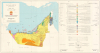
خارطة جيولوجية للإمارات العربية المتحدة / Geological Map of the United Arab Emirates.
Earliest Geological Map of the UAE - the underpinning of regional oil development.
Earliest Geological Map of the UAE - the underpinning of regional oil development.
This is a scarce, large-format bilingual 1976 geological map of the United Arab Emirates prepared by Hunting Geology and Geophysics Ltd. Produced just after the country's independence and formation, it represents the earliest geological map of the UAE and a benchmark on the country's exploitation of petroleum, which has fueled its phenomenal economic growth in the decades since.A Closer Look
This stunning map depicts the territory of the UAE without its internal boundaries, but instead with geological information. Brilliant color is used to indicate types of sand, soil, and rock, arranged by geologic period. Fault or fracture lines, drainage courses, roads, and settlements are marked throughout. The larger cities of the Emirates, especially Abu Dhabi and Dubai, are easily identifiable despite the colorful geological representation.The right half of the sheet consists of an extensive bilingual legend. A disclaimer at bottom that 'this map is not an authority on international boundaries' is a reminder of the newness of the country and its unsettled border disputes, especially with Oman and Saudi Arabia (Hunting, being active in multiple countries in the region, would also want to be sure not to offend anyone's national sensibilities). The most curious of these is the Omani exclave of Madha, surrounded by the UAE, but which also contains within it the second-order enclave or counter-enclave of Nahwa (with a population of only 300 or so), which is part of the UAE Emirate of Sharjah.
Oil and the Early UAE
Although not necessarily obvious at first glance, the involvement of the UAE's Ministry of Petroleum and Mineral Resources and the detailed geological data presented indicate that the map was primarily intended for use in better locating and exploiting the country's petroleum resources. As early as the 1930, well before independence, both Abu Dhabi and Dubai had granted concessions for foreign oil firms, resulting in the discovery of the first large oil fields in the mid-1960s. Thus, when the individual emirates became independent and then unified in late 1971, they already had a nascent oil industry, dominated by Abu Dhabi but with Dubai quickly developing its own resources.The management of petroleum resources and the discovery of additional oil reserves was therefore a primary objective for the government of the UAE in its early years (in fact, Sheikh Zayed bin Sultan Al Nahyan, the central figure of the early history of the UAE, had come to power in Abu Dhabi in 1966 in a bloodless coup backed by the British largely because of the perceived mismanagement of oil resources by his predecessor). Like other newly independent, oil-rich countries in the region, such as Qatar, the UAE aimed to gain control over its natural resources as a matter of national pride, security, and wealth. Unlike some other countries, however, Abu Dhabi did not outright seize foreign oil concessions but instead formed a state-owned corporation (Abu Dhabi National Oil Company, ADNOC) that increased its share of ownership of the foreign companies' stock over several years to the point that they were effectively nationalized. This allowed the country to focus on long-term investments (that foreign shareholders might deprioritize versus short-term profits) and retain the bulk of the profits from the oil industry within the country. This arrangement also let the UAE to continue to benefit from the technology and expertise provided by the now-minority shareholding foreign companies.
Publication History and Census
This map was prepared in 1976 by the British firm Hunting Geology and Geophysics Ltd. in conjunction with the Ministry of Petroleum and Mineral Resources of the UAE. Another map with the same title but a 1:250,000 scale was printed the same year, while a third map with the same title was printed in 1979 on a 1:500,000 scale. A 1:250,000 map of the northern Emirates only was also prepared by Hunting in 1976. These maps are all quite scarce today, with the present map only being cataloged among the holdings of the Natural Environment Research Council Library in Nottingham, England.Cartographer
Hunting Geology and Geophysics Ltd. (1952 - 1987) was a British surveying firm that specialized in cutting-edge methods of mapping, especially aeromagnetic surveys, and focused on discovering potential reserves of natural resources, especially fossil fuels. It was part of the larger Hunting Group, originally founded in 1874 as a shipping company by Charles Hunting, and later moving into aircraft, surveying, and petroleum. Companies within the Hunting group frequently merged with each other and with outside acquisitions, leading to frequent name changes; in this case, Hunting Aerosurveys (founded 1944) merged with Hunting Geophysics (founded 1952) to form Hunting Surveys in 1960. In 1965, a public company was formed called Hunting Associated Industries Ltd., which included Hunting Surveys (Holdings) Ltd. but not a new entity, Hunting Geology and Geophysics Ltd., which remained part of the privately-owned Hunting Group. In 1987, Hunting Geology and Geophysics Ltd. was closed down in a consolidation process that saw the public company (now Hunting PLC) buy out the Hunting Group, though the Hunting family retains a significant share of the company's stock and one of its members remains Chairman of the Board. Hunting Geophysics, and later Hunting Geology and Geophysics Ltd., made pioneering surveys of Great Britain itself, along with several countries in Central Africa (seeking uranium and other minerals), the Philippines, Ethiopia, and especially countries in the Middle East, where the company conducted critically important surveys that helped to develop the lucrative oil industries of the United Arab Emirates, Qatar, and Kuwait, among others. Further Details...
Condition
Very good. Original folds.
References
OCLC 705148931.