
1914 Rummell Bird's-Eye View of the Vatican, Rome

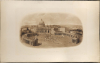
St. Peter's and the Vatican.
Captivus Vaticani
- Digital Map Information
- Suitable for large format printing
- File Size: 627.88 MB
- File Type: ZIP / TIFF
- ICC color profile embedded
- Delivered instantly via download link
Captivus Vaticani
This is Richard Rummell's 1914 bird's-eye view of St. Peter's Basilica and the Vatican in Rome - here in its only known example. When this view was drawn, the Vatican was in a precarious position, divested of its lands and maintaining an uneasy peace with the Italian State, which was not resolved until the Lateran Treaty of 1929.A Closer Look
The view is oriented towards the west, looking over the Piazza San Pietro on St. Peter's Basilica and nearby buildings, including the Sistine Chapel at right. Both it and the basilica are connected to a series of courtyards and buildings at right that serve as museums, including the Gallery of Maps, which includes a series of 16th century fresco maps of Italy and its regions by Ignazio Danti (1536 - 1586). The hill behind St. Peters is Vatican Hill (Mons Vaticanus), an ancient name which is the ultimate origin of the Vatican complex and Vatican City.This view is reminiscent of Rummell's better-known bird's-eye views of American university campuses, produced in conjunction with Littig and Co., as is the present work. Like those works, the present view was produced by etching Rummell's drawing (likely a watercolor) onto a copper plate and producing a photogravure print.
Captivus Vaticani
This was a difficult era for the Popes - not only was the industrial world seemingly secularizing, but much of the worldly power of the Papacy had been eroded. When Italy was unified in 1871, the former lands of the Papal States, including most of Rome, were nationalized. Papal palaces outside the walls of the Vatican (such as the Quirinal Palace) were likewise turned over to the Italian monarchy. However, the Italian state did not encroach on the Vatican itself and allowed the Popes to continue to exercise ecclesiastical authority as well as send ambassadors to foreign countries (under the Law of Guarantees).Even well into the 20th century, the Popes refused to recognize Italian secular rule over Rome and did not leave the Vatican, which they felt would implicitly recognize Italian sovereignty over Rome. The long-simmering 'Roman Question' remained a sore point in Italy's domestic politics for decades and was only resolved in the Fascist Era with the 1929 Lateran Treaty, which established Vatican City as an independent, sovereign state of the Holy See within Italy.
Publication History and Census
This view was drawn by Richard Rummell and published by Littig and Co. in 1914 (undated here but listed in that year's Library of Congress Catalog of Copyright Entries). Additional publication information, likely for Elson and Co. of Boston, has been obscured in the lower-right margin. We have been unable to find any other examples of this work in institutional collections or on the market.Cartographers
Richard W. Rummell (1848 – June 4, 1924) was an American artist active in Brooklyn during the late 19th and early 20th century. Rummell was born in Canada, the son of German immigrant Frank X. Rummell and his wife Eliza Rummell. He immigrated to the United States as a youth settling with his parents in Buffalo. He relocated to Brooklyn when he was in his mid-30s, setting up an illustration office at 258 Broadway in Manhattan. Rummell is best known for his series of views of American colleges completed around the turn of the century. Since Rummell's views universally appear to be drawn from an altitude of about 300 feet, it has been speculated by many art historians that he worked from a balloon. Rummell was also a bit of a futurist and among his more interesting works are a series of speculative images of the New York of tomorrow, with vast airships, trains running over the tops of skyscrapers, and elegant sky bridges. In the 1950s, the original printer's plates for many of Rummell's university views were rediscovered in a Brooklyn warehouse. Rummell's Brooklyn home was located at 45 Bay 28th Street and later 73 Hanson Place. In addition to his work as a visual artist, he was an accomplished actor and an avid yachtsman. He founding member of the Bensonhurst Yacht Club, where his yacht, the Careless was usually docked. He was also a member of the Royal Arcanum fraternal order. Rummell was survived by his wife, Emmeline Rummell, daughter, Chrissie Atkinson, and two sons, John Tribel Rummell, and Richard Rummell Jr., who became a famous Florida architect. Further Details...
W. T. Littig (fl. c. 1900 - 1930) was New York printer and publisher active in the early 20th century. Littig is most commonly associated with Richard Rummell, from whom he commissioned numerous university and college views. He is otherwise extremely elusive and little is known about his person or career. Further Details...
Condition
Excellent. Warm overall toning. A few transference marks. Deckled edges.