
Beauchamp, Pierre-Joseph de (sold)
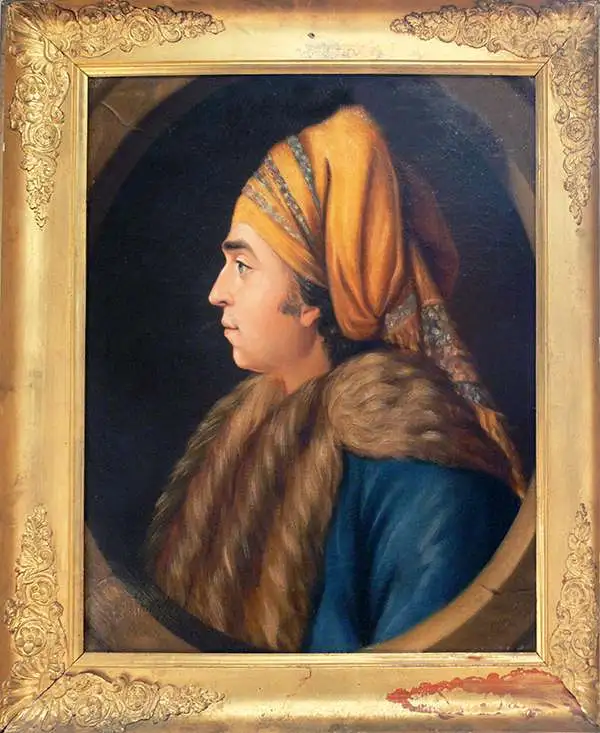
Pierre-Joseph de Beauchamp (June 28, 1752 - November 18, 1801) was a French diplomat, clergyman, and astronomer active in the middle east in the late 18th century. Born in Nice, Beauchamp was the son of the lawyer Xavier de Beauchamp. In 1781 he was appointed vicar general to his uncle, Miroudot du Bourg, titular bishop of Baghdad. He and his uncle left France for Aleppo and from thence, Bagdad, arriving later in that year. In the subsequent year, he, along with French consul Jean-François Rousseau and the botanist André Michaux traveled extensively throughout modern day Iran and Syria, taking astronomical readings along the route. He returned to France in 1780. Five years later, on March 3, 1795, he was appointed consul at Muscat, in Oman. In 1799, Napoleon Bonaparte sent him on a peace embassy to the Ottoman Sultan Selim III (1761 - 1808). His ship, unfortunately, was captured by the English Royal Navy. The Royal Navy consigned Beauchamp's keeping to the Ottomans, who now at war with France, imprisoned him at the notorious Yedikule Fortress. Life in prison left Beauchamp physically and mentally broken. He was freed and returned to France during the Peace of Amiens (1801 - 1802), but died shortly thereafter.
Only known example. Beauchamp's manuscript map of Persia/ Iran and Iraq - the first scientific map of these regions.
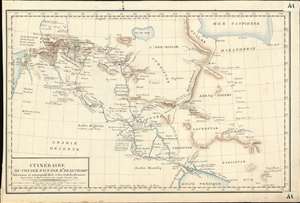
Itinéraire du Voyage Fait par Mr. Beauchamp Astronome et correspond de la cui dev. Acad. des Sciences.
sold
- Digital Map Information
- Suitable for large format printing
- DPI: 600
- File Size: 9.23 MB
- File Type: ZIP / TIFF
- ICC color profile embedded
- Delivered instantly via download link
An extraordinary discovery, this finely executed (hand-drawn) c. 1790 map of Syria, Iraq, and Iran / Persia is the only known map recording the explorations of the French astronomer and clergyman, Pierre-Joseph de Beauchamp. Comprising of the first scientific mapping of any significant part Persia/Iraq, coverage extends from the Mediterranean to the Persian Gulf and reaches as far north as Lake Van and the Caspian Sea. While we cannot definitively prove it, we believe this map to have been composed in Beauchamp's own hand for the use of Joseph Jérôme Lefrançois de Lalande (1732 - 1807), a fellow astronomer and friend. It may have been he who added additional annotations and place names to the map in light red ink. (more details)