
Cotta, Johann Georg (sold) (J. G. Cotta, Klett-Cotta, Johann Friedrich Cotta)
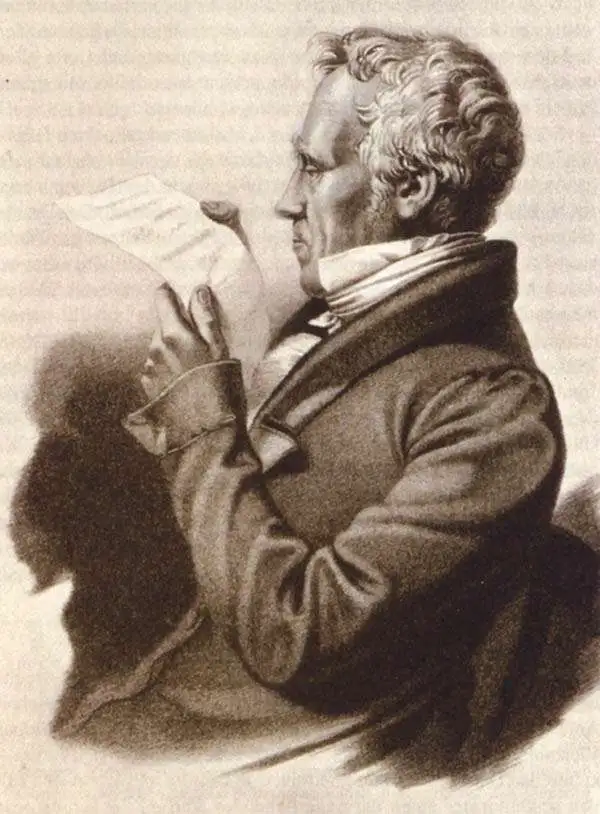
J. G. Cotta (1659 - 1889) was a German publishing house active from the 17th through the 19th centuries. The firm was founded in 1659 when Johann Georg Cotta (1631 - 1692) married the widow of the Tübingen university bookseller, Philipp Braun, and took over the management of his business, rebranding it in his own name. The firm passed in 1792 to Johann Georg Cotta II (1663 - 1712) and then to his son, Johann Georg Cotta III (1693 - 1770). The eldest son of Johann Georg Cotta III, Christoph Friedrich Cotta III (1730 - 1807), relocated the firm to Stuttgart when he acquired a lucrative contract with the royal court. Nonetheless, the firm languished. It was Christoph's son, Johann Friedrich Cotta von Cottendorf (JFC; April 27, 1764 - December 29, 1832), who revived the firm's fortune. In 1787, after studying mathematics, law, and natural sciences at the University of Tübingen, he took over the family firm. JFC moved the firm into lucrative magazine publishing and became closely associated with the publishing interests of the German playwright Friedrich Schiller (1759 - 1805) and, even more significantly, Johann Wolfgang von Goethe (1749 - 1832), a central figure in German literature and a widely influential German poet, novelist, playwright, and scientist. The firm became immensely successful, and JFC went on to a successful career in politics, while never neglecting the publishing business. He passed the firm to his son, Freiherr Cotta von Cottendorf (1796 - 1863), and he to his son, Karl von Cotta ( - 1888). Karl was the last Cotta to control the business. In 1889, after his death, it was acquired by Adolf and Paul Kroner. We use this date as the terminal date of the Cotta family firm. The business, in a more modern corporate form, still publishes under the imprint Klett-Cotta. Its contemporary offerings include German-to-Elvish dictionaries based on J.R.R. Tolkien's Lord of the Rings.
AKA: J. G. Cotta, Klett-Cotta, Johann Friedrich Cotta
'The most beautiful terrain ever engraved' - Hoffmann
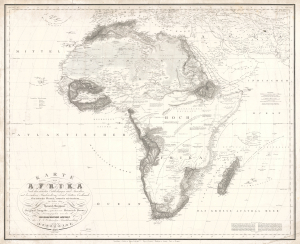
KARTE von AFRIKA Nach den neuesten Entdeckungen und Ansichten, mit besonderer Rücksicht auf Karl Ritters Erdkunde.Ein kritischer Versuch, entworfen und bearbeitet im Jahre 1824 von Heinrich Berghaus.
sold
- Digital Map Information
- Suitable for large format printing
- File Size: 38.76 MB
- File Type: ZIP / TIFF
- ICC color profile embedded
- Delivered instantly via download link
This is Heinrich Berghaus' important 1826 separate-issue map of Africa. As with all of Berghaus' separate issue works, it is scarce today due to small print runs, but was influential in its time for establishing new conventions in the standardized rendering of terrain, one of the major challenges of early 19th-century cartography. It is the great cartographer's earliest known solo work, following only his 1825 contributions to Reymann's topographische Special-Karte von Deutschland. As a whole, this map is the most comprehensive summary of African geography known to Europeans in the early 19th century. (more details)