
Ék, Sándor (sold)
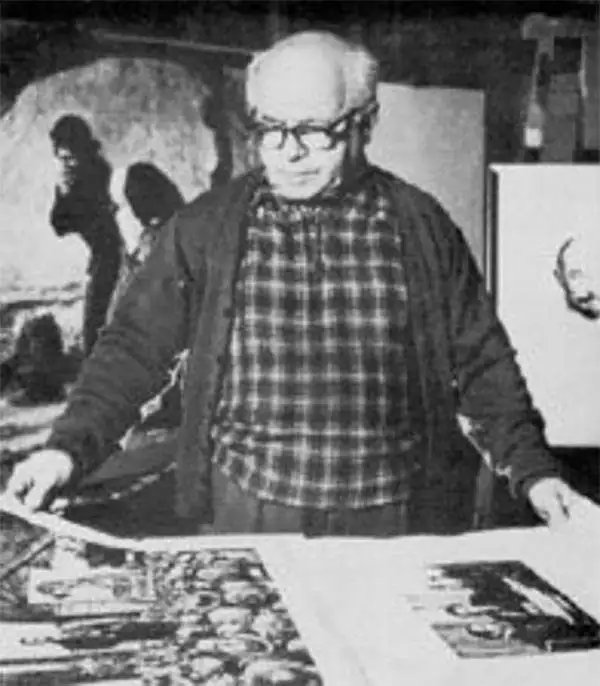
Sándor Ék (August 27, 1902 - January 15, 1975) (a.k.a. Alex Keil) was a Hungarian graphic artist and painter. Ék, the son of a poor working-class family, spent his childhood in a suburb of Pest (Angyalföld). He became interested in socialist ideology at a young age and was a member of the Hungarian Communist Party (KMP) by the age of 16. Ék celebrated the establishment of the Hungarian Soviet Republic (the world's second socialist republic) in 1919, but it survived only 133 days. He fled Hungary after the collapse of the Hungarian Soviet Republic and ended up in Vienna. He participated in the 'Young Worker's International' in Moscow in 1921, where he met Lenin. He stayed in Moscow for some time where he studied with El Lissitzky. During this time he painted in modern and constructivist style, until he gave up these practices for the obligatory socialist realism. He also spent time in Berlin, Paris, and Amsterdam, and settled in Germany in 1925. After Hitler rose to power in 1933 Ék left Germany for the Soviet Union. Ék joined the Red Army in 1944 and was with the army when Budapest was liberated. Following Budapest's liberation, three antifascist posters by Ék, all of which predicted the defeat of Hitler's nazis, were plastered all over the city. After the war, Ék was named the director of the Academy of Applied Arts and, in 1949, he gained a teaching position at the Hungarian Academy of Fine Arts.
A Hungarian anti-fascist poster printed soon after the liberation of Budapest.
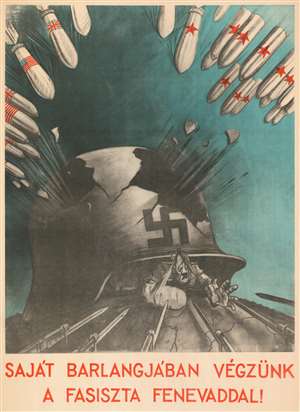
Saját Barlangjában Végzünk a Fasiszta Fenevaddal! / We'll Finish the Fascist Beast in His Own Cave!
sold
- Digital Map Information
- Suitable for large format printing
- File Size: 135.86 MB
- File Type: ZIP / TIFF
- ICC color profile embedded
- Delivered instantly via download link
This is a 1945 Sándor Ék anti-fascist propaganda poster created shortly after the liberation of Budapest by the Soviet Red Army. Centered on a large Nazi helmet with significant sections missing, Ék is making it apparent that the Nazis are losing the war. Large numbers of Allied bombs are illustrated in the top corners, with American and British bombs on the left and Soviet bombs on the right. Graphically, this poster is definitely pro-Soviet (which is not surprising, seeing as it was made by a Red Army soldier), suggesting that the forces brought to bear by the Soviet armed forces outweigh those of the other Allies. Hitler is illustrated with a broken hand and arm trying to escape from underneath the destroyed helmet and is met by a phalanx of sharpened bayonets. There would be no escape. (more details)